On March 30, 2023, my sister told the child molesters where I was which caused the child molesters to put me in county jail for two years and one month. The child molesters tried to put me in prison for the rest of my life. At that time, the child molesters did not put me in prison but I spent two years and one month in county jail while I was fighting the case. That would never have happened if my sister had not told the child molesters where I was. Absolutely everything that happened after that was entirely my sister’s fault.
On March 30, 2023, my sister told the child molesters where I was which caused the child molesters to put me in county jail for two years and one month. I wrote the following while I was inside of the Hanford Jail.
I wrote the following while I was inside of the Hanford Jail for the purpose of teaching physics to the other inmates. Only two inmates read it, and they both only read the beginning. One would change the channel on the TV to the History Channel or Discovery Channel, so I knew he was interested in education. The other inmate was obsessed with UFOs. He let me borrow his book titled “The Day After Roswell”. I showed the loose sheets of paper about polytopes, but not the writing tablet itself, to a third inmate who said he was interested in science but whom I realized was mentally retarded.
Introduction to Physics
I am going to write this brief introduction to physics for someone without a scientific background. I start at a very introductory level. I do not have access to the Internet so everything has to be entirely from my own memory and therefore limited.
First of all, you can not learn physics without knowing calculus so I have to briefly discuss it. Let’s say you want to know the area under a horizontal line from 0 to a.
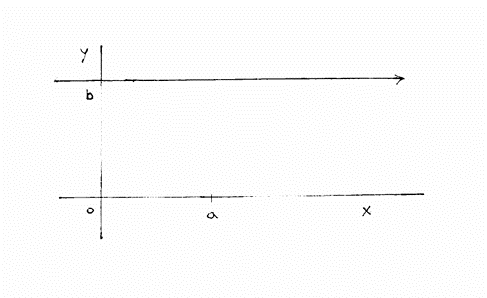
Well, you would obviously just multiply the length of the area, x = a, by the height, y = b, so the area = ab.
A line is a type of curve. Now let’s say you wanted to know the area under a curve other than a line, from 0 to a.
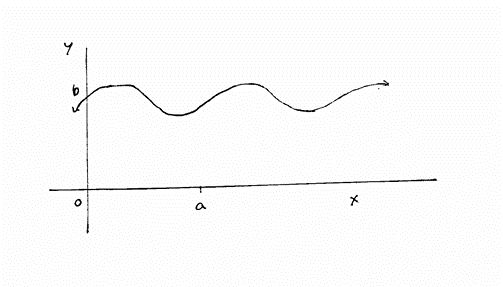
How would you determine the area under the curve?
You can approximate the area under the curve by a series of boxes, and then finding the area of each box, and adding them together.
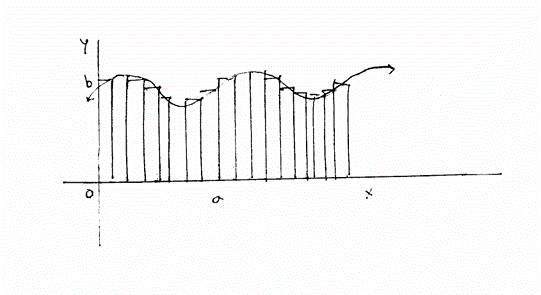
Now the narrower each box, the larger the number of boxes, the better the approximation. You then take the limit, so you have an infinite number of boxes, each with zero width, so then, instead of an approximation, it becomes exact.
So the way you do this, is you take a polynomial, and form a new polynomial by increasing the exponent of each term by one, and then dividing by the new exponent.

f(x) = aⁿ
∫= aⁿ⁺¹/(n + 1)
To find the area under the curve between a and b, you would evaluate the new polynomial and a and b, and then subtract b from a.

Area = ∫f(b) — ∫f(a)
Let’s say you had the following polynomial.

f(x) = 5x³ + 3x² — 2x + 7
The integral would be

∫f(x) = (5x⁴)/4 + (3x²)/3 — (2x²)/2 + 7x + C = (5/4)x⁴ + x³ + 7x + C
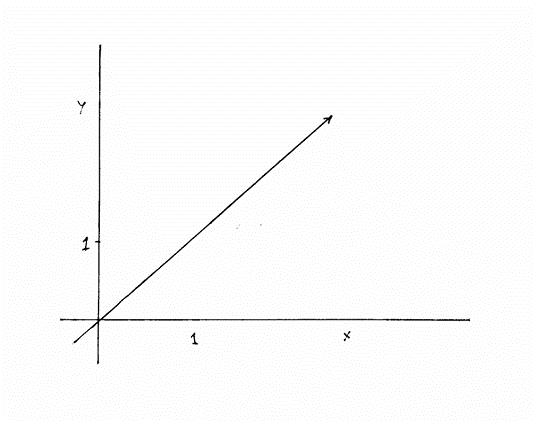
Now let’s show how this works. Let’s say you had y = x which is a straight line at a 45 ° angle, and you want to find the area between 0 and 1.
Press enter or click to view image in full size
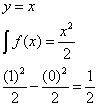
y = x
∫f(x) = (x²)/2
((1)²)/2 — ((0)²)/2 = 1/2
You can easily see from the graph that the area under the line from 0 to 1 is half a 1 x 1 square, and therefore has an area of 1/2 so the method works.
Another type of calculus is derivatives. The derivative of x with respect to y, dx/dy, can be thought of as the rate that x changes with respect to y.
Let’s say you had the following points.
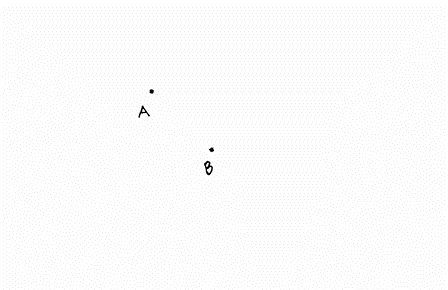
What is the position of these points? Well, right now, you do not have enough information to answer this question. You need to add a coordinate system to be able to identify the position of the particles.
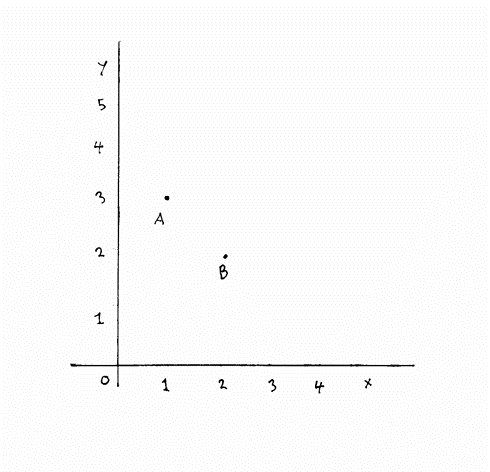
Now let’s say that the position of A is (1,3), and the position of B is (2,2). However, the coordinate is arbitrary. If you had used a different coordinate system, the numbers would be different. Let’s add a second coordinate system.
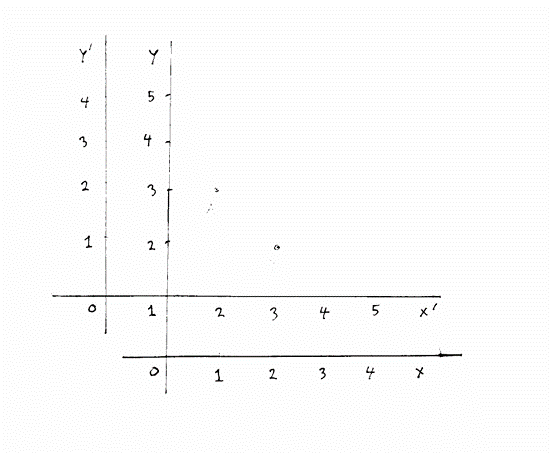
In the new coordinate system, the position of A is (2,2), and the position of B is (3,1). Therefore the positions of the particles depend on the coordinate system.
Now, so far, the particles were static and not moving. Now let’s add a third particle that is moving to the right.
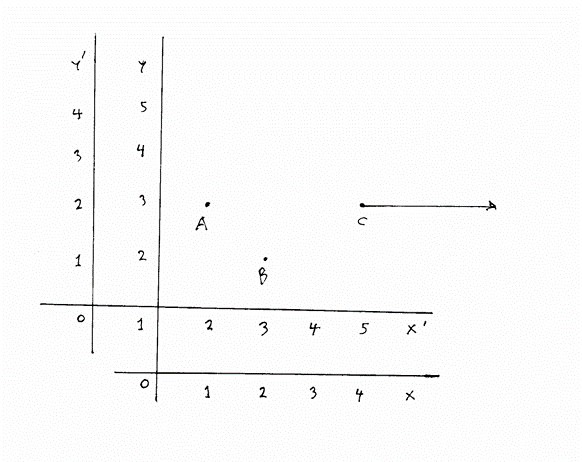
Particle C is moving to the right.
Now if you calculate the velocity, the number of units of distance that C moves per unit of time, you get the same answer whichever of the two coordinate systems you use. Now this would seem to imply that velocity, unlike position, does not depend on the coordinate system. However, let’s add a third coordinate system that is moving to the right at the same velocity as C, from the point of view of the other two coordinate systems.
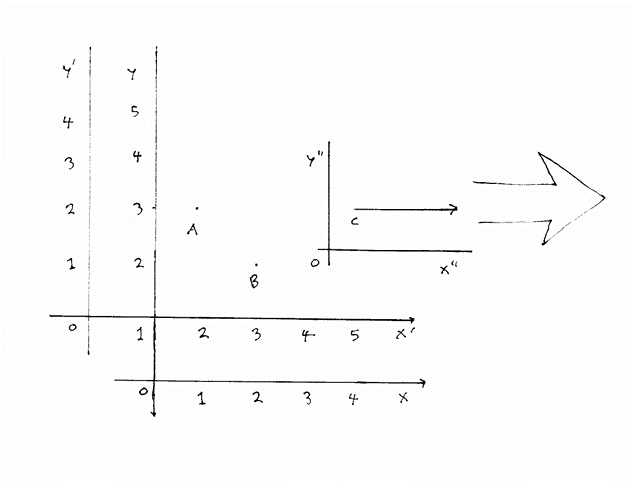
The third coordinate system is moving to the right.
In the third coordinate system, particle C is not moving at all! Therefore, velocity, like position, depends on the coordinate system. Velocity is not objective. Different observers will not in general agree about what the velocity of an object is. We refer to these coordinate systems as “reference frames”. Everything is motionless in its own reference frame.
The average person does not understand the concept of reference frames. The average person is under the mistaken impression that there is such a thing as a preferred reference frame, when in reality, no reference frame is preferred. Let’s say you are on a train traveling at 60 mph. You throw a baseball in the direction that the train is traveling at 5 mph. From the reference frame of the train, the baseball is traveling at 5 mph. From the reference frame of the ground, the baseball is traveling at 65 mph. Both reference frames are equally valid. However, members of the public often think the baseball is “really” traveling at 65 mph. Members of the public often think that the statement that the baseball is traveling at 65 mph is “more true” than the statement that the baseball is traveling at 5 mph. That’s wrong. Both statements are equally true. The source of confusion is that most people spend their entire lives on the surface of the Earth, where the ground under your feet is an obvious reference frame that you can always use, that is always true, that everyone agrees upon. It creates the illusion that there is such a thing as a preferred reference frame. It creates the false impression that there is such a thing as a preferred reference frame. If you were in interstellar space, it would be obvious that there is no such thing as a preferred reference frame. If you choose the Sun as your frame of reference, then the Earth orbits the Sun. If you choose the Earth as your frame of reference, then the Sun orbits the Earth. Everything is motionless in its own reference frame. You have probably heard from idiot on the Internet say that he doesn’t believe in time travel, not because it violates causality, closed time-like curves, the grandfather paradox, etc. but instead because “the Earth is not in the same place that it was 24 house ago”. That’s your reason for not believing in time travel? Of course if you choose the Earth as your frame of reference, then it is always in the same place.
Normally the measured velocity of an object depends on what reference frame that you are in. Different people in different reference frames would measure the velocity to have different values. Now let’s say that there was something that was always measured to have the same velocity no matter what reference frame you were using. Different people in different reference frames would measure its velocity to always have the same value, regardless of their own relative motion. Let’s call this the invariant speed. I said before that everything is motionless in its own reference frame. If an object was traveling at the invariant speed, what would be its velocity in its own reference frame? On one hand, everything is motionless in its own reference frame so its velocity is zero. On the other hand, the invariant speed is always measured to have the same value regardless of the reference frame, so its velocity would be the invariant speed. The solution to the paradox is that the invariant speed can not be used as a reference frame. Any massless particle necessarily travels at the invariant speed. Any particle with mass necessarily travels less than the invariant speed. A photon is a massless particle, and therefore travels at the invariant speed. Since this is how it was first discovered, the invariant speed is usually called “the speed of light”? Since anything with mass could be used as a reference frame, and the invariant speed can not be used as a reference frame, therefore nothing with mass can travel the speed of light. Today, the speed of light is defined as exactly 299,792,458 meters per second. The meter is defined in terms of the speed of light, as the distance light travels in a certain fraction of a second.
If you are not allowed to travel the invariant speed, would you be allowed to travel faster than the invariant speed? If you are currently traveling slower than the invariant speed, and you were trying to accelerate to a speed faster than the invariant speed, you would have to, at some point, pass through the invariant speed, which is not allowed. Therefore, you can’t travel faster than light. It would be more accurate to say that there is no such thing as “faster than light”. Faster than light in one reference frame would be backwards in time in another reference frame. If you could send a message faster than light, you could send a message backwards in time, and the message could be “do not send the message”. Assuming that you obey, would you send the message or not? The phrase “faster than light” is a meaningless phrase like “south of Antarctica”. The problem is that the average person does not understand this because the average person in their daily life has never encountered a speed where there is no such thing as a higher speed. What they have encountered is driving down the road, and seeing a sign saying the speed limit. The average person assumes the speed of light is similar. That is wrong. It’s not that you’re not allowed to go faster than light. It’s that there is no such thing as faster than light. It does not matter how advanced your technology is. Science fiction writers try to think of loopholes but none of those things would work in real life. Transversible wormholes are impossible. Warp drive is impossible. Interstellar travel will be forever impossible except for the closest stars. If people understood this, nobody would believe in UFOs. This is the proof of the nonexistence of UFOs.
Another thing that the public very badly misunderstands is the Big Bang. The public is under the mistaken impression that the Big Bang was some kind of explosion with shrapnel flying away from the epicenter. That is wrong. The Big Bang had nothing to do with an explosion. The public thinks the Big Bang is similar to this. Imagine an expanding circle.
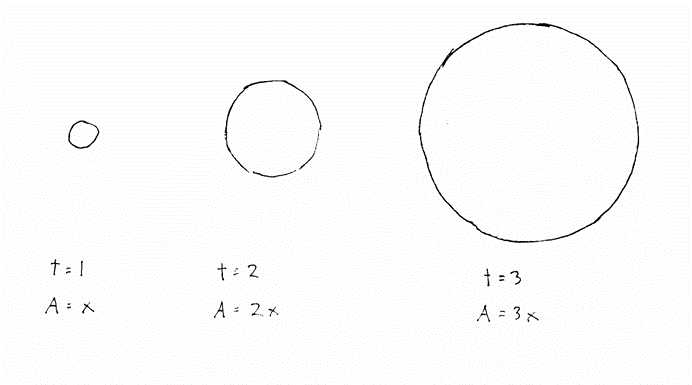
There is a center, a boundary, and an empty space outside that it is expanding into. As time goes on, the area increases. There was a time before the expansion started. In reality, the Big Bang is similar to this. Imagine an infinite sheet of graph paper where the grid printed on the paper is expanding. Press enter or click to view image in full size
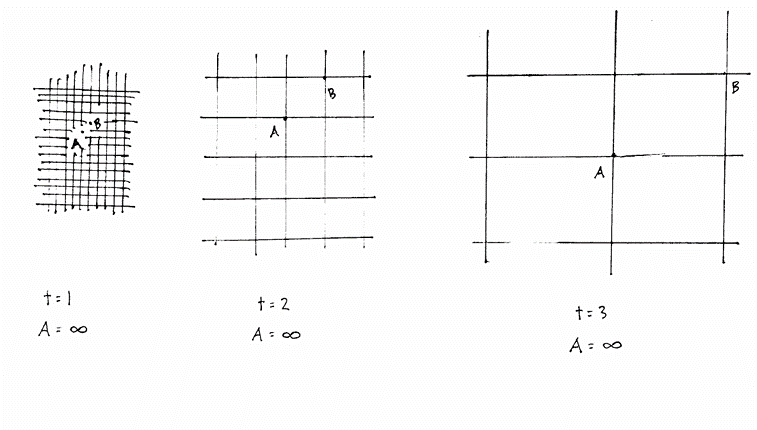
There is no center, no boundary, and no empty space outside that it is expanding into. The area is always infinite so the area is not increasing. As time goes on, the distance between points A and B is increasing. It’s expanding but it is not getting any bigger. There was no time before the expansion started.
Both the phrase “faster than light” and “before the Big Bang” are like saying “south of Antarctica”. There is no such thing as “faster than light” or “before the Big Bang”. Believing that if you had sufficiently advanced technology you could travel faster than light is like believing that if you had sufficiently advanced technology you could travel south of Antarctica. Asking what was before the Big Bang is like asking what is south of Antarctica. It’s not that there’s nothing south of Antarctica. It’s not that we don’t know what is south of Antarctica. It’s not that we are not allowed to know what is south of Antarctica. It is that the question has no meaning because there is no such thing as south of Antarctica. According to the traditional Big Bang theory, there was no such thing as before the Big Bang. There are more recent theories such as eternal inflation that suggest that there could be before the Big Bang but you need to understand the traditional Big Bang before you try to learn about more recent theories. Similarly, there was no such thing as faster than light. Asking how you go faster than light is like asking you go south of Antarctica. It’s a meaningless question. The public can’t understand things that are outside their own experience. The average person, a member of the public has never experienced a speed where there is no such thing as a higher speed. 55 mph is faster than 50 mph. 60 mph is faster than 55 mph. The average person, a member of the public has never experienced a point in time where there is no such thing as an earlier point in time. Yesterday was before today. The day before yesterday was before yesterday. People can not imagine something they have never experienced. Your sense of what is intuitive is shaped by your own experience in your own daily life. Another thing that the average person has never experienced is a situation where friction is negligible. If you roll a baseball on the ground, it will eventually slow to a stop unless you keep kicking it. It creates the illusion that you have to keep applying a force to something to keep it moving at a constant velocity. However, if you were in interstellar space, and throw a baseball, it would keep traveling forever at a constant velocity. Actually, even in interstellar space, there is interstellar dust and gas but the point is, without fiction, there would be nothing slowing it down.
Another situation that the average person has never encountered is an object without constituents. To ask what something is made of is to ask what are its constituents. However, if something is fundamental, then it has no constituents, so it’s meaningless to ask what it’s made of. Yet you hear people ask meaningless questions like “What is an electron made of?” or “What are superstrings made of”?
You see how the general public’s misunderstanding is shaped by their limited personal experience. They have never, in their daily life, experienced the following.
A situation where there is not an obvious reference frame that is always there, and that everyone agrees upon.
A speed where there is no such thing as a higher speed.
A point in time where there is no such thing as an earlier point in time.
A situation where friction is negligible.
An object without constituents.
There are other examples. They have never experienced temperature where there is no such thing as a lower temperature. This is why in the beginning of the movie “Fifth Element”, it refers to something having a temperature of minus one million, because the writers were unaware that there is no such thing. The average person has never encountered an object where the speed of sound in the object is so slow that you can see an pressure wave moving through it with your eyes. There are Youtube videos of a falling slinky which not surprise a physicist but surprises the average person because they are not used to objects where the speed of sound in the object is so slow that you can see it.
Here is a list of equations describing linear motion and rotational motion in classical mechanics.
Linear motion
1. Position
x
2. Velocity

v = dx/dt
3. Acceleration

a = dv/dt = d²x/dt²
4. Momentum

p = mv = m(dx/dt)
5. Force
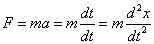
F = ma = m(dv/dt) = m(d²x/dt²)
6. Kinetic Energy

K = ½mv² = ½m(dx/dt)²
Rotational Motion
1. Angle
θ
[insert graph]
2. Angular Velocity

ω = dθ/dt
3. Angular Acceleration

α = dω/dt = d²θ/dt²
4. Angular Momentum

L = I ω= I(dθ/dt)
5. Torque
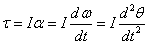
τ = Iα = I(dω/dt) = I(d²θ/dt²)
6. Kinetic Energy

K = ½Iω² = ½I(dθ/dt)²
7. Moment of Inertia

I = ∑Fᵧ d
The total energy is kinetic energy plus potential energy.
E = K + U
In the above equations, “I” is the “moment of inertia”, and has to do with how the mass is distributed about the axis of rotation.
The purpose of the above list of equations is two fold. Firstly, the above list of equations is very basic physics that anyone learning physics should be expected to know. Secondly, the above list of equations affords us the opportunity to make some observations about physics. The first thing you should immediately notice is the similarity between the equations for linear motion and rotational motion. This is a recurring theme in physics. It is common in physics for different physical systems to be described by the same mathematics or similar looking equations. Sometimes one physical system that is easier to study can be used as an analog for a different physical system that is more difficult to study because they are described by the same mathematics. There is a long list of condensed matter systems that are used as analogs for particle phyics or cosmology. My cousin Ian Spielman at NIST uses Bose-Einstein condensates as analogs for magnetism. Now let’s make another observation about physics. Let’s look at the following equation.
L = I ω= I(dθ/dt)
where L is the angular momentum, I is the moment of inertia, ω is the angular velocity, which is the derivative of θ which respect to time, and theta is the angle. You have seen this equation in action if you have watched the Winter Olympics on TV. If a female figure skater is spinning and pulls her arms in, she spins faster. Why is that? By pulling her arms in, her moment of inertia I goes down, which means that her angular velocity omega has to go up in order for her angular momentum L to stay the same. This illustrates a psychological difference between physicists and the average person. The average person would be a figure skater spin faster when she pulled her arms in, and not wonder at all about why that is. A physicist would see the same thing, wonder why that is, and then use physics to explain it. I can list a lot of examples where a physicist saw something mundane in their daily life, and was curious enough to derive a physics explanation. I can list a lot of examples where a physicist felt the need to come up with a physics explanation for something they saw, even if it is unrelated to their field, motivated by curiosity, when most people would see the same thing, and never wonder about it at all. Lyd´eric Bocquet wrote a physics paper on the physics of stone skipping. Raymond Goldstein, Patrick Warren, and Robin Ball wrote a physics paper on ponytails, where they define a dimensionless parameter called the “Rapunzel number”. One of the physics professors at UBC is William Unruh, most famous for Unruh radiation, and he wrote a physics paper about the falling slinky. Physicists Dominic Vella and Lakshminarayanan Mahadevan wrote a physics paper explaining why Cheerios clump together when floating in milk, which they call the “Cheerios effect’” to minimize the over all surface energy. Sidney Nagel saw ring shaped stains left by his coffee mug, and it peaked his curiosity so much that he and his coauthors wrote a physics paper explaining in detail how that happens.
This equation is also an example of a conservation law, in this case, the conservation of angular momentum.
L = I ω= I(dθ/dt)
The reason a female figure skater skates faster when she pulls her arms in is because if the moment of inertia goes down, then the angular acceleration has to go up in order for the angular momentum to stay the same, and the reason why it has to stay the same is because of conservation of angular momentum. Conservation laws are ubiquitous in physics. The importance of conservation laws in physics can not be overstated. Even without using Newton’s Laws, you can go a surprising long way in physics just by using conservation laws.
An example of a physics discovery resulting from conservation laws is the discovery of the neutrino. Experiments showed that in beta decay, where a neutron transforms into a proton and an electron, the emitted electrons had a range of energies, not a single fixed energy. This suggested that the total energy before the decay wasn’t equal to the total energy after, violating the law of energy conservation. Wolfgang Pauli proposed that a new, uncharged particle was also emitted, but so weakly interacting that it was undetectable. This particle, which he called a “neutron,” would carry away the “missing” energy and momentum, explaining the continuous energy spectrum observed. The Italian physicist Enrico Fermi later renamed Pauli’s hypothetical particle the “neutrino,” or “little neutral one,” to distinguish it from the particle that we now call the “neutron”, discovered by James Chadwick in 1932. The neutrino proposed by Wolfgang Pauli was confirmed experimentally 26 years later by Clyde Cowan and Frederick Reines in 1956.
In this case, predicting a new particle was a less radical solution than suggesting that a conservation law did not hold. Other times, important discoveries in physics result from realizing that a conservation law does not hold. Charges conjugation(C), parity(p), and time reversal (t) used to be considered symmetries that held in isolation. Today we know that’s not true but the product, CPT symmetry, is always obeyed. In the Standard Model of particle physics, baryon number conservation is a symmetry that is strictly obeyed at low energies. However, under extreme conditions, such as those present in the early universe or in certain high-energy particle collisions, this symmetry can be violated. This violation is essential for explaining the observed asymmetry between matter and antimatter in the Universe. CP violation allows for processes where the baryon number changes in a way that favors the creation of more matter than antimatter.
Consider the following equation from the list I gave earlier.
τ = Iα = I(dω/dt) = I(d²θ/dt²)
This says torque is the moment of inertia times the angular acceleration. This illustrates another problem which is members of the public tossing around physics words and phrases without knowing what the words mean. How often have you heard someone use the word “torque” while obviously not knowing what the word means? The next time you hear someone use the word “torque”, interrupt them, and ask, “What is torque?” If they do not immediately say “torque is the moment of inertia times the angular acceleration.”, walk over, and punch them in the face. They are talking about something they nothing about. They don’t even know what they are saying. You hear people who drive pickup trucks say “torque”, without knowing that torque is the moment of inertia times the angular acceleration. You hear people say “volt” without knowing that one volt is one amp per coulomb. You hear people who play electric guitars say “amp” without knowing that ampere is one coulomb per second. How many people who don’t know what a watt is does it take to change a light bulb? One watt is one joule per second. Many times, members of the public under the mistaken impression that a physics word means something totally different than what it means. The public thinks that the word “energy” refers to some sort of material or substance, as if something could be “made of” energy. In reality, the word “energy” refers to an ability to do work. The public thinks that the word “dimension” refers to a place. You could refer to the dimensions of an object as the length, width, and height. Does the word “length” refer to a place? Physicists groan and sigh whenever they hear New Age nuts toss around the word “quantum”. You might see a business called “quantum yoga”. Quantum physics has nothing to do with what the public thinks it means.
Let’s look at the following equation.

E = K + U
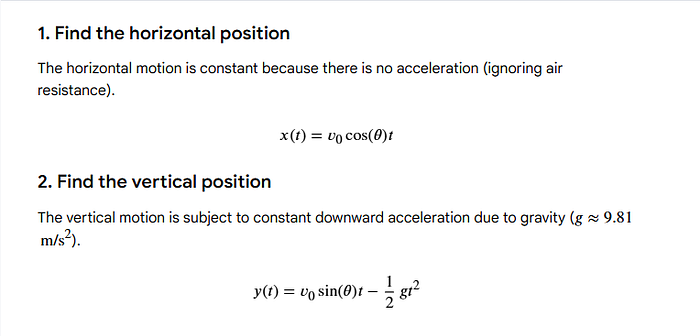
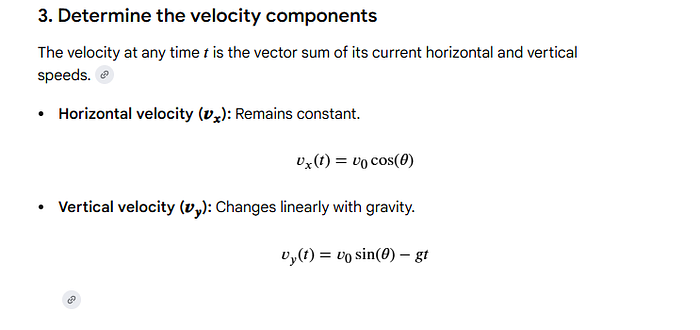
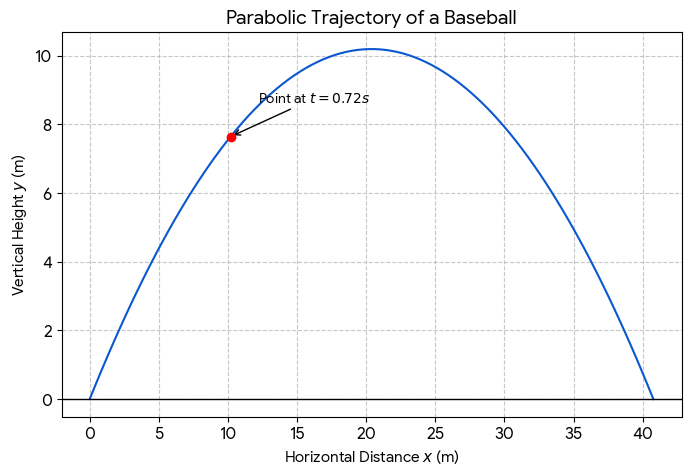
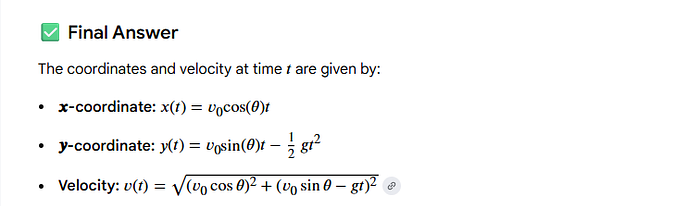
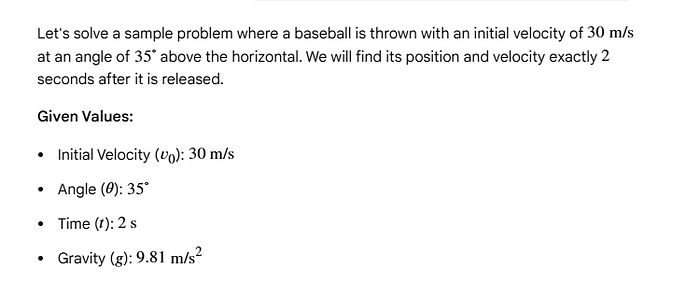
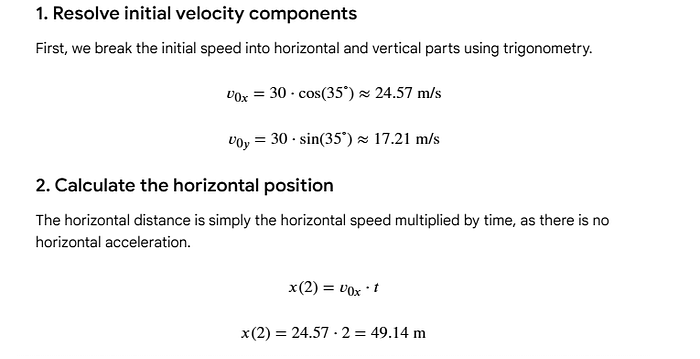
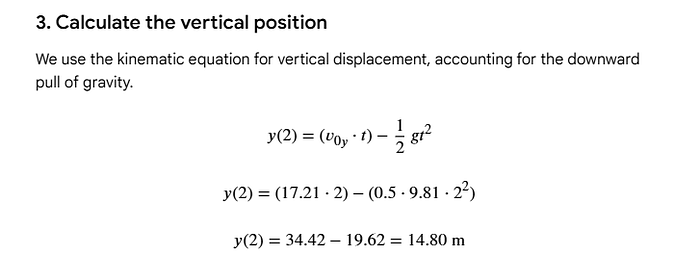
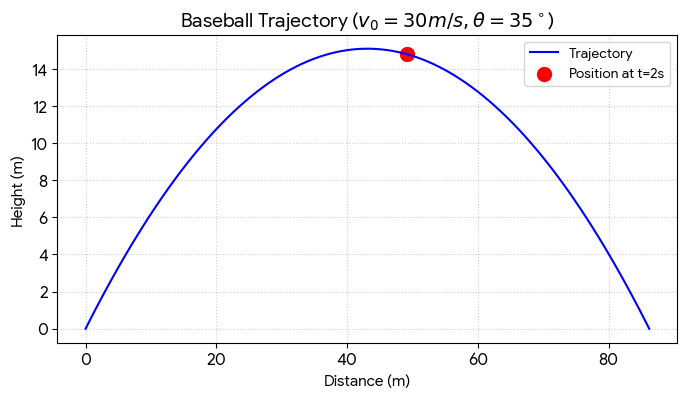
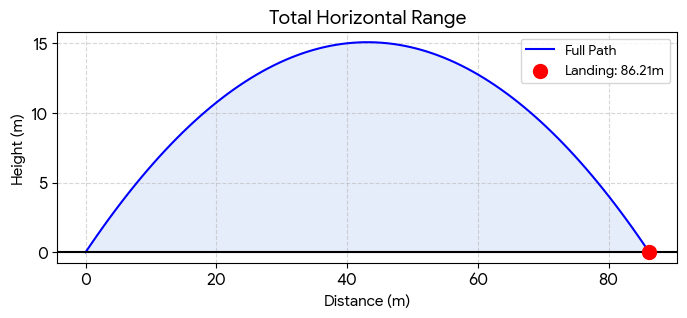
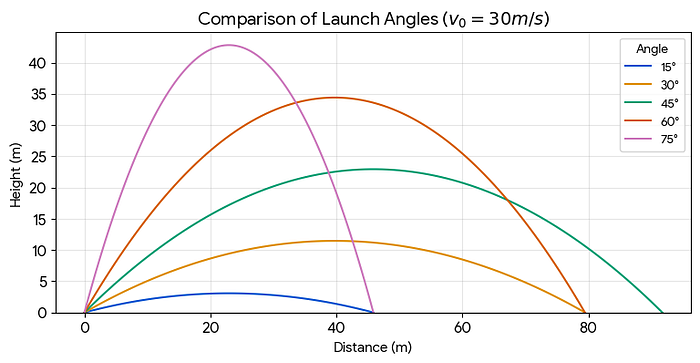
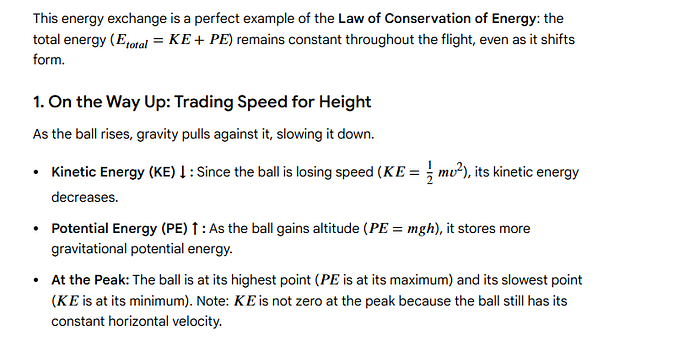
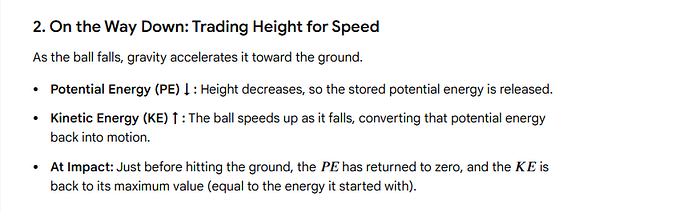
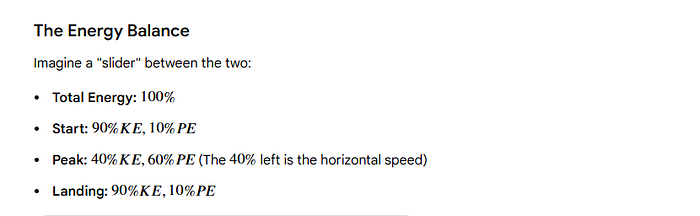
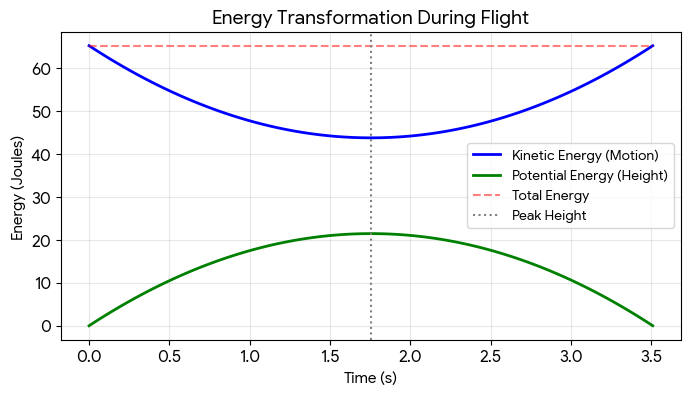
Total energy equals kinetic energy plus potential energy. You have conservation of energy so when the kinetic energy goes up, the potential energy goes down, and vice versa. Let’s say you throw a baseball in the air. It traces a parabola.
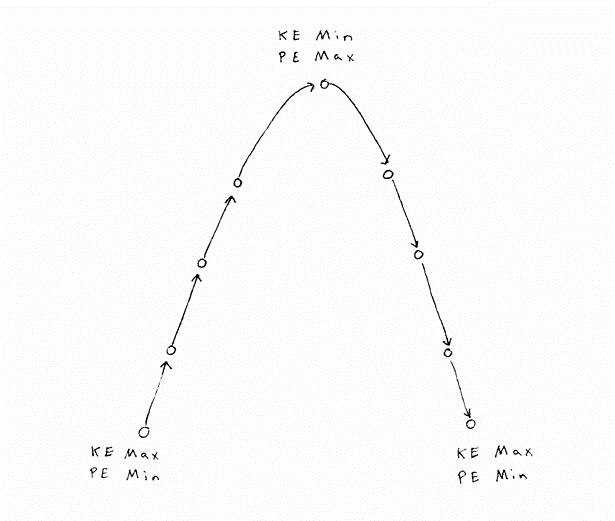
When you first throw it, it has maximum kinetic energy and minimum gravitational energy. As it travels upwards, the kinetic energy goes down, and the gravitational potential energy goes up. When it is at the top, it is briefly not moving at all, and it has maximum gravitational potential energy. Then as it falls back down, the gravitational potential energy goes down, and the kinetic energy goes up. Then the baseball hits the ground with the same velocity it had when you threw it. There are different kinds of potential energy. You have gravitational potential energy, electrostatic potential energy, elastic potential, and chemical potential energy.
The difference in potential energy is the negative of the work done by the system.

Uբ — Uᵢ= -W
The force is the work done by the system multiplied by the distance over which the work is done.

F = Wd
The force is also mass times acceleration.

F = ma
Press enter or click to view image in full size
Press enter or click to view image in full size
Press enter or click to view image in full size
Press enter or click to view image in full size
Press enter or click to view image in full size
Press enter or click to view image in full size
Press enter or click to view image in full size
Press enter or click to view image in full size
Press enter or click to view image in full size
Press enter or click to view image in full size
Press enter or click to view image in full size
Press enter or click to view image in full size
Press enter or click to view image in full size
Press enter or click to view image in full size
Press enter or click to view image in full size
Press enter or click to view image in full size
Press enter or click to view image in full size

Press enter or click to view image in full size
Press enter or click to view image in full size
Press enter or click to view image in full size
Press enter or click to view image in full size

Press enter or click to view image in full size
Press enter or click to view image in full size
Press enter or click to view image in full size
Press enter or click to view image in full size
Press enter or click to view image in full size
Press enter or click to view image in full size
Press enter or click to view image in full size
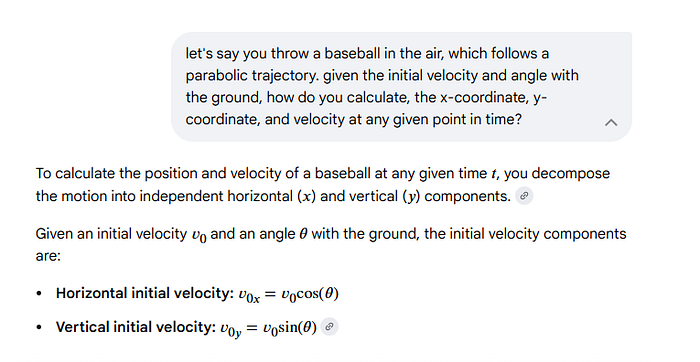
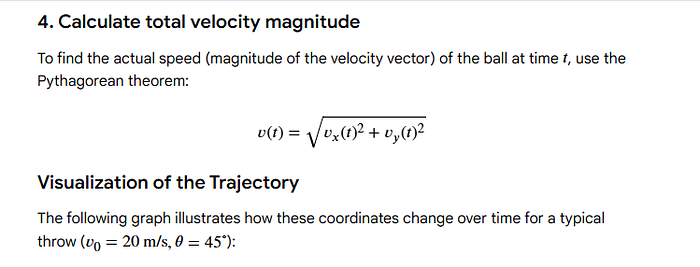
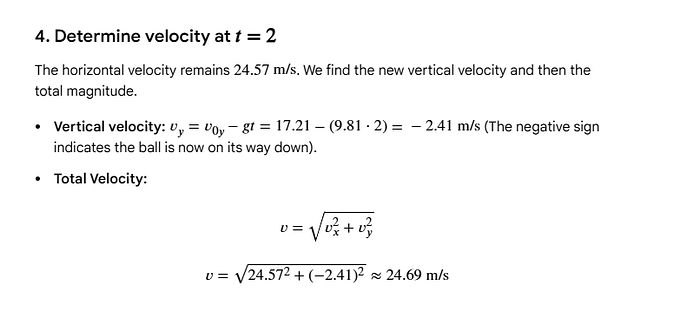
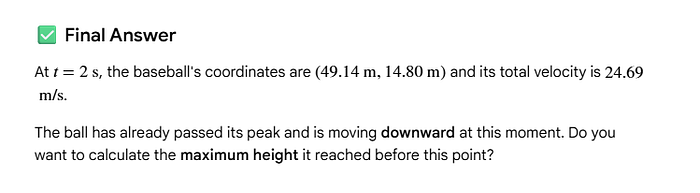
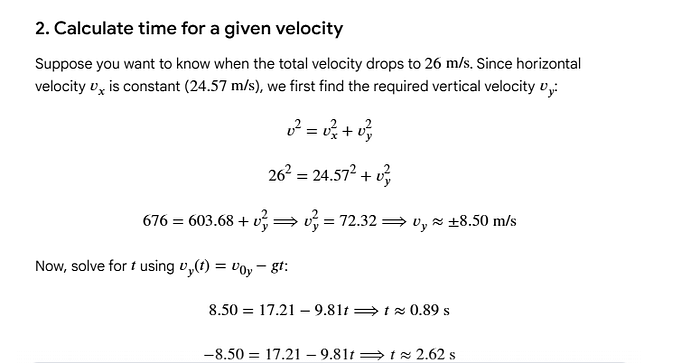
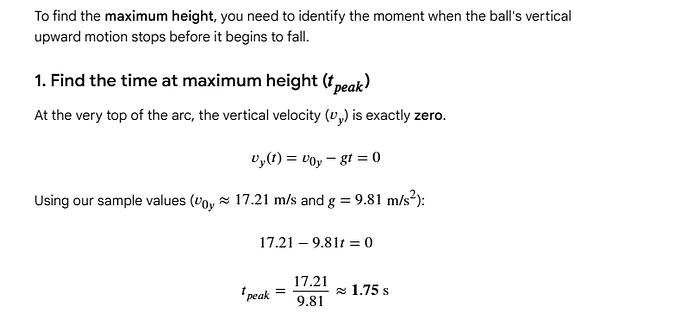
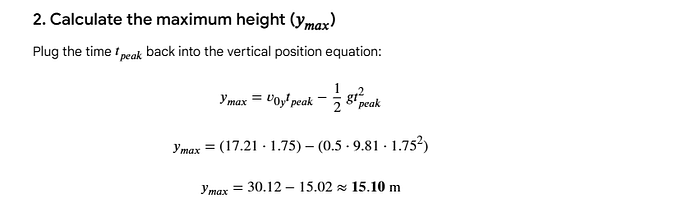
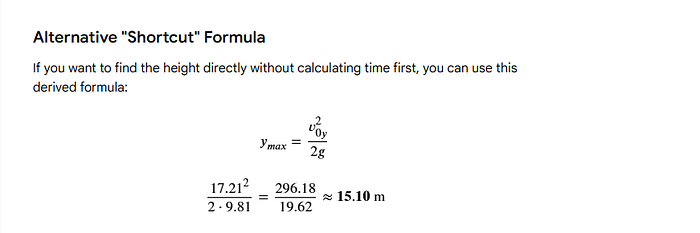
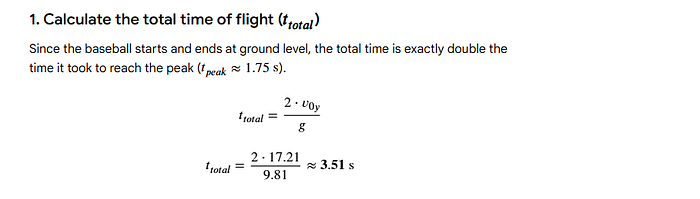
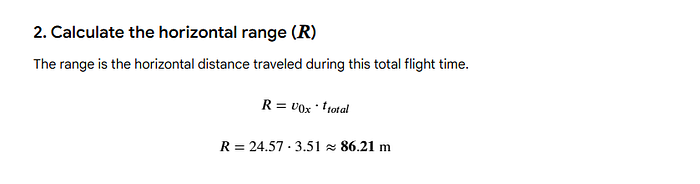
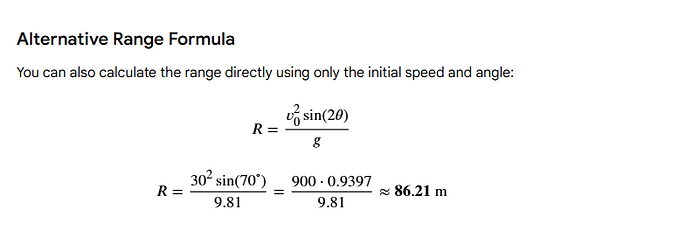
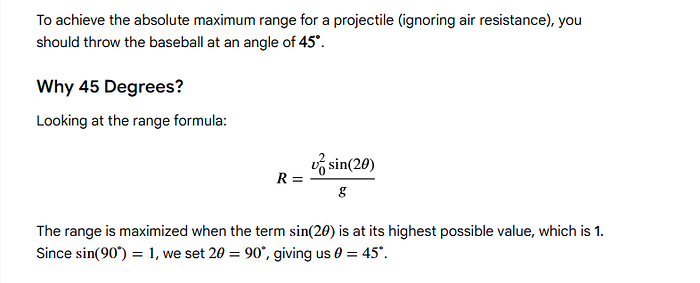
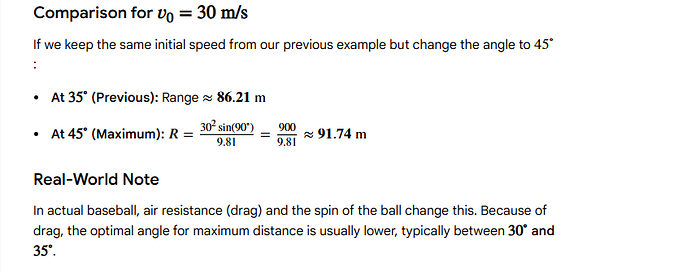
We can make some observations. You always should pay close attention to the signs. What do negative signs mean? We have established a vertical axis, the y axis, and we chose, quite arbitrarily, its upward direction to be positive. A negative velocity means that the baseball is moving in the direction of decreasing y, which is downwards. The velocity of the ball is positive while it is rising and negative while it is falling. We have taken the acceleration due to gravity, -9.0 m/s², to be negative. A negative acceleration means that, as time goes on, the velocity of the baseball becomes more and more negative. This is true no matter where the ball is located, an no matter how fast, or in what direction, it is moving. The acceleration of the ball is negative throughout its flight, whether the ball is rising or falling. The rising ball shows down. The falling ball speeds up. In both cases, the velocity becomes more and more negative.
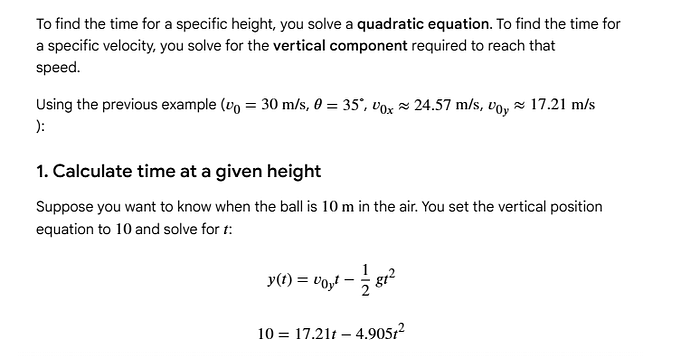
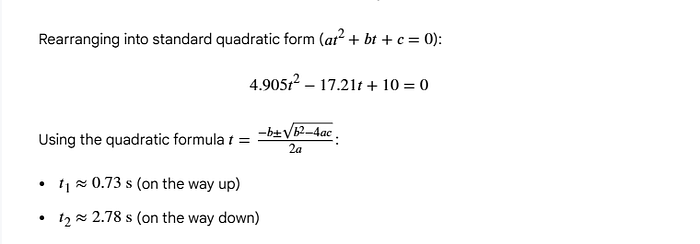
When you were calculating at what time the ball would be at a specific height, you might not have expected to get two different answers. However, this is not surprising, since it passes through the height twice, first on the way up, and then on the the way down. This shows that often you get answers that you never thought of. If you get more answers than you expect, do not discard out of hand the ones that do not seem to fit. Examine them carefully for physical meaning. If time is your variable, even a negative value can mean something. Negative time simply refers to time before t = 0, the arbitrary time at which you started our stop watch.
In 1928, physicist Paul A. M. Dirac found an unexpected negative root to a complicated equation he was working on. It turned out to be a prediction of antimatter. “The Unreasonable Effectiveness of Mathematics in the Natural Sciences” is a landmark 1960 essay by physicist Eugene Wigner, exploring the mysterious power of abstract mathematics to accurately predict physical phenomena. Wigner argued that the exact coincidence between mathematical concepts and physical reality is a “wonderful gift” that we neither understand nor deserve.
I said before that similar mathematics can describe very different physical systems. You would not expect that the mathematics describing the trajectory of a thrown baseball to also describe the entire Universe, but indeed this is the case. Of course, in this case, it is an overly simplistic toy model of a universe, and is also, in this case, not describing the universe we live in. Imagine a hypothetical universe that had more matter than the real Universe. It would start in a Big Bang, expand at an increasingly slower rate until it stopped expanding. Then it would contract, and end in a Big Crunch. You can think of the graph of the parabolic trajectory of the thrown baseball as also describing the expansion and contraction of such a hypothetical universe. Of course, the real Universe does not have enough matter to cause it to contract, so instead, it will expand forever. Not only that, but the expansion is accelerating. You could imagine a universe that expands forever without accelerating, but in our case, the expansion is accelerating. We attribute this to a mysterious phenomenon called Dark Energy.
No doubt, you have seen the following famous physics equation.

E = mc²
The public misunderstands this equation. It is not called the “mass energy conversion relation”. It is called the “mass energy equivalence relation” because it explains how mass and energy are equivalent under certain circumstances. Here m is the rest mass, meaning the mass as measured in the rest frame, which is the reference frame of the particle itself. As I said before, a massless particle necessarily travels at the invariant speed, and since an object is motionless in it’s own reference frame, that means that an object that travels at the invariant speed can not be used as reference frame, since that would lead to a contradiction, and therefore, does not have a rest mass. Therefore the above equation does not apply to photons. If you were to just naively stick m = 0 into the above equation, as some people mistakenly do, you would get E = 0, which is clearly false. The photons, you would use the following equation.

E = hν
where h is Planck’s constant, and the Greek letter ν is the frequency.
When you multiply two numbers of the same sign, the answer is positive. When you multiple two numbers of opposite sign, the answer is negative.
2 × 3 = 6
-4 × -5 = 20
-3 × 3 = -9
Let’s ignore the magnitude so we can focus on the sign.
1 × 1 = 1
-1 × -1 = 1
1 × -1 = -1
Square root means what number multiple by itself gives that number.

√4 = 2 since 2 × 2 = 2
√9 = 3 since 3 × 3 = 9
So what would be the square root of -1?

√-1
At first, it seems like this would be impossible since any number is the same sign as itself so multiplying a number with itself would be multiplying two numbers of the same sign, which would be positive. However, mathematicians invented a number that is defined as the square root of -1. This is part of a long tradition of humans inventing new numbers throughout history, such as the invention of irrational numbers in Ancient Greece, zero in India, negative numbers, initially by Arab mathematicians, but mainly in the Renaissance, or the concept of infinity, implicit in calculus, but mainly in the 19th Century.
The imaginary unit is defined as the square root of -1.

i = √-1
Complex numbers have the following form.

z = a + bi
where a and b are real numbers. If b = 0, then z is a real number. If a = 0, then z is a pure imaginary number. You can also define the complex conjugate of z.

[z bar] = a — bi
You can also define the real part and the imaginary part of a complex number.

Re| z | = a
Im| z | = b
Mathematicians did not stop there. Just as real numbers are a subset of complex numbers, the complex numbers are a subset of the quaternions.
The complex numbers have one imaginary unit, which is i. The quaternions have three imaginary units: i, j, and k. William Rowan Hamilton, an Irish mathematician, invented the quaternions in 1843 as a four-dimensional number system to describe three-dimensional rotations. His breakthrough came while he was trying to extend the two-dimensional complex numbers to a three-dimensional space, but he found the solution required a fourth dimension. Then, in an act of mathematical vandalism, he carved the following equation for quaternion multiplication into a stone on Dublin’s Broom Bridge to commemorate his discovery.

i² = j² = k² = ijk = -1
Complex numbers have the following form.

a + bi
where a and b are real numbers, and i is the imaginary unit. Quaternions have the following form.

q = w + ix + jy + kz
where w, x, y, and z are real numbers and i, j, and k are imaginary units.
The quaternions are a subset of a larger group of numbers called the octonions. The octonions were first discovered by John T. Graves in December 1843, inspired by his friend William Rowan Hamilton’s earlier discovery of quaternions. Arthur Cayley independently discovered the octonions around the same time and published his findings first in 1845, leading to the octonions also being known as Cayley numbers. Graves’ contributions were later acknowledged by Hamilton, who also initially called them “octaves”.
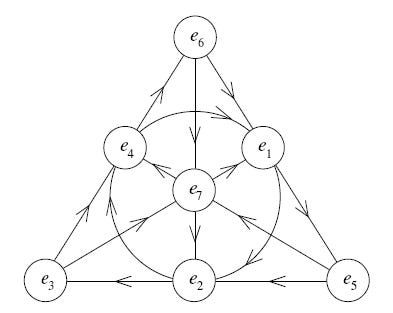
Just as the complex numbers have one imaginary unit, and the quaternions have three imaginary units, the octonions have seven imaginary units.

e₁, e₂, e₃, e₄, e₅, e₆, e₇
The multiplication rules for the octonions are described by the following figure called the Fano Plane.
The real numbers are ordered and self-conjugate.
The complex numbers are not ordered but are commutative.
The quaternions are not commutative but are associative.
The octonions are not associative but are alternative.
These are the only four normed division algebras.
There are many types of numbers which are subsets of each other like nestled Russian Matryoshka dolls. Here are some examples in a Venn diagram.
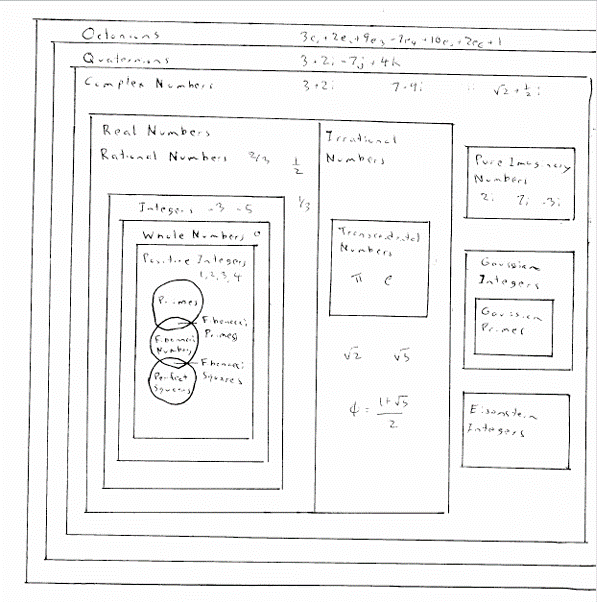
In this Venn diagram, you can imagine each larger set as a generalization of each internal set. Numbers can be generalized in other ways, such as matrices, which I discuss next, or as vectors and tensors.
Usually, when I first introduce the square root of -1 to people, they freak out, and are like “That’s impossible! How could you have the square root of minus one? Obviously there is no number where if you multiply it to itself you would get minus one because any time you multiply two numbers of the same sign the answer is positive!” You can see from the expression on their face that they are not believing you. They are being thrown for a loop. They can’t get their minds around it. I enjoy seeing their reaction. You are helping someone expand their mind, their conception of what’s possible, which is what learning physics is all about. After the first time I was falsely accused over 20 years ago, and the child molesters put me in prison when I never broke any law, I was in minimum security federal prison. At that time, I agreed to try to teach physics to an old white man with a short gray beard who said that he was interested in learning physics. I told him that i was the square root of -1. I wrote the following on a piece of paper, and showed it to him.
i = √-1
I expecting to have the same reaction that I usually get out of the audience where they look like they are bowled over or knocked back on their heels, where they go “WHAT????!!!!” Sometimes they don’t believe you. Sometimes, they say, “How can you have the square root of minus one? That’s impossible”. I was expecting that reaction but instead, he had absolutely no reaction whatsoever. There was zero change in his facial expression or body language. He had a totally blank expression on his face. After a long pause, where he had absolutely no trace of reaction, and a totally blank expression on his face, he finally spoke, with absolutely no change in his tone of voice. After a long pause, without the slightest hint of surprise, in a casual normal voice, he finally said the following.
“So if its under this thing that means it’s equal to i?”
I suddenly realized that the reason why he had no reaction is because he had no idea what a square root was! He had never heard of a square root before his life! He was using the phrase “this thing” to mean the square root symbol which he had never seen before in his life. That is why in this paper, I felt the need to carefully explain what a square root was, and the multiplication rules for negative numbers.
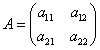
In physics, we frequently use matrices, so now I am going to introduce matrices. A matrix is a rectangular array of entries. The entries are usually complex numbers, remembering that real numbers are a subset of the complex numbers, although they could be any type of mathematical object. A matrix is a n x m array of entries with n rows and m columns. Each entry is identified by its row and column, and can be written aₙₘ.
This is a 2 × 2 matrix.
This is a 3 × 3 matrix.
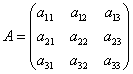
This is a 2 × 4 matrix.
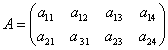
Here is a specific example of a 2 × 2 matrix where the entries are positive integers.

A matrix where n = 1 is a row matrix.
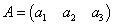
A = ( a₁, a₂, a₃)
A matrix where m = 1 is called a column matrix.

A matrix where n = m is called a square matrix.
If n = m = 1, you just have a single number, so in fact, a single number could be considered a type of a matrix. Matrices are a generalization of numbers in which you no longer assume that n = m = 1.
If you have a square matrix, where the only nonzero entries appear in a diagonal line that goes from the upper left to the lower right, and all other entries are zero, that is called a diagonal matrix. Often, we don’t bother to write down the zeroes, so if a space is blank, that means its zero.
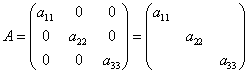
A diagonal matrix where all the entries in the diagonal are zero is called the identity matrix.

If you have a diagonal matrix, the sum of the entries in the diagonal is called the trace.
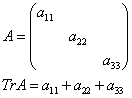
Tr A = a₁₁ + a₂₂ + a₃₃
If the trace is 1, the matrix is called traceless.
Tr A = 1
A matrix where all the entries are zero is called a zero matrix.
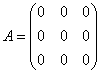
If you have a matrix, you can form a new matrix by exchanging rows and columns. This is called the transpose of the original matrix.
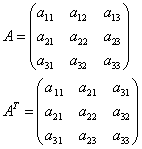
If a matrix equals its transpose, A = Aᵀ, it is called symmetric. If a matrix equals the negative of its transpose, A = -Aᵀ, it is called antisymmetric.
The following defines the determinant of a 2 × 2 matrix.
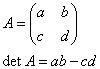
det A = ab — cd
The following defines the adjoint of a 2 × 2 matrix.
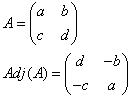
The identity matrix is a diagonal matrix where all of the entries are 1.
There are many operations you can perform on matrices. For example, you can multiply a matrix by a number by multiplying all of the entries by that number.
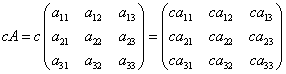
You can add two matrices with same number of rows and columns by adding their entries.

Matrix multiplication is complicated. You multiply each entry in the first row of the first matrix by the corresponding entry in the first column of the second matrix, and add them together to get the first entry in the final matrix. Then you do the same thing with the other rows of the first matrix and the other columns of the second matrix to get the other entries of the final matrix. Press enter or click to view image in full size
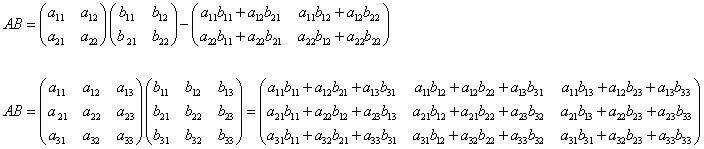
Matrix multiplication is noncommutative, which means that the order matters. In general AB does not equal BA.
Matrices have inverses. If you multiply a matrix by its inverse, you get the identity.

AA⁻¹= A⁻¹A= I
If you multiply a matrix by the identity, you get the same matrix. The identity is its own inverse.

AI = IA = A
I = I⁻¹
Only square matrices have inverses. A square matrix is considered invertible if there exists another matrix, called its inverse, that, when multiplied with the original matrix, results in the identity matrix. Essentially, it means the matrix’s transformation can be reversed. If a matrix is invertible, it is also called non-singular or non-degenerate. Not all square matrices are invertible; a square matrix is only invertible if it is non-singular, which means its determinant is non-zero and its rank is equal to its dimension. Matrices like the zero matrix are square but not invertible because they map every input to the zero vector, making the mapping many-to-one and not bijective. The set of all invertible n × n matrices of a given field (e.g., real or complex numbers) forms a group under matrix multiplication, a structure known as the general linear group.
The inverse of a 2 × 2 matrix is one over the determinant of the matrix multiplied by the adjoint of the matrix. Here is how you calculate the determinant of a 2 × 2 matrix.
Here is how you calculate the adjoint of a 2 × 2 matrix.
Put that together, here is how you calculate the inverse of a 2 × 2 matrix. The inverse of a 2 × 2 matrix is the inverse of the determinant multiplied by the adjoint of the matrix.
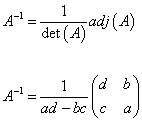
Here is how you find the inverse of a 2 × 2 matrix.
- Represent the matrix: Let the given 2 × 2 matrix be
A = [[a, b], [c, d]]. - Calculate the determinant: Find the determinant of the matrix, which is
ad - bc. - Check if the determinant is zero: If
ad - bc = 0, the matrix is singular and does not have an inverse. - Form the adjugate matrix: Swap the elements on the main diagonal (
aandd) and change the signs of the off-diagonal elements (bandc) to get[[d, -b], [-c, a]]. - Multiply by the reciprocal of the determinant: Divide each element of the adjoint matrix by the determinant calculated in step 2.
Here is how you find the inverse of a 3 × 3 matrix.
- Calculate the determinant:
- You can use the formula:
- The determinant of a 3 × 3 matrix is calculated by expanding along a row or column, using a specific sign pattern (+ — + or — + -).
det(A) = a(ei − fh) − b(di − fg) + c(dh − eg)
where A is the matrix:
| a b c |
     | d e f |
     | g h i |
- 1. Find the minor matrix:
- For each element in the original matrix, find its minor matrix by crossing out the row and column it belongs to.
- For example, the minor of element ‘a’ is the 2×2 matrix formed by the remaining elements.
- 2. Find the cofactors:
- Each minor matrix has a corresponding cofactor. To find the cofactor, multiply the determinant of the minor matrix by either +1 or -1, following a checkerboard pattern of signs (+ — +; — + -; + — +).
- 3. Form the matrix of cofactors:
- Replace each element of the original matrix with its corresponding cofactor.
- 4. Find the adjoint matrix:
- Transpose the matrix of cofactors (swap rows and columns).
- 5. Calculate the inverse:
- Multiply the adjoint matrix by the reciprocal of the determinant.
- If the determinant is 0, the matrix has no inverse (it is singular).
- The formula for the inverse is:
A⁻¹ = (1/det(A)) * adj(A).
The complex conjugate of a matrix is formed by replacing each element in the original matrix with its own complex conjugate, where the complex conjugate of a number (a + bi) is (a — bi). Essentially, you change the sign of the imaginary part of every complex number within the matrix. If a matrix contains only real numbers, its complex conjugate is identical to the original matrix because real numbers have no imaginary part to change.
If a matrix is equal to its transpose, it is called symmetric.
A = Aᵀ
If a matrix is equal to the negative of its transpose, it is called antisymmetric or skew symmetric.
A = -Aᵀ
If a matrix is equal to its inverse is called an involutory matrix.
AA = I
The identity matrix is a type on involutory matrix.
A matrix that is equal to its complex conjugate transpose is called Hermitian.
A = A†
This is pronounced “A dagger”. A unitary matrix is a complex square matrix that has the property that its inverse is equal to its conjugate transpose. A unitary matrix whose entries are all real numbers is said to be orthogonal. A Hermitian matrix is equal to its complex conjugate transpose (A = A*), meaning it preserves the real inner product of vectors, with real eigenvalues. A unitary matrix is a matrix whose inverse equals its complex conjugate transpose (U* = U⁻¹), meaning it preserves the complex inner product, and its eigenvalues lie on the unit circle in the complex plane.
Matrices are frequently used in physics. Among the most important matrices in physics are the Pauli spin matrices.
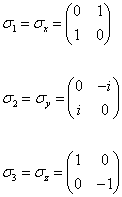
The Pauli spin matrices describe a type of spin where it has to rotate twice to return to its original state. Paul A.M. Dirac illustrated this with several parlor tricks such as Dirac’s belt or Dirac’s teacup. I said before that often similar mathematics can describe a different physical systems. That is what you have here. Wolfgang Pauli introduced the Pauli spin matrices in 1927 to mathematically describe the intrinsic spin of an electron, which is a non-classical property he had previously introduced as a “two-valued quantum degree of freedom” in 1924. His 1927 work utilized the matrix theory of quantum mechanics, developed by Werner Heisenberg, to formulate the matrices that represented spin operators. Of course, the word “spin” in the context of fundamental particles refers to a quantum mechanical property and has nothing to do with anything rotating. An electron is a zero-dimensional point particle with zero volume and no internal structure so obviously it can not be rotating in any literal sense. Julian Schwinger said, “We will borrow only names from classical physics”.
This allows us to segue into quantum mechanics. Paul A. M. Dirac invented the bra-ket notation commonly used in quantum mechanics.

x|α> = c|α>
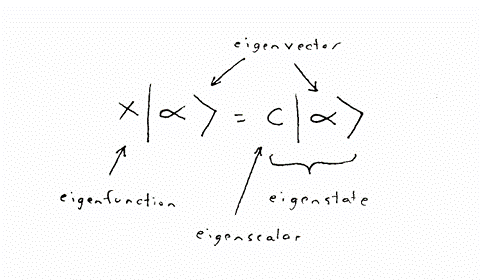
The state is described by the ket |α>. A linear combination of kets |α>|[beta]> defines a new state. An operator acts on a ket from the left.

c|α>
An operator acts on a bra from the right.

<α|c
The inner product defines a scalar.

<α|β>
The outer product defines an operator.

|α><β|
In quantum mechanics, the states are in a Hilbert space which is an infinite dimensional complex vector space.
A particle is described by its wavefunction Ψ. What you actually observe is the probability of detecting a particle which is the square of the absolute value of its wavefunction.
|Ψ|²
Now in physics, if replacing some quantity with another value, or a transformation of the quantity has taken place, does not change what you observe, then you can not prove that the replacement or transformation has not taken place. What could you replace Ψ with that could leave |Ψ|² unchanged? The way a physicist would phrase it is what transformations of psi leave |Ψ|² invariant? One transformation is simply to replace Ψ with Ψ itself.
Ψ → Ψ
Now the average person would think that is silly because you are not doing anything. However, mathematicians consider doing nothing to be equivalent to taking an action. If you ask a mathematician what rotations of a square leave it invariant, they would include no rotation at all. Absolute value converts any number, positive or negative, into a positive number. Therefore, another transformation that leaves Ψ invariant is to replace Ψ with -Ψ.
Ψ → -Ψ
Since there are these two transformations, one of which has a minus sign, and the other does not have a minus sign, let’s delve more deeply into the meaning of a minus sign. What is the difference between multiplying by +1 and multiplying by -1? If you multiply a number by +1, you can perform the operation once to get it back to the way it was before. If you multiply a number by -1, you have to perform the operation twice to get it back to the way it was before.
A × +1 = A
A × -1 = -A
-A × -1 = A
With +1, performing the operation once, leaves the quantity invariant. With -1, performing the operation twice leaves the quantity invariant.
x(1) = x
x(-1) = -x
-x(-1) = x
Remember when I said that the Pauli spin matrices describe a type of rotation where the object has to rotate twice to return to its original state. This is another example of something where you perform an operation twice to leave the object invariant.
If an operation is commutative, then the order of the quantities does not matter. Normal addition and multiplication of numbers is commutative.
3 + 2 = 2 + 3 = 5
3 × 2 = 2 × 3 = 6
However, not all operations are commutative. We saw before that matrix multiplication is noncommutative.
AB does not equal BA
If an operation is commutative, then
AB = BA
AB — BA = 0
This is called the commutator.
[A, B] = AB — BA = 0
Now, I talked before about the minus sign. You have two possibilities, either the presence of a minus sign or the absence of a minus sign.
This is the commutation relation.
AB — BA = 0
We have already considered the possibility of not having a minus sign. Now let’s consider the other possibility. Let’s see what happens if you stick a minus sign in there.
AB — (-B)A = 0
AB + BA = 0
This defines a new type of relation called the anticommutator.
{A, B} = AB + BA = 0
Now what mathematical objects obey the commutation relation and anticommutation relation? This is the commutator.
[A, B] = 0
What numbers obey this relation? Well, all real numbers obey this relation. For example
AB — BA = 0
(3)(4) — (4)(3) = 0
12–12 = 0
so the answer to the question is all real numbers.
A, B are members of R
This is the anticommutator.
{A, B} = AB + BA = 0
What numbers obey this relation? Well, most real numbers do not obey this relation.
AB + BA
(3)(4) + (4)(3)
12 + 12 = 24 ≠ 0
They invented a new type of number called Grassmann variables, which are not real numbers, which satisfy this relation, similar to how they invented imaginary numbers to satisfy equations that were not satisfied by the real numbers. However, let’s stick to the real numbers. There is only one real number which satisfies the anticommutation relation, which is zero.
AB + BA = 0
(0)(0) + (0)(0) = 0
0 + 0 = 0
so the answer is zero.
A = B = 0
so to recap.
[A, B] = AB + BA = 0
A, B are members of R
{A, B} = AB + BA = 0
A = B = 0
Any number will satisfy the commutation relation. Only zero satisfies the anticommutation relation. For wavefunctions governed by these relations, the numbers that obey the relation is the number of additional particles that can be added to one that is already there. If a wavefunction is governed by the commutation relation, then any number of additional particles can be added to one that is already there. If a wavefunction is governed by the anticommutation relation, then the number of additional particles that can be added to one that is already there is zero.
This can be illustrated visually. The wavefunction determines the probability of detecting a particle at a given point.
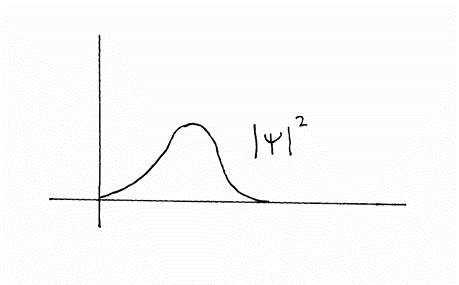
You can add wavefunctions by adding the y coordinates of graphs at each x coordinate, drawing a new graph, and then seeing what the probability is of detecting a particle at a given point.
Let’s try adding two wavefunctions. This is just qualitative and not rigorous. Press enter or click to view image in full size
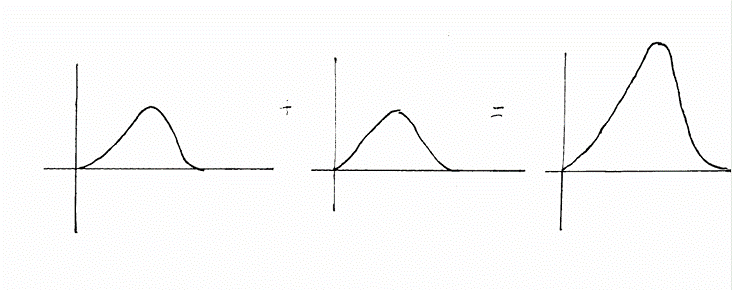
So you see that you end up with a nonzero probability of detecting an additional particle in addition to the one that’s already there. Now let’s stick in a minus sign. The minus sign flips one of the wavefunctions upside down.
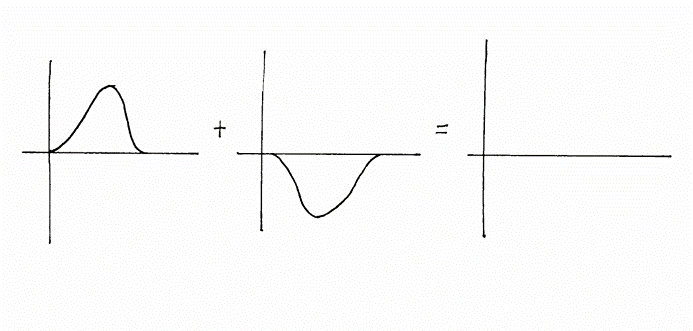
The two wavefunctions cancel out leaving zero. Therefore, the probability of detecting an additional particle in addition to the one that’s already there is zero.
The Pauli Exclusion Principle says that you can not have two particles of the same type at the same place at the same time. Not all particles obey the Pauli Exclusion Principle. If a particle obeys the Pauli Exclusion Principle, it called a “fermion”. If a particle does not obey the Pauli Exclusion Principle, it’ called a “boson”. Fermions involve anticommutators. Bosons involve commutators. Fermions have antisymmetric wavefunctions. Bosons have symmetric wavefunctions.
The fact that electrons are fermions is what makes all of chemistry possible. As you add more electrons to an atom, they fill up all of the available spots. When an orbital is filled, the next electron has to go into the next orbital. The number of electrons in the outermost orbital is what determines the chemical properties of an element. This is why elements can be grouped according to their chemical properties in the periodic table. The electrons in an atom have three quantum numbers, which are 1, m, and s. For electrons in an atom, at least one of these three has to be different since you can not have two fermions with the same quantum numbers at the same place at the same time. If electrons were not fermions, they would all cluster together in the lowest energy level of an atom, and chemistry would not be possible. The Δ++ baryon played an important role in the history of particle physics. The quark model proposed by Murray Gell-Mann and George Zweig explained this particle with a charge of +2e as three up quarks. This went a long way in convincing physicists of the validity of the quark model. In addition, the fact the you had three up quarks, all spin up, would violate the Pauli Exclusion Principle if they were not different in some other respect, so they invented a new quantum property called “color” so they could be different in some way, so they would not be all the same. This has nothing to do with the colors you see. This is another example of “borrowing only names from classical physics”.
Let’s say you had a classical system, like a pendulum. You have an infinite number of energy levels between minimum energy and maximum energy.
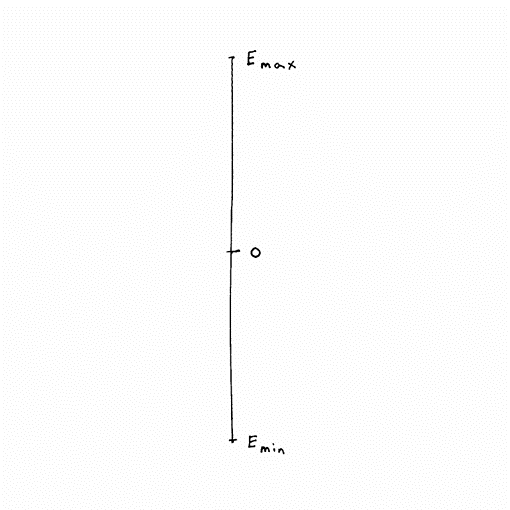
However, if you have a quantum system, such a quantum harmonic oscillator, energy is quantized in units of Planck’s constant h. Therefore, you would have a finite number of energy levels between Eₘᵢₙ and Eₘₐₓ, which would be some integer multiple of h.
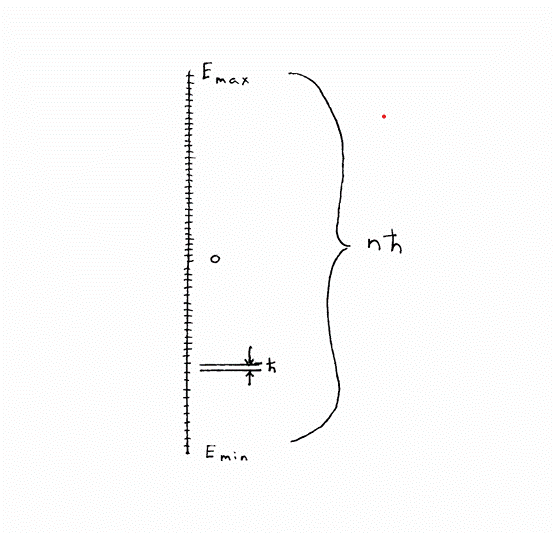
Let’s say that the number of steps between Eₘᵢₙ and 0 is the same as the number of steps between 0 and Eₘₐₓ.
The number of steps between Eₘᵢₙ and Eₘₐₓ would be 2Eₘₐₓ.

2Eₘₐₓ = nh
Divide both sides by 2h.
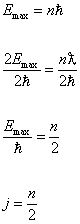
2Eₘₐₓ/2h = nh/2h
Eₘₐₓ/h = n/2
Eₘₐₓ/h is the spin j. If n can take integer values, then the spin j can take either integer or half-integer values.
n = 0, 1, 2, 3, 4,…
j = 0, 1/2, 1, 3/2, 2,…
Particles with integer spin are called “bosons”. Particles with half-integer spin are called “fermions”. Fermions have half-integer spin, and obey the Pauli Exclusion Principle. Bosons have integer spin, and do not obey the Pauli Exclusion Principle.
Spin 0
Type: scalar, boson
Examples: Higgs particle, axion, selectron, dilaton
Spin 1/2
Type: spinor, fermion
Examples: electron, up quark, down quark, photino, gluino
Spin 1
Type: vector, boson
Examples: photon, gluon, W+, W-, Z
Spin 3/2
Type: Rarita-Schwinger, fermion
Examples: gravitino
Spin 2
Type: tensor, boson
Examples: graviton
We do not know whether all of the particles listed above exist but this is what their spins would be if they were to exist. Also, I listed the axion as a scalar when actually it is a pseudoscalar.
Even though I have not mentioned it, what I have been talking about involves the interchange of particles. Let’s say you have two particles of the same type in 3D space, and you interchange them, meaning switch their positions. Press enter or click to view image in full size
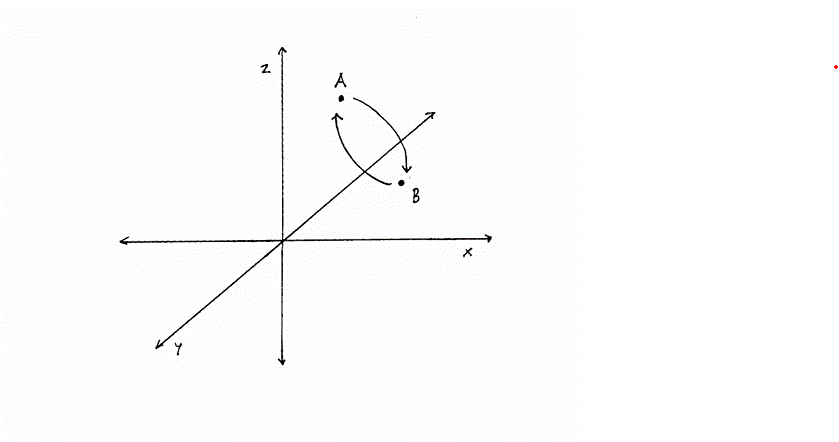
Then you have the whole thing of what transformations of the wavefunction can you do when you interchange the particles that leaves them invariant. Let’s say you have two particles of the same type in 3D space. If they are indistinguishable, that means if you interchange them, they would look the same as before, which means there is no way to know if you interchanged them or not. There would be no way of knowing whether you interchanged them or not, so you have to allow any interchange that would cause them to look the same. Therefore, you are allowed to do any interchange where they would look the same afterwards. Now let’s say you were interchanging two particles in 2D space. Since they are confined to two dimensions, they have less room to move around in, and this affects how they can be interchanged. When identical particles change places, their quantum statistical character shines through. In three spatial dimensions, exchanging particles twice is the same as leaving them alone, and it follows that particles lust be either fermions or bosons but in reduced dimensional spaces, there’s a spectrum of other possibilities.
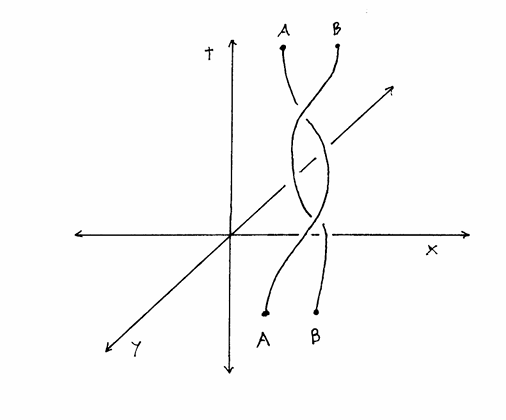
In this graph, depicting two spatial dimensions and one time dimension, the vertical axis is time, and the path traced by a particle is called a “wordline.
Because the particles are confined to two dimensions, it makes a difference how the particles move around each other. This affects interchange. Ultimately, this causes the previous argument that particles can only have integer or half-integer spin to break down. The result is that particles in two dimensions can have spin with any value. Because they can have spin with any value, they are called anyons.
Now you might think this is all hypothetical since we don’t live in a universe with two spatial dimensions and one time dimension. We observe three spatial dimensions and one time dimension. String theory predict that we live in a universe with 10 spatial dimensions and one time dimension. However, in experimental condensed matter physics, we can artificially create systems that are effectively two dimensional. There are 2D structures such as graphene and boron nitride. There are surfaces on bulk materials, and interfaces between two different bulk materials, which are effectively 2D. Anyons could be physically realized within such systems.
Here I list the particles of the Standard Model.
| Name | Mass | Charge | Color | Spin | Baryon Number | Lepton Number | Year First Detected |
| up quark | 6 MeV | 2/3 | R, B, G | 1/2 | 1/3 | 0 | 1967 |
| down quark | 10 MeV | -1/3 | R, B, G | 1/2 | 1/3 | 0 | 1967 |
| strange quark | 0.25 GeV | -1/3 | R, B, G | 1/2 | 1/3 | 0 | 1967 |
| charm quark | 1.2 GeV | 2/3 | R, B, G | 1/2 | 1/3 | 0 | 1974 |
| bottom quark | 4.3 GeV | -1/3 | R, B, G | 1/2 | 1/3 | 0 | 1977 |
| top quark | 175.6 GeV | 2/3 | R, B, G | 1/2 | 1/3 | 0 | 1995 |
| electron | 0.511 MeV | -1 | none | 1/2 | 0 | 1 | 1897 |
| electron neutrino | 0.05 eV < m < 0.45 eV | 0 | none | 1/2 | 0 | 1 | 1953 |
| muon | 0.106 MeV | -1 | none | 1/2 | 0 | 1 | 1937 |
| muon neutrino | < 0.17 MeV | 0 | none | 1/2 | 0 | 1 | 1962 |
| tau | 1.777 GeV | -1 | none | 1/2 | 0 | 1 | 1975 |
| tau neutrino | < 24 MeV | 0 | none | 1/2 | 0 | 1 | 2000 |
| photon | 0 | 0 | none | 1 | 0 | 0 | wave – 1690 particle – 1905 |
| W+, W– | 80.3 GeV | +1, -1 | none | 1 | 0 | 0 | 1983 |
| Z0 | 91.2 GeV | 0 | none | 1 | 0 | 0 | 1983 |
| gluon | 0 | 0 |  , ,  , ,  , ,  , ,  , ,  , ,  , , 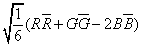 | 1 | 0 | 0 | 1979 |
| graviton | 0 | 0 | none | 2 | 0 | 0 | not yet |
| Higgs particle | 125.3 ± 0.6 GeV | 0 | none | 0 | 0 | 0 | 2012 |
In addition to these particles, there are four forces.
Electromagnetism, mediated by the photon, relative strength — 10
Weak force, mediated by the W+, W+, Z, relative strength — 10^-2
Strong force, mediated by eight gluons, relative strength — 10^-3
Gravity, mediated by the graviton, relative strength — 10^-40
All particles are both particles and waves. When physicists use the word “particle”, they mean a subatomic entity that sometimes manifests itself as a particle and other times manifests itself as a wave. This is another example of a concept in physics that the public misunderstands very badly. The average person is under the mistaken impression that a particle goes back and forth between being similar to a baseball and similar to ocean waves. In reality, it is never similar to either a baseball or ocean waves. It is a subatomic entity totally unlike anything in the macroscopic environment. In some circumstances, it is best approximated by the same mathematics that we also use to describe a particle, and under different circumstances, it is best approximated using the same mathematics that we also use to describe a wave. This is another example of different physical systems being described by similar mathematics. In reality, it never similar to what the average person envisions when they hear the word “particle” or what the average person envisions when they hear the word “wave”. This is another example of “borrowing only names from classical physics”. The fact that particles can appear as either particles or waves is called “particle-wave duality”. Let’s say you had a tank of water, with waves coming in from left to right, and they encounter a partition with two apertures. The waves on the other side form an interference pattern. In 1801, Thomas Young first performed the double-slit experiment to demonstrate the wave-like nature of light. The experiment, presented to the Royal Society in a paper titled “On the Theory of Light and Colours,” provided evidence that light behaved as a wave, refuting Isaac Newton’s particle theory. Albert Einstein received the Nobel Prize in 1921 for explaining the photoelectric effect by saying that light is particle.
You can observe both the particle and wave nature of any particle with the double slit experiment. Let’s say you have electrons passing through a double slit. If you do not check to see which slit the electron went through, the electrons act like waves, and you see the interference pattern.
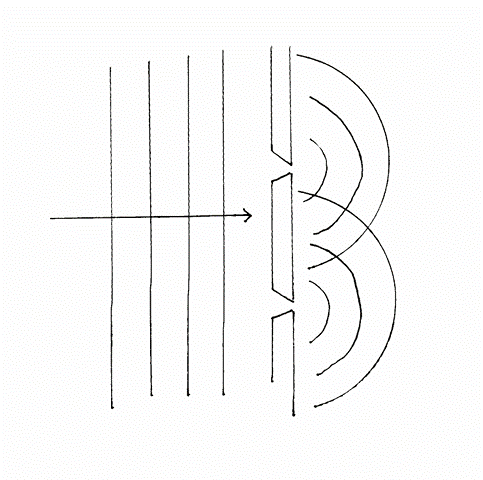
This is the same type of pattern you would see if you were using water or light. We use the wave nature of electrons in an electron microscope. Now, repeat the experiment, this time, checking to see which slit the electron goes through.
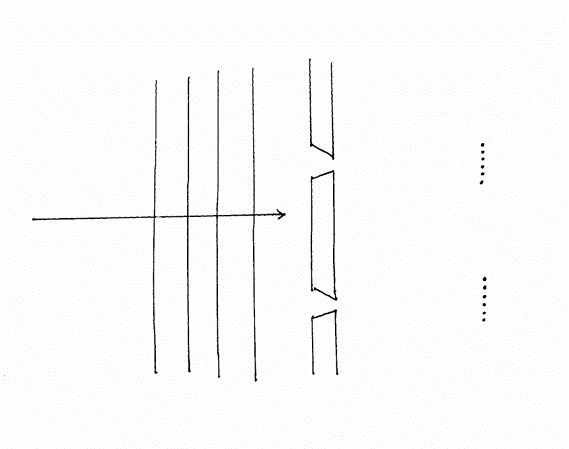
Now the electrons form a speckle pattern on the screen which is what you would expect to see if the electrons were particles, not waves, where each electron goes through only one of the slits. Choosing to observe a particle-like characteristic, such as which slit they pass through, causes them to act like particles. You can also think of particles as an excitation of a field. Ladder operators raise and lower the number of particles.
First they had the Schrödinger equation which is a partial differential equation that governs the wave function of a non-relativistic quantum-mechanical system.

[H hat]Ψ= EΨ
where [H hat] is the Hamiltonian operator, Ψ is the wavefunction, and E is the energy. This is the general time-dependent Schrodinger equation.

i[h bar]∂ₜΨ(r, t) = [H hat]Ψ(r, t)
This is the time-dependent Schrodinger equation for a single particle.

i[h bar]∂ₜΨ(r, t) = [(-[h bar]²/2μ)∇² + V(r, t)]Ψ(r, t)
Quantum mechanics combined with special relativity is quantum field theory. The Klein–Gordon equation was first considered as a quantum wave equation by Erwin Schrödinger in his search for an equation describing de Broglie waves. This is the Klein Gordan equation.

([d’Alembertian] + m²)ɸ = 0
Here is another way of writing down the Klein-Gordan equation.
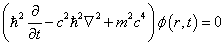
([h bar]²∂ₜ²— c²[h bar]² + (m²)(c⁴))ɸ(r, t) = 0
Then, after that, you had the Dirac equation developed by Paul A. M. Dirac in 1928. The Dirac equation is a fundamental relativistic wave equation that combines quantum mechanics and special relativity to describe spin-1/2 particles like electrons. It accounts for the electron’s intrinsic spin, predicts the existence of antimatter (specifically, the positron), and provides the theoretical foundation for quantum electrodynamics (QED). It is a first-order differential equation in both time and space, unlike the Schrödinger equation, which is first-order in time but second-order in space.
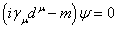
(iɣ_μd^μ— m)Ψ = 0
where is the imaginary unit, ɣ_μ are the Pauli spin matrices, d^μ is the derivative in four dimensions, m is the fermion mass, and Ψ is the wave function.
Here are other ways of writing down the Dirac equation.
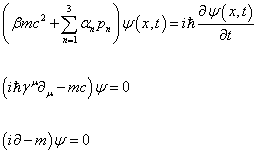
(βmc² + c[ ∑ over n from 1 to S](α_n)(p_n))Ψ(x, t) = i[h bar]∂ₜΨ(x, t)
(i[h bar]ɣ^μ∂_μ] — mc) Ψ= 0
(i[partial derivative slash] — m)Ψ = 0
Paul A. M. Dirac held the same Lucasian chair at Cambridge had previously been held by Isaac Newton, and later by Stephen Hawing. Paul A. M. Dirac was also the grandfather of Olivia Newton John, which is why her middle name is “Newton”. Olivia Newton John wrote a song named “Xanadu” which is now a lake on Titan, which was discovered by the Cassini probe to Saturn, which was named after Christiaan Huygens. Isaac Newton and Christiaan Huygens respected each other and met in person in 1689, but they had significant disagreements, particularly regarding Newton’s corpuscular (particle) theory of light, which Huygens opposed in favor of his own wave theory of light. Huygens’ scientific ideas were influential but initially overshadowed by Newton’s reputation, with his wave theory not gaining full acceptance for over a century. Thomas Young proved that light was a wave with the double slit experiment in 1801, and Einstein proved that light was also a particle to explain the photoelectric effect in 1905. On Star Trek, the character of Data also held the Lucasian chair at Cambridge, after having played poker with two previous holders of the chair, Isaac Newton and Stephen Hawking, as well as Albert Einstein, who never held the chair. During the poker scene, Stephen Hawking played himself. I myself met Stephen Hawking at a physics conference at UC Davis in 2003, along with other famous physicists, such as Lenny Susskind, Alan Guth, Andrei Linde, Martin Rees, and Jim Peebles. When I was with those famous physicists, I never imagined in my wildest dreams that one week later, child molesters would break into my house and ransack it, looking for something to masturbate to. The notes I took during that physics conference were in a red spiral physics notebook that was stolen by the child molesters the first time they ransacked my house looking for something they would enjoy masturbating to, 22 years ago, on April 1, 2003. The child molesters later returned the physics notebook, but I was baffled and perplexed why the letter they included with the physics notebook referred to me using the word “suspect”. Another question is, on Star Trek, why did they not mention Paul A. M. Dirac when listing previous holders of the Lucasian chair, when revealing that Data held the same chair? Is it because the writers never heard of Paul A. M. Dirac who is a famous physicist?
The Dirac equation, applied to electrons, predicted negative energy states, which at the time was inexplicable. These negative energy states would manifest themselves as positively charged particles. Initially, Paul A. M. Dirac tried to identify these with protons, the only positively charged particle then known, but they knew that could not be right because the equation predicted they should be the same mass as the electron, and the proton was much more massive.
These new particles were, in fact, positrons which are the antimatter counterpart of electrons. Therefore, the Dirac equation predicted the existence of antimatter. They discovered positrons in cloud chambers where the tracks were bending the other way than what you would expect for electrons. Carl Anderson received the 1932 Nobel Prize for detecting antimatter. Today we can create positrons, antiprotons, combine them to form antihydrogen, measure its spectra, and compare its spectra to that of hydrogen. So far, we have found no difference between the spectra of hydrogen and antihydrogen. This is one of the experiments they have done at TRIUMF, which is on the campus of UBC. I know Makoto Fujiwara at TRUMF who studies antihydrogen. I am often stunned to hear people ask whether we have detected antimatter. I remember reading an interview that a journalist did with a physicist at TRIUMF where the journalist was surprised to learn that antimatter was real.
Energy can kick an electron from a lower energy state to a higher energy state in an atom. Paul A. M. Dirac suggested that there were an infinite number of levels below the lowest energy level of an atom, and these lower energy levels were all filled. Energy can kick an electron out of one of these lower energy levels, leaving a hole behind, where the hole is the positron. He called this the “Dirac Sea”. We no longer take this literally the way he did. However, this is how we think of it in condensed matter or solid state physics, such as semiconductors, when we talk about electrons and holes.
Some particles are their own antiparticle. The photon, Z, Higgs, and graviton are their own antiparticle. We do not know whether neutrinos are “Majorana”, meaning are their own antiparticle. Maybe they are. Maybe they aren’t. We currently have experiments looking for neutrinoless double beta decay, or 0[nu][beta][beta], which can only happen if neutrinos are their own antiparticle.
When they first developed quantum field theory, part of the problem was that you had these infinities that did not make sense. Richard Feynman, Julian Schwinger, and Sin-Itiro Tomonaga shared the 1965 Nobel Prize in physics for independently discovering renormalization, which is a way for the infinities to cancel out. Richard Feynman invented Feynman diagrams which were a way to make the calculations easier.
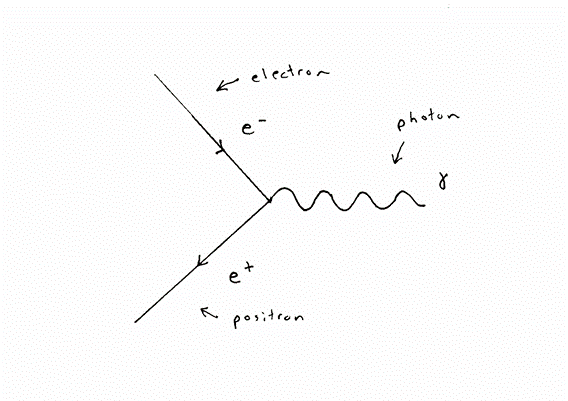
Because nothing can go faster than light, particles can not instantly affect each other from a distance. They interact by exchanging virtual particles. Electromagnetism works by the exchange of virtual photons.
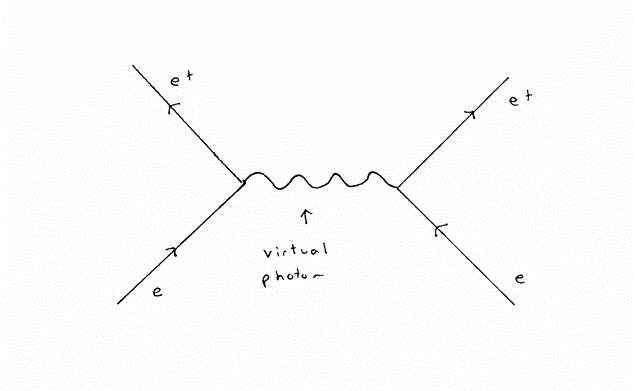
Feynman diagrams can be read in any direction. You can either think of the x axis as space and the y axis as time or the y axis as space and the x axis as time. Above is a simple diagram without any internal loops but you could have an infinite number of more complicated diagrams with more and more internal loops. Each diagram represents a different term in the S-matrix. The more terms you include, the better the approximation. You apply the Feynman rules to Feynman diagrams to calculate scattering amplitudes.
The following, which is about a different subject, was written later on loose sheets of paper which I put in the back of the writing tablet in the Hanford Jail. This is introducing the subject of polytopes.
0. Zero dimensions
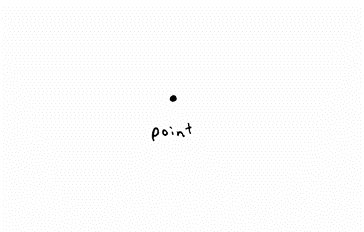
point
1. One dimension
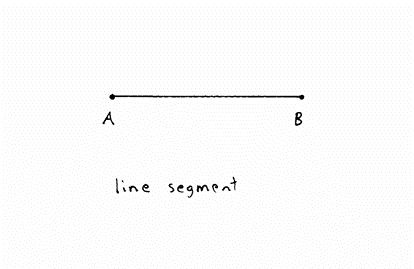
line segment
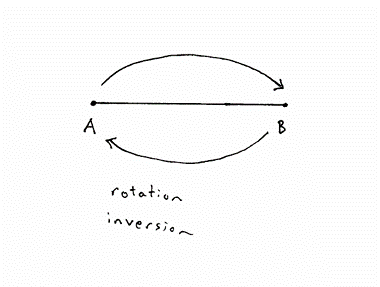
rotation, inversion
2. Two dimensions
Polygons — closed two dimensional figures
Irregular polygons
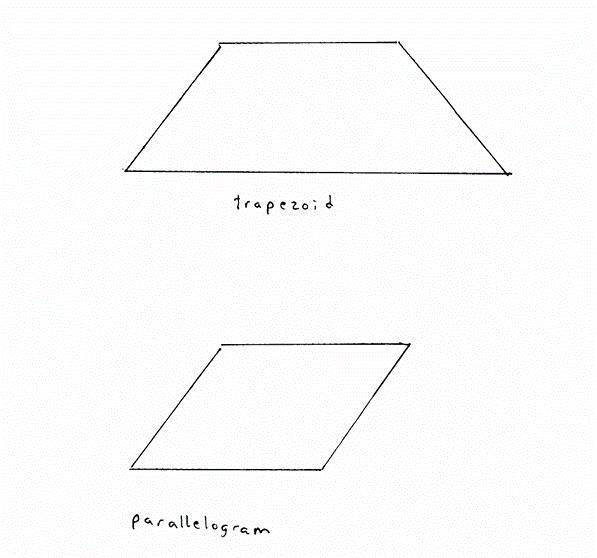
trapezoid
parallelogram
Regular polygons
Sides are all the same length.
All angles are the same.
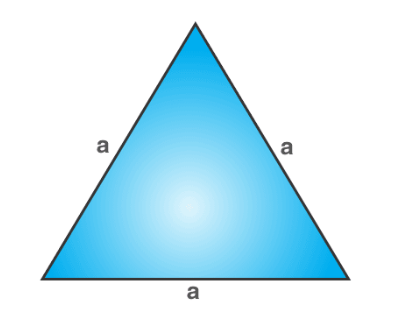
equilateral triangle
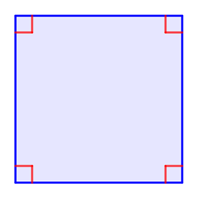
square
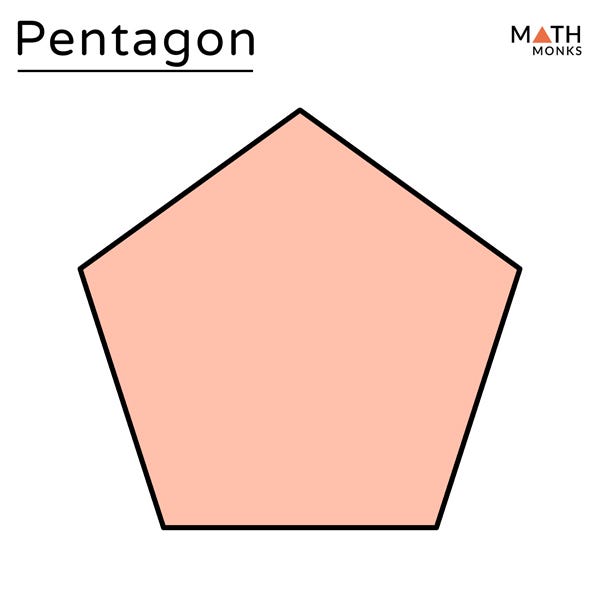
pentagon Press enter or click to view image in full size
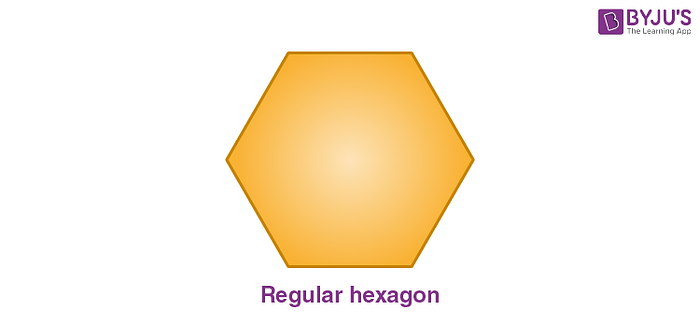
hexagon
They have symmetry groups based on rotations. A square can be rotated 90°, 180°, 270°, or 360° (the same as 0°) and look the same.
Tessellations — tiling
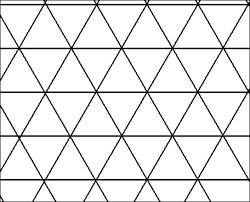
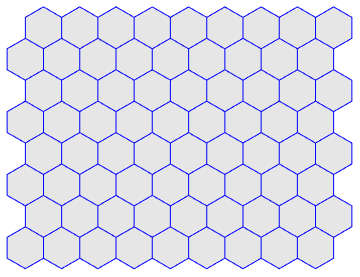
A tessellation is when the figure is repeated in a way that fills the space. In two dimensions, this is called a tiling. Only three regular polygons can form tiling. They are the equilateral triangle, the square, and the hexagon.
equilateral triangle — triangular lattice
square — grid

hexagon — honeycomb
Stellations
A stellation is formed by extending the sides until they meet. No polygon with under five sides can form a stellation.

pentagram

hexagram
Notice the first two stellations of regular polygons are religious symbols. The pentagram is a symbol of Wicca, where it’s called a “pentacle”, and is often portrayed within a circle. The hexagram is a symbol of Judaism, where it is called the “Star of David”, which was originally supposed to be an abstract diagram of sexual intercourse. A triangle pointing up symbolically represented the human male reproductive organ. A triangle pointing down symbolically represented the human female reproductive area.
Duality
The same polygon rotated
[insert diagram]
3. Three dimensions
Polyhedra
Regular polyhedra — Platonic solids
All faces are regular polygons.
All faces are the same.
All the angles are the same.
(1) Tetrahedron
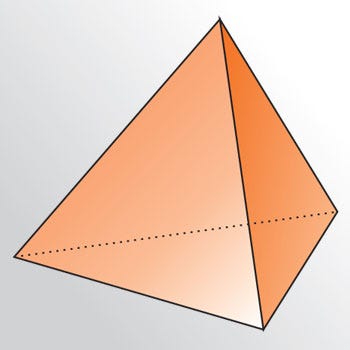
All faces are equilateral triangles.
Faces — 4
Vertices — 4
(2) Cube
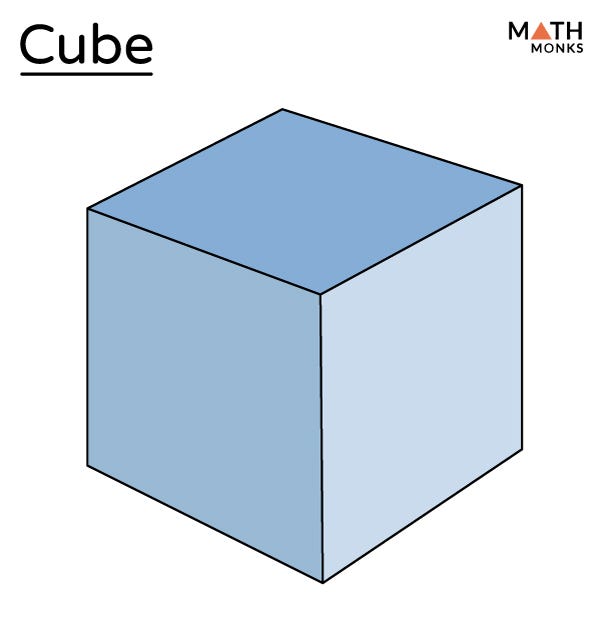
All faces are squares.
Faces — 6
Vertices — 8
(3) Octahedron
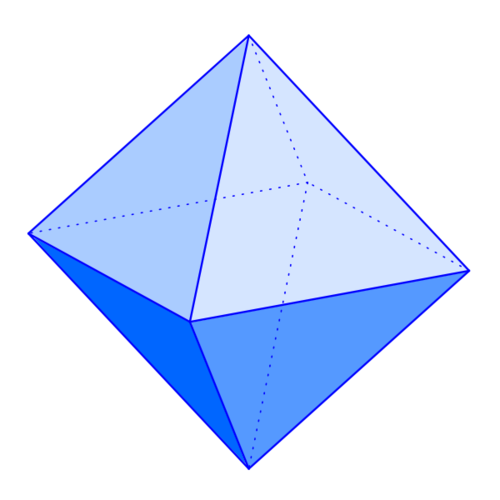
All faces are equilateral triangles.
Faces — 8
Vertices — 6
(4) Dodecahedron
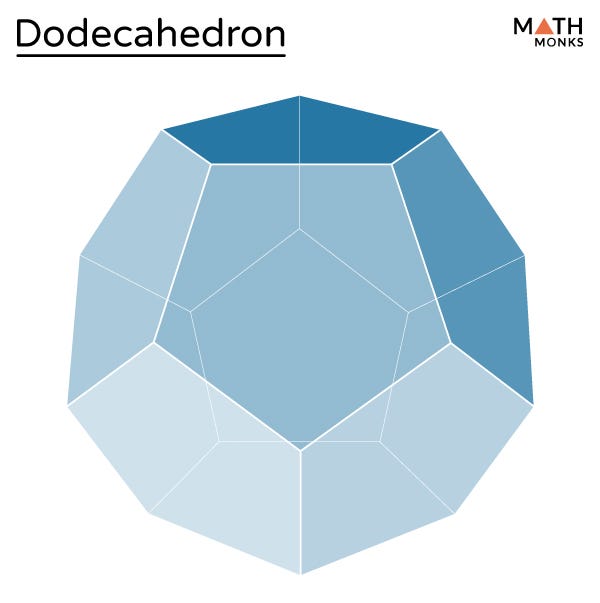
All faces are pentagons.
Faces — 12
Vertices — 12
(5) Icosahedron
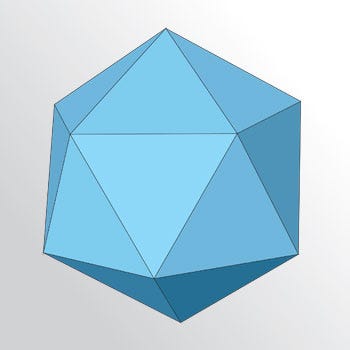
All faces are equilateral triangles.
Faces — 20
Vertices — 12
Tessellations
Cubical Lattice
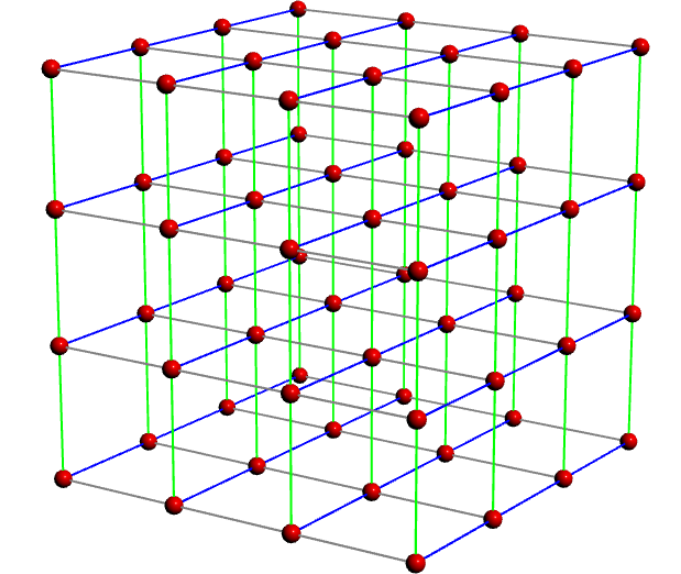
Stellations
Small Stellated Dodecahedron
Great Stellated Dodecahedron
Ninth Stellation of an Icosahedron
Duality
[insert table]
A dual of a polyhedron is where you replace the faces with vertices, and the vertices with faces.
Look at the cube and octahedron. See how the cube has a square on the top and bottom, and four around the sides. An octahedron has a point on the top and bottom, and four around the sides.
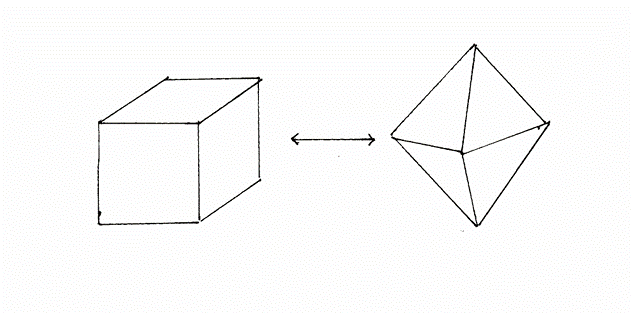
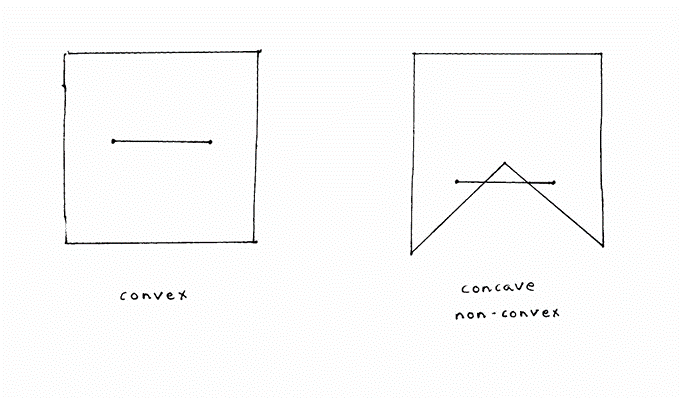
A polygon or polyhedron is convex if a line segment connecting two points in the interior is entirely within the interior, and concave or non-convex otherwise.
The non-convex version of the Platonic solids are the Kepler-Poinsot Polyhedra. Kepler-Poinsot polyhedra are a family of four regular, non-convex (self-intersecting) polyhedra. Unlike the convex Platonic solids, these four solids use star polygons (like pentagrams) or allow for faces to intersect each other. The four Kepler-Poinsot polyhedra are the small stellated dodecahedron, the great stellated dodecahedron, the great dodecahedron, and the great icosahedron.
The Archimedean solids are a special group of 13 semi-regular polyhedrons. They have a high degree of symmetry. A polyhedron is a geometric solid whose faces are each flat polygons. In an Archimedean solid, the faces are regular polygons — that is, their sides are all of equal length.
There are 13 different Archimedean solids, plus two infinite families.
Cuboctahedron
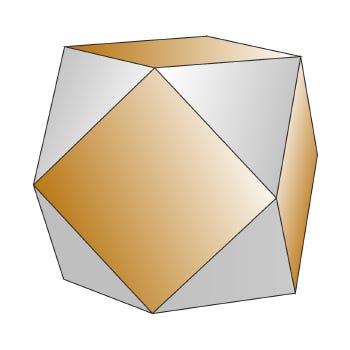
Faces — 6 squares + 8 triangles = 14 faces
Icosidodecahedron Press enter or click to view image in full size
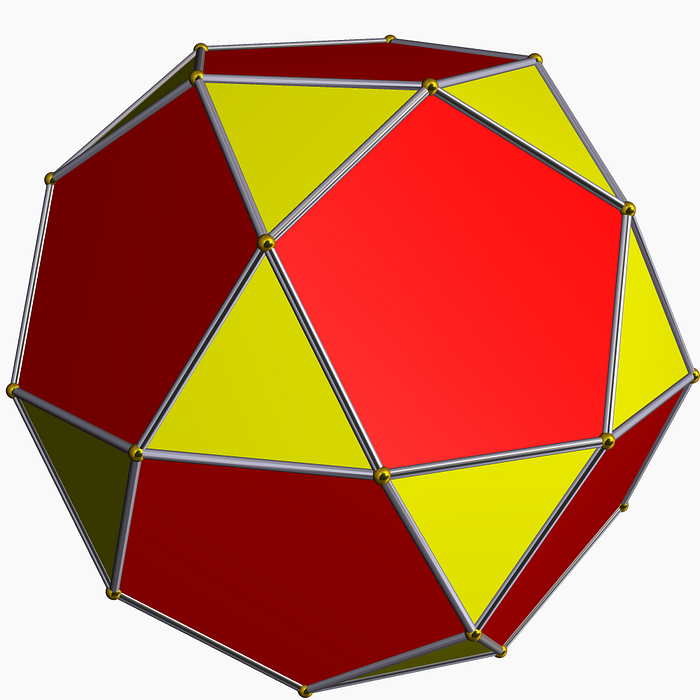
Faces — 12 pentagons + 20 triangles = 32 faces
Catalan solids are polyhedra that are the dual polyhedra to the Archimedean solids. Each Catalan solid is characterized by having identical faces (making them isohedral), faces that are not necessarily regular polygons, and a constant dihedral angle between any two adjacent faces. There are 13 Catalan solids, named after the Belgian mathematician Eugène Catalan who first described them in 1865.
Rhombic Dodecahedron
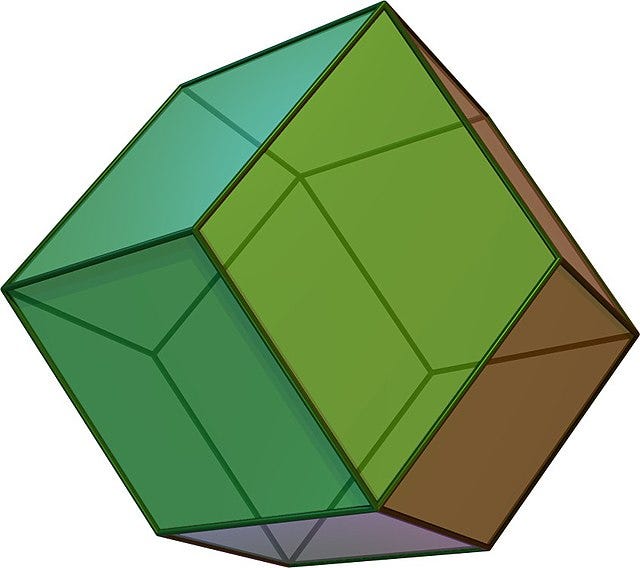
Faces — 12 rhombuses
Triacontahedron
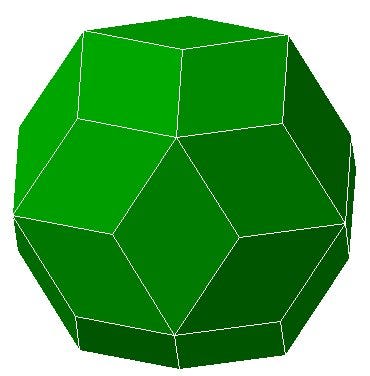
Faces — 30 rhombuses
The first time I was falsely accused, which was over 20 years ago, I was teaching physics to other inmates in the Fresno Jail and minimum security federal prison. When I first arrived in the Hanford Jail 21 months ago [at the time I wrote this], I thought I might do the same thing here. The thing is there are normal people in minimum security federal prison. There was even one normal guy interested in learning physics in the Fresno Jail. There are no normal people in the Hanford Jail. Shortly after I arrived in the Hanford Jail, I wrote my book “Introduction to Physics” to try to introduce physics concepts to members of the public who are interested in science but have no background in science. I gave it to two different inmates to read, whom I thought would be interested and who would be capable of understanding it but they only read the beginning before giving up. The second guy believed in UFOs and let me read his book “The Day After Roswell”. Then later there was a third guy who was very enthusiastic about learning science. Talking about me, he said, “He’s my science guy”. I asked him what he was most interested in learning, and he said, “Newton’s Law”. Another time, he said, “I’m really good at engineering”. Now you might think at this point, I would give him the book I wrote in the Hanford Jail titled “Introduction to Physics” to read. However I never gave it to him because I could sense he was to stupid to understand it. Before trying to teach him physics, I started off by testing his ability to do 7th grade math. Although it was not immediately obvious, it turned out that he was mentally retarded. He literally did not even know what the word “area” meant. The concept of an “area” did not exist inside his head. The concept of an “area” exists inside the heads of toddlers before they even know the word “area”.
When I was in the 7th grade, in Mr. Pettigrew’s math class, they would teach how to add two fractions with different denominators so I thought I would start with that. I gave him the following problem.
1.

2/3 + 1/4 =
So what you do is you find the lowest common denominator (LCD). You multiply the two denominators to find the lowest common denominator. You have to multiply the numerator and denominator by the same number to keep the value the same. That means that you multiply each numerator by the denominator of the other number. Once the two fractions have the same denominator, you just add the numerators.
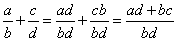
a/b + cd = ad/bd + cb/bd = (ad + cd)/bd
So let’s solve the above problem.

2/3 + 1/4 =
(2 × 4)/(3 × 4) + (1 × 3)/(3 × 4) =
8/12 + 3/12 = 11/12
You can also show this graphically. Press enter or click to view image in full size
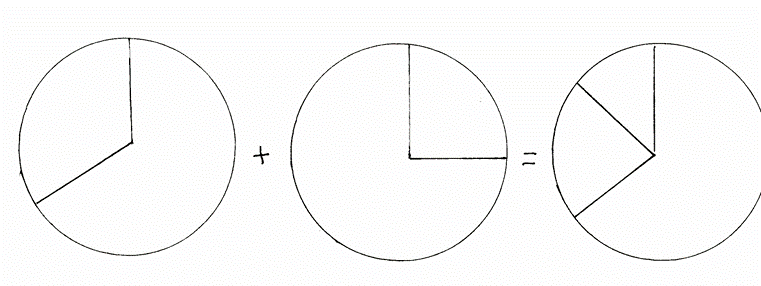
I gave the retard the following problem.
2/3 + 1/4
This is what he wrote.

2/3 + 1/4 = 7/7
Now 7/7 = 1 so he was only 1/12 off from the correct answer. Don’t give him any credit for that. What he was trying to do was add the two numerators, and then add the two denominator. Maybe he believed 2 + 1 = 7. Maybe he was trying to add 2 + 1 but even if he knew that 2 + 1 = 3, his small brain was so distracted by seeing the numbers 3 and 4 written on the page, that he ended up adding 3 and 4 twice. Anyway, what he meant to write was 3/7. He was assuming the following method of adding two fractions with different denominators.
a/b + c/d = (a + c)/(b + d)
Let’s say you take one half and add one fourth to it.

1/2 + 1/4 =
In this case, it is so obvious, it can be “solved by inspection”, which means you can see the answer right away. Clearly, the answer is 3/4. Let’s say you want to go through the whole song and dance.

1/2 + 1/4 =
(1 × 4)/(2 × 4) + (1 × 2)/(2 × 4) =
4/8 + 2/8 = 6/8 = 3/4 Press enter or click to view image in full size
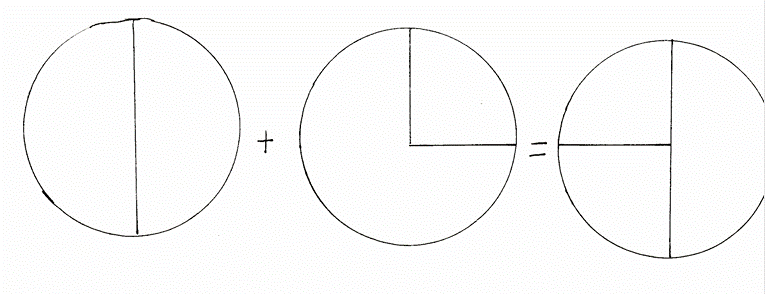
Now let’s say you were to use this guy’s method of adding two fractions.
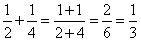
1/2 + 1/4 =
(1 + 1)/(2 + 4) = 2/6 = 1/3 Press enter or click to view image in full size
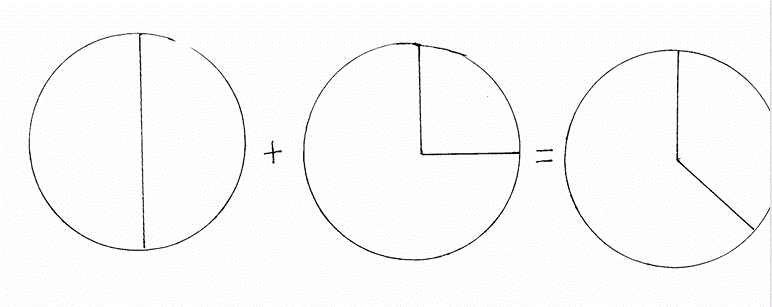
Therefore if you one half and added one fourth to it, you would get one third, which is smaller than one half. He believes that you took one half and added one fourth to it, the act of adding one fourth to it would make it smaller than it was before. He believes that adding two positive numbers results in a number smaller than one of the two numbers.
Then I gave him a very simple equation, similar to what you would have in a 7th grade math class.
2.

2x + 2 = 12
The goal of solving an equation is to get x by itself. For some equations, it is extremely difficult to get x by itself but for an equation like this, it is very easy. There are only two mathematical operations in this equation which are addition and multiplication. If an operation is performed on x, you negate it by doing the inverse operation. An inverse operation is actually doing the same operation to the inverse of one of the elements of a group. What we call “subtraction” is actually addition with a negative number. What we call “division” is actually multiplication with the reciprocal of a number. If you have a group where the binary operation is addition, the inverses of the elements are negatives. If you have a group where the binary operation is multiplication, the inverses are reciprocals. This is more than you need to know to solve the above simple equation. The above equation is so simple, it could also be “solved by inspection”. However, let’s show all the steps.
2x + 2 = 12
In order to get x by itself, we have to get rid of the second “2”. You do that by subtracting two from both sides. You have to always do the same thing to both sides of the equation to keep both sides equal.
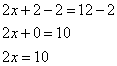
2x + 2 -2 = 12–2
2x + 0 = 10
2x = 10
Now in order to get x by itself, we have to get rid of the remaining “2”. If something is multiplied by two, you get rid of the remaining two by dividing by two. Remember that you have to do the same thing to both sides to keep both sides equal.

2x = 10
2x/2 = 10/2
x = 5
Therefore x equals 5. This was overkill for a very simple equation. There are other hugely more complicated equations with trigonometric functions, integrals, partial differential equations, or whatever.
Here is the equation with the correct solution.
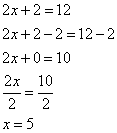
2x + 2 = 12
2x + 2–2 = 12–2
2x + 0 = 10
2x = 10
2x/2 = 10/2
x = 5
I gave this problem to the retard, and told him that the goal was to get x by itself, which he would not have known if I had not told him.
2x + 2 = 12
Then he just crossed out the two “2”s.
̶2̶x + ̶2̶= 12
Then he said, “It equals twelve”. In other words, he just crossed out the two twos, and then declared that x equals twelve. Let me show you the steps separately.
2x + 2 = 12
2x + ̶2̶= 12
2x = 12
̶2̶x = 12
x = 12
So this guy thought that the way you get x by itself meant just crossing out anything other than x. From his point of view, he successfully got x by itself, proving that his method works.
When are you allowed to take something out of an equation just by crossing it out? You are only allowed to do it when doing so does change the meaning or the values of the variables. That is only the case if the thing you are removing is the identity of the binary operation. The identity for addition is zero. The identity for multiplication is one. We used this ability in the correct solution when we took out the “+ 0” from the left hand side. Adding by zero does not change its meaning. Multiplying by 1 does not change its meaning. Therefore, crossing them out is not going to change the meaning of the equation. Let’s say you had the following equation.

1x + 0 = 12
In this case, you could just cross the one and the zero.
1x + 0 = 12
1x + ̶0̶= 12
1x = 12
̶1̶x = 12
x = 12
His method only works in this case because what you are crossing out does not change the meaning. Does this guy believe that adding two or multiplying by two does not change the meaning? If you had four apples and added zero apples, you would have the same number of apples you had before. Does this guy believe that if you had four apples and added two apples, that you would have the same number of apples that you had before?
When I was in the 7th grade, in Mr. Pettigrew’s math class, one of the things we would do is calculate the area of 2D geometric figures. For example, the area of a circle is A = [pi]r². We would calculate the volume of 3D figures. That’s the sort of thing you would do in a 7th grade math class. I gave this guy the following simple problem.
3.
Find the area of the triangle. Press enter or click to view image in full size
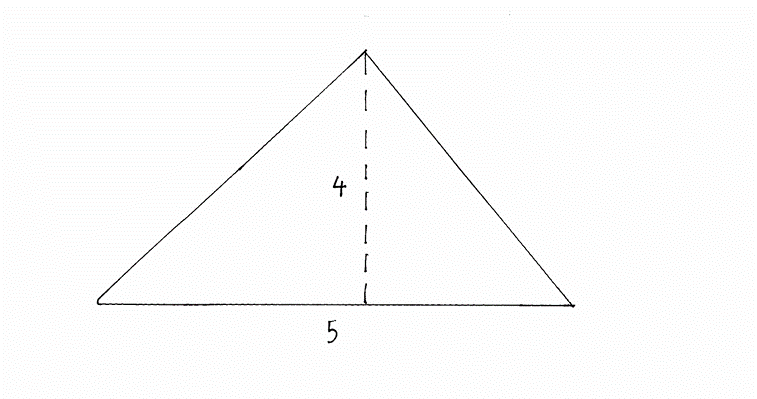
The area of a triangle is half the base times the height. Press enter or click to view image in full size
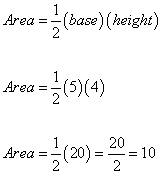
Area = (1/2)(base)(height)
Area = (1/2)(5)(4)
Area = (1/2)(20)
Area = 20/2 = 10
Therefore, the area is 10.
Even if nobody told you that the area of a triangle is half the base times the height, you could figure it on your own. You see that the area of a rectangle is the base times the height.
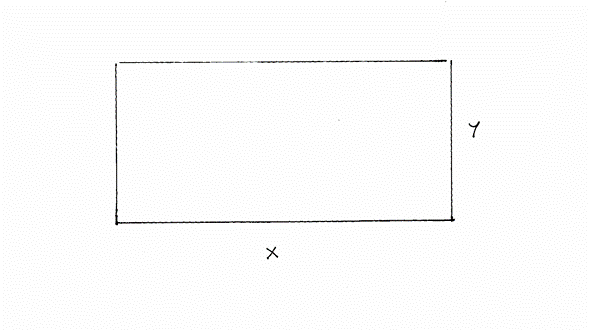
You see this would also have to be true for a parallelogram.
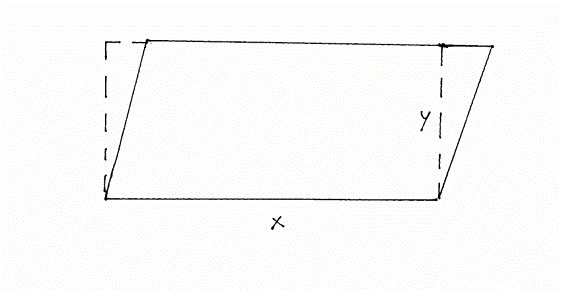
The extra piece on the right is identical to the extra piece on the left. Now if you cut a rectangle or parallelogram in half you get a triangle.
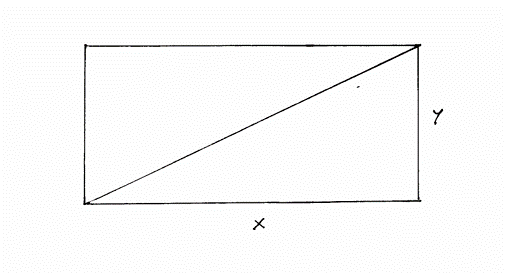
So that means that to calculate the area of a triangle you can calculate the area of the rectangle or the parallelogram that the triangle is half of, and then take half of that.
I gave the retard the following problem.
Find the area of the triangle. Press enter or click to view image in full size
Now at this point I am predicting that he would come up with some glaringly wrong method producing a bogus solution, such as 4 x 5 = 20. I was not prepared for what happened next. Despite all of the stupid stuff he said before that, I was totally caught off guard. He touched his pencil on the paper on the triangle, lifted it up, and put it back down, several times in a row. Then he wrote the following.
3
I said, “What?”
Then he said, “The answer is three”.
I said, “Why do you say three?”
Then he said, “It has three sides so the area is three”.
I was so flabbergasted, I didn’t know what to say.
The tables in the day room are shaped like this.
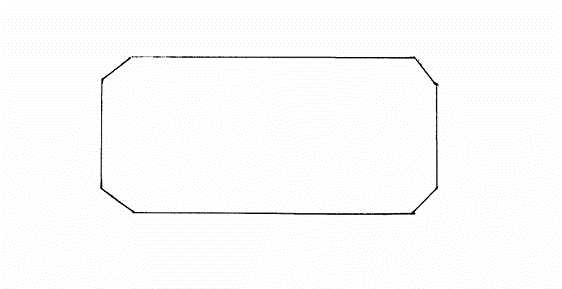
The top of the table looks like a rectangle with the corners cut off so it’s an irregular octagon. Then I asked, “What’s the area of this table”?
Then he said, “One, two, three, four, five…It has five sides so the area is five”.
Of course the table did not have five sides anyway. It had eight sides. He was to stupid to be able to count the sides of the table. He had no idea what the word “area” meant. He thought the word “area” meant “the number of sides”. Where the hell did the retard get the idea that the area was the number of sides? I’m sure that nobody else ever told him that. He just came up with this entirely on his own. He thinks that the following two triangles have the same area because they have the same number of sides, and therefore the same area.
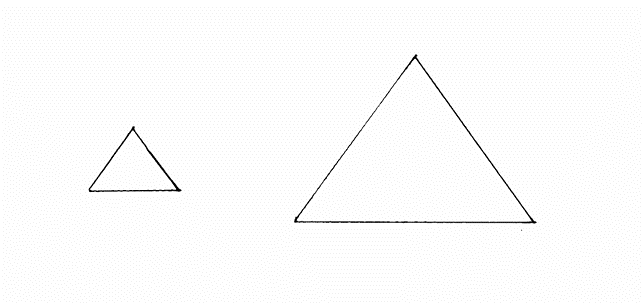
Of course, this guy did not have the slightest clue what the word “area” meant. Then I tried to tell him what an area is, and then I realized that it is very difficult to say what an area is without using the word “area” or limiting the definition to squares, rectangles, or parallelograms. If you define area as “length squared”, that’s true only for squares. If you define “area” as “x times y”, “length” times “width”, or “height times the base”, that’s only true for rectangles and parallelograms. How do you define the word “area” for a general closed 2D figure? I found myself groping for a definition by awkwardly stammering, “The area is the area of something, so when you measure the area of something, what you are measuring is called its area”. You try defining the word “area” for an arbitrary closed 2D figure without saying the word “area”. It’s almost impossible. The reason why it is so difficult is because the concept of an area is self-evident. Every preschooler knows what the word “area” means. Every toddler has to the concept of an “area” inside their brain even before they know the word. Then let’s you find an adult man who is so stupid that he doesn’t know what an area is. How do you tell him what is? The fact is that normally you never have to do this because all English speakers learn the word “area” when they first learn to talk. The word “area” is one of those words that toddlers learn when they first learn to talk. Nobody has to tell you what it means. You just intuitively know what it means when you learn to talk.
It’s more stupid than that. When toddlers first learn to talk, the word “area” is attached to a concept that was already in their head before they learned to talk. A two year old looking at the small rug on the floor on their bedroom, has in their brain an intuitive understanding on the concept of the size of the rug, that a flat thing could be bigger or smaller than something else, so the concept of measuring or comparing the two-dimensional size of something exists in their brain before they even learn the word “area”. Later, when they are in school, their teacher might tell them that the area of a rectangle is the “length times the width” or the “height times the base”. However, the teacher is assuming that the child already knows what the word “area” means. The teacher is telling the child how to find the area, but it would never cross the mind of the teacher that they needed to tell the child what the word “area” meant. Later a mathematician could define it more precisely, and more generally, using calculus to define the area under an arbitrary curve. However, you don’t have to know calculus to know what the word “area” means. A child does not even have to know multiplication to know what the area of a rectangle is. Here I was talking to an adult man who had absolutely zero clue what the word “area” meant, and where the very concept of “area” did not exist inside his brain. Someone with Down’s Syndrome knows what an area is but this guy did not have Down’s Syndrome. How did this guy get so far in his life without knowing what an “area” is? I was flabbergasted that there could exist an adult man, for whom English was his first language, who did not know what the word “area” meant, and flummoxed as to how to explain it to him. Then, at this point, all of a sudden, he said the following.
“I’m really good at engineering.”
This was the fourth and last problem.
4.
Find the hypotenuse.
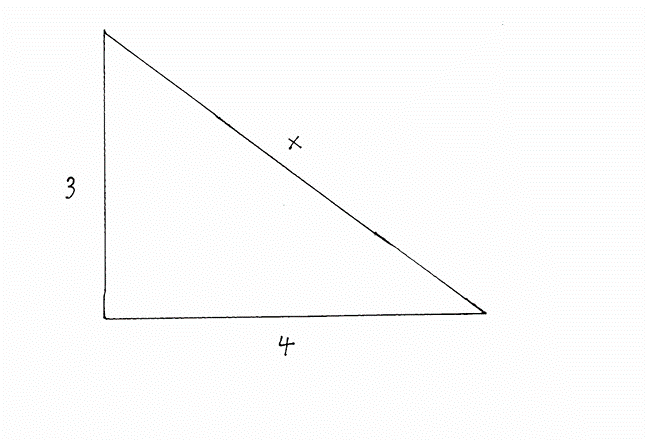
You would not do this in 7th grade. You would do this during Freshman Year of high school, so this is the most advanced of the four problems. You would use the Pythagorean theorem.
a² + b² = c²
c² = a² + b²
c = √(a² + b²)
c = √((3)² + (4)²)
c = √(9 + 16)
c = √25
c = 5
The Pythagorean theorem is attributed to Pythagoras of Samos (c. 570 — c. 496 BC) who was an Ionian Greek philosopher and mathematician. He did not discover it. The Ancient Egyptians used it. They would actually use this very math problem, which I’m calling “problem 4”, to create a right triangle. They would take a rope, tie 12 equally spaced knots into it, and then tie it into a loop. They would then shape it into a triangle, with three knots on one side, four knots on another side, and five knots on the last side. Such a triangle is necessarily a right triangle. You can take the Pythagorean theorem, and generalize it in different directions. One generalization of the Pythagorean theorem is Fermat’s Last Theorem. Fermat’s Last Theorem states that there are no three positive integers a, b, and c that satisfy the equation aⁿ + bⁿ = cⁿ for any integer n greater than 2. First proposed by Pierre de Fermat in 1637, the theorem remained unproven for over 350 years until Andrew Wiles completed the proof in 1994. The simple statement of the theorem, compared to the immense difficulty of its proof, made it a famous challenge in mathematics.
In Ancient Greece, the Pythagorean theorem led to the discovery of irrational numbers. Let’s say a = b =1.
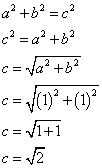
a² + b² = c²
c = √(a² + b²)
c = √((1)² + (1)²)
c = √(1 + 1)
c = √2
The Ancient Greeks tried to measure the diagonal of a square, and they realized there was no such number, according to the way they defined numbers, so they had to expand the very concept of number. We have been continuing the process ever since with the invention of zero, negative numbers, complex numbers, quaternions, octonions, matrices, vectors, and tensors.
In Newtonian mechanics, you can only find the distance between two points at the same time.
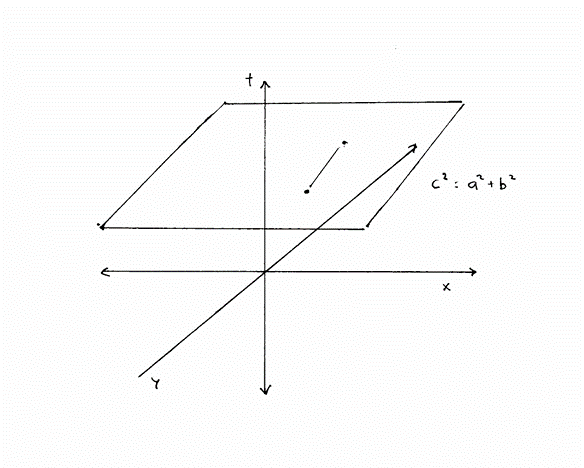
In special relativity, space and time are combined into one thing called spacetime so you can talk about the analog of distance for two points located at two different points in spacetime.
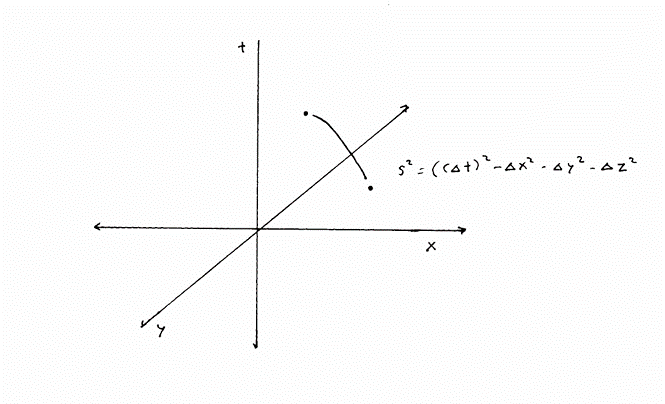
To find the “distance” between two events in spacetime, you calculate the spacetime interval using a modified Pythagorean theorem, such as s² = (cΔt)² - (Δx)² - (Δy)² - (Δz)², where c is the speed of light, Δt is the time difference, and Δx, Δy, Δz are the spatial differences between the two events. This invariant quantity, often called the spacetime interval, is not a physical distance in the same way as in everyday space but rather a measure of the causal connection or separation between events, with different types of intervals (timelike, spacelike, or null) indicating different physical relationships.
Steps to Calculate the Spacetime Interval
- 1. Identify the two events:
- These are points in spacetime with four coordinates, typically represented as (x, y, z, t) or (x, y, z, ct).
- 2. Calculate the differences in coordinates:
- Find the differences for each coordinate between the two events:
Δx = x₂ - x₁Δy = y₂ - y₁Δz = z₂ - z₁Δt = t₂ - t₁
- 3. Use the spacetime interval formula:
- Substitute these differences into the formula. For a standard Minkowski spacetime, this is:
s² = (cΔt)² - (Δx)² - (Δy)² - (Δz)²- Where
cis the speed of light.
- 4. Interpret the result:
- Timelike interval (
s² > 0): The events can be causally connected; a signal traveling at or below the speed of light could go from one to the other. - Spacelike interval (
s² < 0): The events are too far apart in space and too close in time for a causal connection. - Null (or lightlike) interval (
s² = 0): The events are connected by a light signal, meaning a light ray could travel from one to the other.
Notice that the time coordinate has the opposite sign than the spatial coordinates. You can then write down the metric for different kinds of spacetime. You could write down the metric for de Sitter space, anti-de Sitter space, or more exotic things. You could think of all of these as generalizations of the Pythagorean theorem.
You can’t mention Pythagoras without saying that he inspired a mystical cult that remained popular for centuries. These mystical Eastern cults were very popular, and other one that became even more popular was Christianity. The mystical numerology of the Pythagoreans has not disappeared, and you can still find it in New Age religion,
So here is the fourth problem.
Find the hypotenuse.
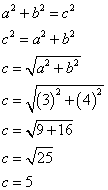
a² + b² = c²
c² = a² + b²
c = √(a² + b²)
c = √((3)² + (4)²)
c = √(9 + 16)
c = √25
c = 5
I gave the problem to the retard, and the retard wrote the following.
12
I said “Why?”, and he said, “Because three times four is twelve.”
The retard wrote this on the diagram.
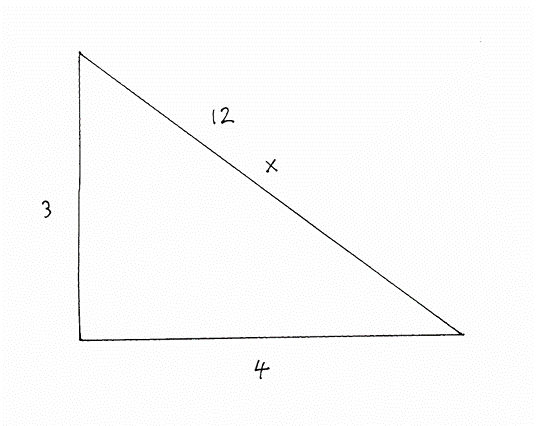
I said, “Why?” and he answered,
“Because three times four is twelve”.
If the base is four units long, and the height is three units long, without measuring it, just looking at it with your eyes, does it look like the hypotenuse could possibly be twelve units long? Press enter or click to view image in full size
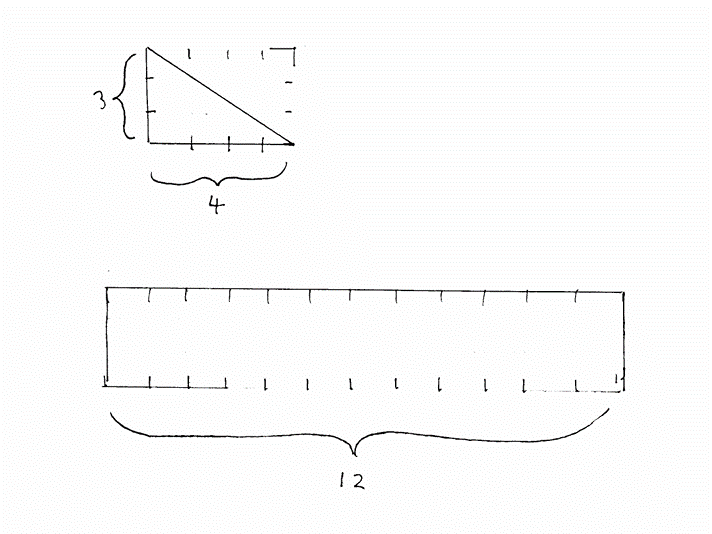
Even if you are not using graph paper, it should be obvious that there is no way that the hypotenuse could possibly be twelve units long.
How is it possible that this guy believed that the third side was twelve units long? Why did he decide that you get the answer by multiplying them, instead of adding, subtracting, or dividing them?
Normally, if you gave a math problem to someone, and they didn’t know how to do it, they would say that they did not know how to do it. This guy never said that he didn’t know how to do it. Instead he would just make up something, and then believe that’s how you get the answer.
Earlier, I was trying to teach him about polygons and polyhedra because that’s something you can really introduce to anybody, even if they have no background in science or math, and you can go as basic as you want, or as advanced as you want. Also, it is visual and has beautiful shapes, so it appeals to the general public. At one point, I mentioned the Platonic solids, and he suddenly shouted the following.
“Because they are made of plutonium! Have you ever been the Auditorium? If you look at the sidewalk, you see little black things! That’s plutonium! It’s worth millions!”
He said this just because the word “Platonic” sounds similar to the word “plutonium”.
Another time, there was a different inmate in my cell named Arthur, and we had the following conversation.
Him: “Scientists are finding more and more evidence for God.”
Me: “What the hell are you talking about?”
Him: “Scientists say that a cell has so many small parts that it could not have evolved”.
Me: “Who says that?”
Him: “Scientists”
Me: “There is not a single scientist who says anything remotely like that.”
Him: “Except that there is.”
Me: “There is not a single scientist who says anything remotely like that.”
Him: “…oh…ok…”
When he said this, he was smirking. When he said this last thing, he had a knowing smile on his face as if he was humoring or patronizing an ignorant person.
In my discussion of the second question, I made reference to group theory so now I am going to say more about group theory. In mathematics, a group is an object with the following properties.
1. Binary Operation
A group has members A and B, and a binary operation
AB = C
such that C is guaranteed to also be a member.
2. Associativity
If you do the binary operation on a member, and then take the result and do the binary operation on a third member, you get the same answer as if you had done the binary operation on the second and third, and then took the result, and did the binary operation on the result and the first.
(AB) C = A(BC)
3. Identity
A group has a specific element called the “identity” where if you do the binary operation on an element and the identity, you just get the same element.
AI = IA = A
4. Inverses
Every element of a group has an inverse, also a member of the group where if you do the binary operation on a member of a group and its inverse, you get the identity. The identity is its own inverse. The identity is the only member for which that’s true.
AA⁻¹ = A⁻¹A = I
I = I⁻¹
5. Commutativity
When you do the binary operation, the order of the members does not matter.
AB = BA
The simplest possible group is the identity group which has only one member which is the identity. You could consider a group with three elements, where you have the identity, and then two other elements, which are inverses of each other. A group can be either finite or infinite. A group could be either discrete or continuous. Let’s consider some simple groups. The first is the positive and negative integers where the binary operation is addition. In addition to being a group, it is also a abelian group, so it obeys all five axioms.
1. Binary Operation
AB = C
3 + 4 = 7
Three, four, and seven are all integers,
1. Associativity
(AB)C = A(BC)
(3 + 4) + 5 = 3 + (4 + 5)
7 + 5 = 3 + 9
12 = 12
3. Identity
The identity for addition is zero.
AI = IA = A
3 + 0 = 0 + 3 = 3
4. Inverses
The inverse of a positive integer is a negative integer. The inverse of a negative integer is a positive integer. Of course, zero equals negative zero.
AA⁻¹ = A⁻¹A = I
3 + (-3) = (-3) + 3 = 0
0 = 0 = 0
I = I⁻¹
0 = -0
It is an abelian group so it obeys the commutative relation.
5. Commutativity
AB = BA
3 + 4 = 4 + 3
7 = 7
The second group that I am going to discuss is the rational numbers where the binary operation is multiplication. It is a abelian group so it obeys all five axioms.
1. Binary Operation
AB = C
3 × 4 = 12
Three, four, and twelve are all rational numbers.
2. Associativity
(AB)C = A(BC)
(3 × 4) × 5 = 3 × (4 × 5)
12 × 5 = 3 × 20
60 = 60
3. Identity
The identity for multiplication is one.
AI = IA = A
3 × 1 = 1 × 3 = 3
4. Inverses
The inverse of a number under multiplication is its reciprocal, meaning one divided by that number.
AA⁻¹ = A⁻¹A = I
3 x (1/3) = (1/3) x 3 = 1
3/3 = 3/3 = 1
1 = 1 = 1
Of course one equals one divided by one.
I = I⁻¹
1 = 1/1
It is an abelian group so it obeys the commutative relation.
AB = BA
3 × 4 = 4 × 3
12 = 12
Of course there are many other types of groups. For instance, there are groups of rotations. Let’s say you are rotating a three-dimensional object in three-dimensional space.
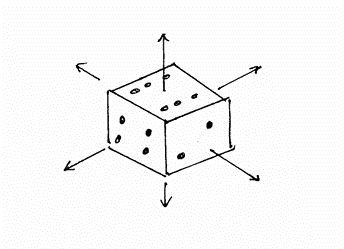
This is a nonabelian group because if you rotated about the x-axis and then rotated about the y-axis, it would look different than if you rotated about the y-axis, and then rotated about the x-axis.
The group of all rotations in three dimensions is called the Special Orthogonal Group, denoted as SO(3). This mathematical group consists of all 3×3 orthogonal matrices with a determinant of positive one, which represent transformations that preserve distances, angles, and the orientation (or “handedness”) of the 3D space. It is a mathematical group, meaning that its elements (the rotation matrices) can be combined through matrix multiplication, and there is an identity element (no rotation) and an inverse for each rotation.
You get different groups by considering groups of rotations within different types of mathematical space.
Groups of rotations within real space is called the special orthogonal group or SO(n), also called A_n.
Groups of rotations within complex space is called the special unitary group or SU(n), also called B_n.
Groups of rotations within quaternionic space is called the special sympletic group or Sp(n), also called C_n and D_n.
Groups of rotations within complex octonionic space is called E_6.
Groups of rotations within quaternionic octonionic space is called E_7
Groups of rotations within octooctionic space is called E_8.
We understand the last one, octooctionic space, less than the others so the E_8 group is somewhat mysterious while also being very important in advanced physics. You may have heard of the Heterotic string theory, which could be either of the following two groups: SO(32) or E_8 x E_8.
Before I introduced special relativity, so I want to say more about that. Let’s say you are on a moving train, and you throw a baseball vertically up in the air, and then catch it. First consider this from the reference frame of the train.
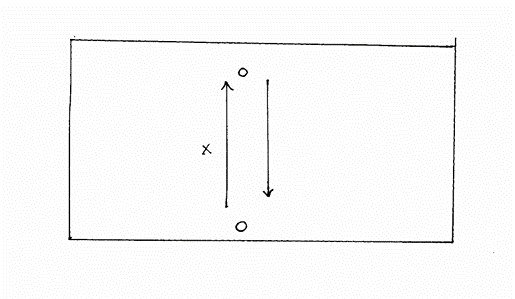
The velocity of the ball is the distance the ball travels divided by the length of time that it was traveling.

v = x/t
Now consider the same thing from the reference frame of someone standing on the ground, watching the train go by.
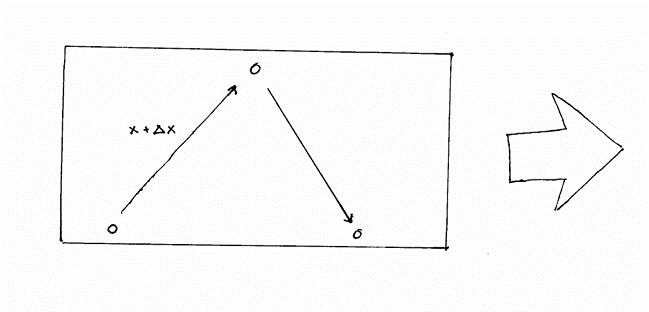

v = (x + 𝚫x)/t
The total distance that the ball is traveling is longer but the time that it’s in the air is the same, which means that the velocity must be higher.
Now consider the same thing except instead of throwing a baseball up in the air, you shine a flashlight directly up, and the light bounces off a mirror on the ceiling, and is reflected back down.

c = x/t
The velocity is necessarily the speed of light, c = 2.99792458 × 10⁸ m/s. Now consider the same thing from the reference frame of someone standing on the ground outside the train.

c = (x + 𝚫x)/(t + 𝚫t)
At first, you might think that it would be the same as the case with the baseball, and the velocity would be higher but then you remember that light can only travel at the invariant speed so the velocity has to be the same. If the velocity is the same, and the distance it travels is longer, that means that the amount of time that passes must be longer. If the numerator of the fraction is larger, then the denominator of the fraction must also be larger, in order for the fraction to still have the same value.
If the people on the ground outside the train are experiencing more time than people on the train, then from the point of view of people on the ground outside the train watching people on the train, it would appear to people on the ground outside the train, that the shorter interval of time experienced by people on the train is stretched to match the longer interval of time experienced by people on the ground outside the train, so it would appear that time on the train is slowed down from the point of view of people outside the train. Of course people on the train would not feel like time was slowed down. The reason why time appears to slow down on the train, from the point of view of people on the ground outside is because light always travels at the invariant speed, so if the numerator in the fraction is larger, the denominator must likewise be larger in order for the fraction to still have the same value.
Now imagine that you are on a train, and throw a baseball forward. What would be the velocity of the baseball from the point of view of someone standing on the ground outside?
Normally, you would just add the velocity of the baseball [Delta]v to the velocity of the train v, so it would be v + [Delta]v. However, what if the train was going very close to the speed of light, so adding the two velocities together would push it over the speed of light?
As the train’s speed increases toward the speed of light c, the classical rule of simply adding velocities no longer works. According to special relativity, the universe has a universal speed limit, c, which cannot be exceeded. To calculate the new velocity, the relativistic velocity addition formula must be used.

u = (v+ u’)/(1 + (vu’)/c²)
where
u is the final velocity of the baseball as measured by the observer on the ground.
v the velocity of the train relative to the ground observer.
u’ is the velocity of the baseball relative to the train.
c is the speed of light.
As the values of v and u’ get larger and closer to c, the denominator also increases. This effect prevents the resulting velocity u from ever exceeding c.
Let’s say you are halfway between two explosions, such as lightening strikes. The light from both of them would reach you simultaneously so you would say the two events were simultaneous.
Now imagine that the same thing happened while you are on a train moving from A to B. Press enter or click to view image in full size
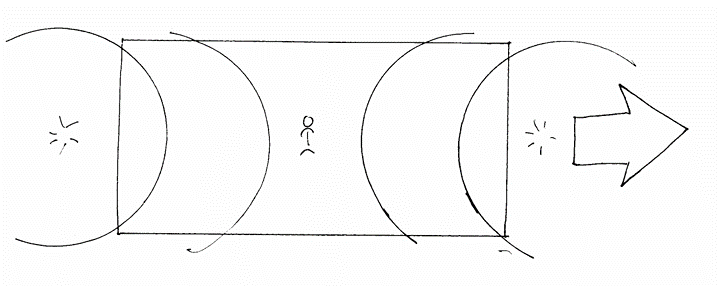
The light from B would reach you before the light from A reached you. You would say that B happened before A. Different observer will not in general agree as to whether two events were simultaneous. One of the two events could be a clock reading a certain time so different observers will not in general agree about what time an event occurred.
The lower case Greek letter gamma is used to represent the Lorentz factor.

ɣ = 1/√(1 — (v/c)²)
This is time dilation.

t = ɣt₀
This is length contraction.

L = L₀/ɣ
This is the relativistic mass.

m = ɣm₀
As you can see, if there is a reference frame moving faster than your reference frame, then from your reference frame, looking at the other reference frame, it would appear that time is slowing down in the other reference frame, that lengths are foreshortened in the direction of their motion, and their mass increases. As they approach the speed of light, time grinds to a halt, lengths shrink k to zero, and everything becomes infinitely massive, from your point of view, from the reference frame, watching the other reference frame that is moving relativistically from the point of view of your reference frame. Of course, from the point of view of people in the other reference frame, everything would appear perfectly normal when looking at themselves, and they would think that we were the ones experiencing the strange effects.
As v → 0, ɣ → 1, and it reduces to the rest frame.
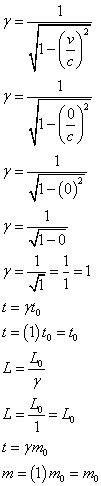
ɣ = 1/√((1 — (v/c)²)
ɣ = 1/√((1 — (0/c)²)
ɣ = 1/√((1 — (0)²)
ɣ = 1/√((1 — 0))
ɣ = 1/√1= 1/1 = 1
t = ɣt₀
t = (1)t₀ = t₀
L = L₀/ɣ
L = L₀/(1) = L₀
m = ɣm₀
m = (1)m₀ = m₀
As v → c, ɣ → ∞. Of course, a particle with mass can never go at a velocity of c, but you see what values these quantities approach.
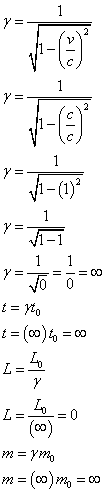
ɣ = 1/√(1 — (v/c)²)
ɣ = 1/√(1 — (c/c)²)
ɣ = 1/√((1 — (1)²)
ɣ = 1/√(1–1)
ɣ = 1/√0 = 1/0 = ∞
t = ɣt₀
t = (∞)t₀ = ∞
L = L₀/ɣ
L = L₀/(∞) = 0
m = ɣm₀
m = (∞)m₀ = ∞
Of course, no object with mass can ever go the speed of light so we are saying that it approaches these values as the velocity approaches the speed of light.
The reason why we don’t notice these relativistic effects in daily life is because the speeds of objects with mass that we encounter in daily life are much slower than the speed of light, which is 2.99792458 x 10⁸ m/s. At slow speeds, the speed might as well be effectively infinite. If you are never going to be close to the speed of light, then it is the same as being infinite in the sense that you are never going to be close to it in the same way that you are never going to be close to infinity. At slow speeds, the speed of light might as well be effectively infinite. Since the speed of light is effectively infinite compared to the slow speeds accurately described by classical mechanics, if you replace c with infinity in relativistic equations, it must reduce to classical physics. Special relativity would not be true if it did not accurate describe show speeds in addition to fast speeds!
As c → ∞, ɣ → 1, and it reduces to classical physics.
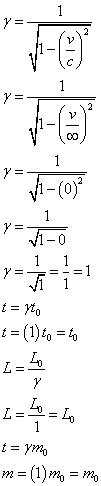
ɣ = 1/√1 — (v/c)²)
ɣ = 1/√(— (v/∞)²)
ɣ = 1/√(1 — (0)²)
ɣ = 1/√(1–0)
ɣ= 1/√1 = 1/1 = 1
t = ɣt₀
t = (1)t₀ = t₀
L = L₀/ɣ
L = L₀/(1) = L₀
m = ɣm₀
m = (1)m₀ = m₀
Actually, Aristotle erroneously believed that the speed of light was infinite which led him to accidentally stumble into the truth that there is no such thing as faster than light. The reason Aristotle believed that light traveled infinitely fast is because when at sunrise, the mountains on the western horizon were instantly illuminated. However, all that proves is that light travels faster than you can see. Actually, there was an Ancient Greek philosopher, not as famous or influential as Aristotle, who proposed light traveled at finite speed. Empedocles lived in the 5th Century B.C., in Sicily, and proposed that the world is made of four elements, earth, air, fire, and water. Two cosmic forces, Love (Philia) and Strife (Neikos), interact to bring elements together and separate them. The universe is in a cycle of eternal change, where Love combines the elements to form all beings and Strife separates them, a process that repeats endlessly. Empedocles proposed a finite speed for light, the survival of the fittest, and a concept related to the conservation of energy and chemical reactions. He developed theories on cosmic cycles, the transmigration of souls, and an early form of natural selection in his work “On Nature”. The fact that light traveled at finite speed The fact that light travels at finite speed was proven in 1676 by Danish astronomer Ole Rømer that light travels at a finite speed, rather than instantaneously. He observed variations in the timing of eclipses of Jupiter’s moon Io and concluded that these differences were due to the time light took to travel across Earth’s orbit, which depends on the distance between Earth and Jupiter. Rømer noticed that the observed times of Jupiter’s moon Io’s eclipses changed depending on whether Earth was moving away from or toward Jupiter. He realized this discrepancy was caused by the finite speed of light, as it took light longer to reach Earth when the planets were farther apart. It was not only a scientific interest that caused people to be paying such close attention to the moons of Jupiter through a telescope. Some people were hoping that it could be a solution to the longitude problem. The longitude problem was the centuries-old challenge of accurately determining a ship’s east-west position at sea, a problem that proved deadly for countless sailors during the age of exploration. The difficulty lay in the lack of a reliable method to tell time precisely on a moving ship. Looking at the moons of Jupiter was one of several astronomical solutions that were proposed but none were practical because it was very difficult to make astronomical observations on the swaying deck of a ship. The solution came through the invention of the marine chronometer by John Harrison, a mechanical clock that kept accurate time at sea, allowing for the calculation of longitude by comparing it to the time in a known location like Greenwich.
Up until now, we have been discussing special relativity. If you are inside a closed room, you can not tell if it is stationary or moving with a constant velocity in relation to the ground outside. These are called “inertial reference frames”, and are explained by special relativity. However, you would be able to tell if the room was accelerating. These are called “non-inertial reference frames”, and are described by a general relativity. Press enter or click to view image in full size
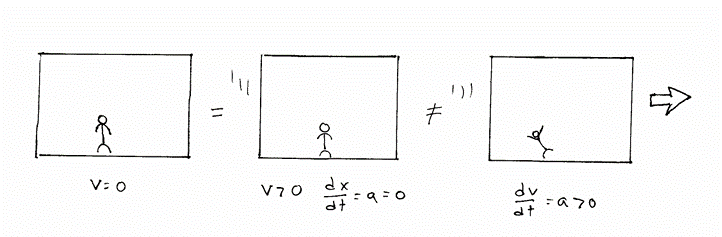
The main point of general relativity is that acceleration is the same thing as gravity. You could not tell if you were in a closed room on the surface of the Earth or in space accelerating at 9.8 m/s². Press enter or click to view image in full size
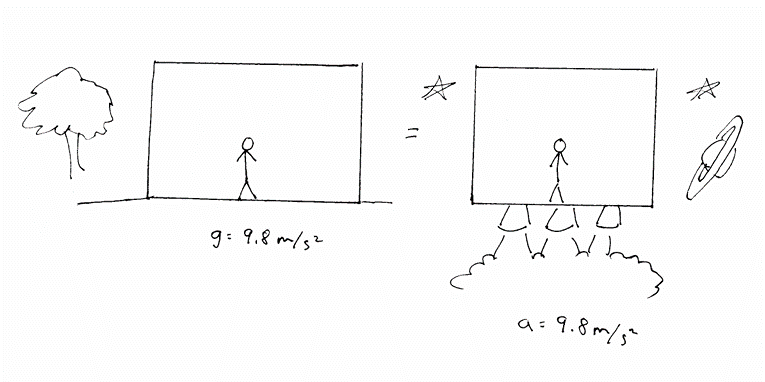
You would not be able to tell the difference if you were in a room that was in free fall, such as if you were in an elevator, and the cable snapped, or if the room was in space.
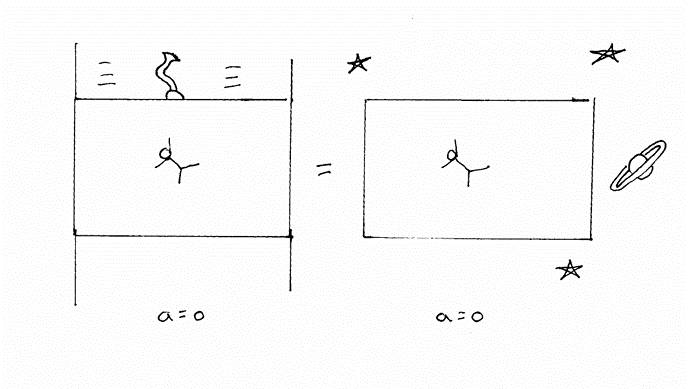
Often when explaining general relativity to the public, we use the rubber sheet analogy. This is just a metaphor. Please do not take this literally. Imagine you had a heavy ball resting on a taunt rubber sheet, and sort of weighs it down forming a depression. Then you roll a small ball across the sheet, which swings around the heavier ball. Press enter or click to view image in full size
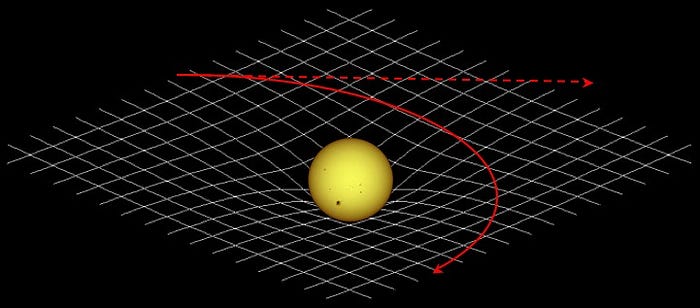
This is similar to what were to happen if a comet were to swing around the Sun, or an interplanetary probe were to swing around a planet. If you were pushing the small ball out of the depression, it would have to be going fast enough to climb out. This is analogous to escape velocity. The heavier the ball, the deeper the depression.
In every jail cell I was in, in both the Seattle Jail and the Hanford Jail, I wrote the following in one or two places on the walls. These are the Einstein Field Equations which are a set of ten non-linear partial differential equations published by Albert Einstein in 1915, which form the mathematical core of his General Theory of Relativity. These equations relate the distribution of mass and energy to the geometry of spacetime, explaining gravity not as a force but as the result of spacetime’s curvature. In simpler terms, they describe how matter and energy tell spacetime how to curve, and how that curved spacetime tells matter how to move.
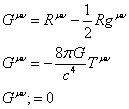
G^μν = (R^μν) — (1/2)R(g^μν)
G^μν = -(8πG)/(c⁴)T^μν
where the last is the Bianchi Identity, and
G^μν = Einstein tensor
R^μν = Ricci tensor
R = Ricci scalar
g^μν
G = Newton’s constant
c = speed of light
T^μν = energy momentum tensor
; = covariant derivative
I would not expect any other inmate placed in any of my former cells to understand these equations which I had previously written on the walls.
Earlier I discussed both conservation laws and Feynman diagrams. Next I will use Feynman Diagrams to illustrate conservation laws. You have heard of carbon dating. Earth’s atmosphere has a lot of nitrogen N₂. A nitrogen atom contains seven protons and seven neutrons. Sometimes one of the protons will turn into a neutron, so instead of seven protons and seven neutrons, you have six protons and eight neutrons, which means that it has turned into carbon-14. If you had a given amount of carbon-14, after 5730 years, half of it would remain. Plants take in carbon-14 as a small percentage of the CO₂ they take in. Animals eat the plants. Animals eat other animals. When they die, they stop taking in carbon-14. Then the carbon-14 in their remains will exponentially decay. You can use this to date things. This is called “radiocarbon dating”. Now earlier, I casually said, “Sometimes one of the protons will turn into a neutron”. How exactly does that happen? This is called “weak beta decay”. A proton is two up quarks and a down quark. A neutron is two down quarks and an up quark. If the up quark turns into a down quark, a proton will turn into a neutron. Because of conservation of charge, the positive charge of the proton has to “go somewhere” when it turns into a neutron, so it goes into a W+ boson which is emitted. The up quark decays into a down quark and a W+ boson, which then decays into an electron neutrino, e_ν, and a positron, e+.
Here you can see the Feynman diagram for weak beta decay. Here the Feynman diagrams are read from bottom to top, so imagine that the particles are entering from the bottom, and leaving through the top.
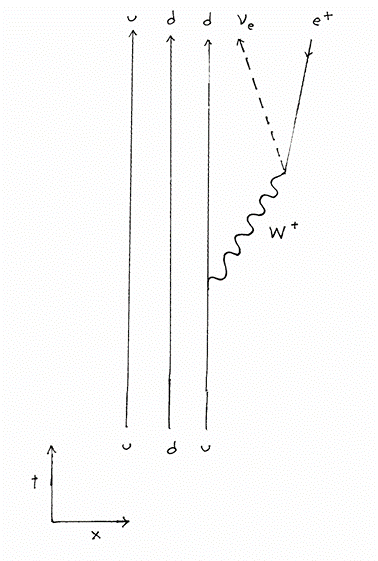
Now if you were to draw a horizontal line through any part of this diagram, and add up the quantum numbers of all the particles on the line, you will always get the same sums where ever you draw the horizontal line. This demonstrates that the quantum numbers are conserved. Here are the electric charge, baryon number, and lepton number for the particles in the above Feynman diagram.
[insert table]
Let’s draw a horizontal line at the beginning of the reaction at the bottom of the diagram.
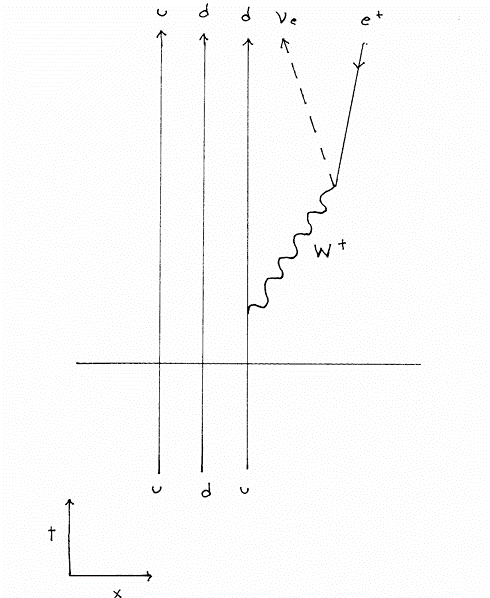
An up quark has an electric charge of +2/3
A down quark has an electric charge of -1/3.
electric charge
2/3 + 2/3 -1/3 = 4/3–1/3 = 1
All quarks have a baryon number of 1/3 and a lepton number of 0.
baryon number
1/3 + 1/3 + 1/3 = 1
lepton number
0 + 0 + 0 = 0
Let’s draw the horizontal line after the up quark decays into a down quark and a W+ boson.
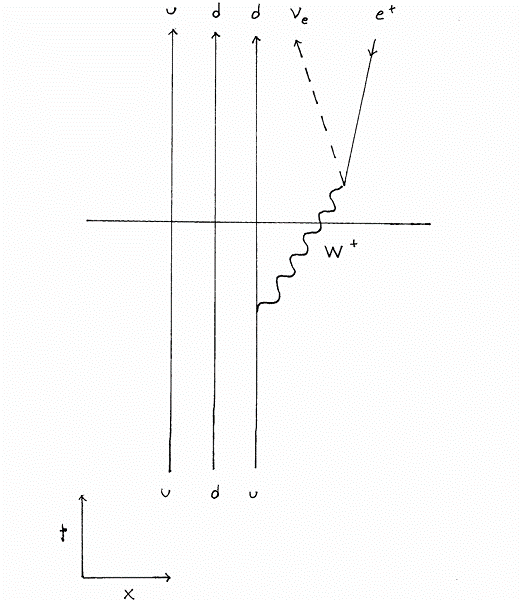
There are now four particles on the line. The W+ boson has an electric charge of +1, baryon number of 0, and lepton number of 0.
electric charge
2/3–1/3–1/3 + 1 = 2/3–2/3 + 1 = 0 + 1 = 1
baryon number
1/3 + 1/3 + 1/3 + 0 = 1
lepton number
0 + 0 + 0 + 0 = 0
Lastly, let’s draw the horizontal line after the W+ boson decays into an electron neutrino and a positron.
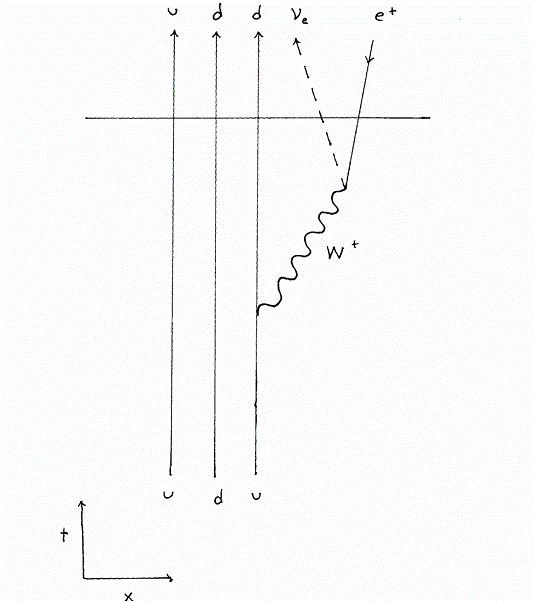
There are five particles in the final line. The two new particles are both leptons so they have a baryon number of zero. The positron is the antiparticle of an electron. Being an antiparticle, its quantum numbers have the opposite sign from the electron so its charge is +1, and its lepton number is -1. The electron neutrino has no electric charge,
electric charge
2/3–1/3–1/3 + 0 + 1 = 2/3–2/3 + 0 + 1 = 0 + 0 + 1 = 1
baryon number
1/3 + 1/3 + 1/3 + 0 + 0 = 1
lepton number
0 + 0 + 0 + 1–1 = 1–1 = 0
Notice that no matter where you draw the horizontal line, you always get the following sums.
electric charge = 1
baryon number = 1
lepton number = 0
This proves that these quantum numbers are conserved. This illustrates the concept of conservation laws.


Leave a comment