For Christmas 2025, I received the following books.
1. “A Brief History of Infinity: The Quest to Think the Unthinkable” by Brian Clegg
2. “The Soul of an Octopus: A Surprising Exploration into the Wonder of Consciousness” by Sy Montgomery
3. “A Colorful History of Popular Delusions” by Robert E. Bartholomew and Peter Hassall
4. “Princeton Guide to Advanced Physics” by Alan C. Tribble
5. “Falling Upwards: How We Took to the Air” by Richard Holmes
6. “Calabi-Yau Manifolds: A Bestiary for Physicists” by T. Hubsch
7. “Classical Electromagnetism: Third Edition” by John David Jackson
All of the books relate to science, but they can be grouped into two categories, which are technical “physics books” and “pop-sci books”.
Technical Physics Books
1. “Princeton Guide to Advanced Physics” by Alan C. Tribble
2. “Calabi-Yau Manifolds: A Bestiary for Physicists” by T. Hubsch
3. “Classical Electromagnetism: Third Edition” by John David Jackson
Pop-sci Books
1. “A Brief History of Infinity: The Quest to Think the Unthinkable” by Brian Clegg
2. “The Soul of an Octopus: A Surprising Exploration into the Wonder of Consciousness” by Sy Montgomery
3. “A Colorful History of Popular Delusions” by Robert E. Bartholomew and Peter Hassall
4. “Falling Upwards: How We Took to the Air” by Richard Holmes
All of the physics books were good. All of the pop-sci books were bad, some worse than others. The truth is the writers were the pop-sci books were mentally retarded. That does not mean that everything they said is wrong. A retard could say something that just happens to be correct. With my pre-existing knowledge of these subjects, I was able to tell what was correct and what was incorrect. These requires already having extensive knowledge of the subject to be able to differentiate between what’s plausible and what’s not plausible. The average person would not be able to do this so I would not recommend the average person read these books. I was able to read these books, and the inaccuracies and the author’s misundertstanding jumped out at me, and was a constant distraction, but nonetheless, I was able to learn some things I did not know before, so I do not regret reading these books. The average person would not be able to read the technical books. The average person would believe the nonsense in the pop-sci books. What the average person needs is a pop-sci book written by someone who knows what they are not talking about. These pop-sci writers did not know what they were talking about, and had very bad misunderstanding of very basic concepts. From my point of view, there were sections that were painful to read, where I would groan, sigh, or roll my eyes.
I am going to try to respond to some of the nonsense in these books.
Infinity: The Quest to Think the Unthinkable
by Brian Clegg
Robinson Publishing (2003)
I had first seen it in the UBC Bookstore. When I was in the bookstore, I was glacing at the beginning, and I read a paragraph about a child reciting positive integers, and ends with a blur of words, abd shouts “infinity!” Just based on that quick glance, I added the book to my list of books to eventually receive at Christmas. That was a mistake. Now, that I have started reading the book, I realize that the guy who wrote it was mentally retarded. Everything he believes is wrong. It’s not just wrong. It’s infinitely wrong. Every single word of the book contains infinite infinite infinite wrongness. Then this same retard sincerely believes that he is an expert on the subject. Then he writes a book filled with very bad misunderstanding and misinformation. Then a well-intentioned novice picks up his book mistaking him for an authority. Then by reading the book, this very bad misunderstanding and misinformation is put in their head that was not in their head before they read the book. Reading the book made them stupider. This retard is spreading ignorance, misunderstanding, and misinformation to other people.
1. Zeno’s Paradoxes, pg. 10–18
If you read my paper “Introduction to Physics”, which is included within “What I Wrote While Inside the Hanford Jail”, I give a good explanation of reference frames. Let’s say object A is constant motion relative to object B. Everything is motionless in its own reference frame. From the reference frame of object A, object A is stationary, and object B is moving. From the reference frame of object B, object B is stationary, and object A is moving. It’s symmetric. Therefore, in Zeno’s paradox about the arrows, if you say, what’s the difference between the arrow that is moving, and the arrow that is stationary, the correct answer is that there is no difference. That is still true if you take special relativity into account. If the relative motion of the two arrows was relativistic, then what you see from the reference frame each arrow would be still be identical to the other, which is they would perceive themselves as motionless, with no difference in their length or passage of time, but would see the other arrow looking strangely, foreshortened with time appearing to move slower. Agan, it’s symmetric, and again, there is no difference between the two arrows.
The mistake that both Zeno and Brian Clegg were making is erroneously assuming that it’s meaningful to ask which is “really moving”, when they use the phrase “really moving” to mean “moving with respect to the ground”. There is nothing special about the ground. The ground is just one possible reference frame, no different than any other.
Zeno’s paradox about the stadium is not a paradox but simply an illustration of the concept of reference frames. If object A is the first group of people, object B is the second group of people, and object C is the walls of the stadium, the velocity of A from the reference frame of B is different from the velocity of A from the reference frame of C.
The other two Zeno’s paradoxes, Achilles and tortoise, are simply an example of calculus, where you take the limit, so you can take an infinite number of steps in a finite amount of time. A more obvious practical explanation is that the mathematical points are just mathematical concepts that only exist in the mind, while your foot is a physical object, so you can imagine your foot sweeping through an infinite number of these imaginary mathematical points in a single stride.
2. Reference Frames and Special Relativity, pg. 15–17
The next shocking misunderstanding by Brian Clegg is beyond infinitely stupid, and more than anything else, proves that Brian Clegg is mentally retarded. I will begin by quoting a section from my own article “Introduction to Physics” which I wrote while I was inside of the Hanford Jail.
Let’s say you had the following points.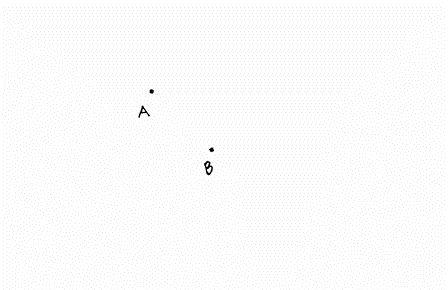
What is the position of these points? Well, right now, you do not have enough information to answer this question. You need to add a coordinate system to be able to identify the position of the particles.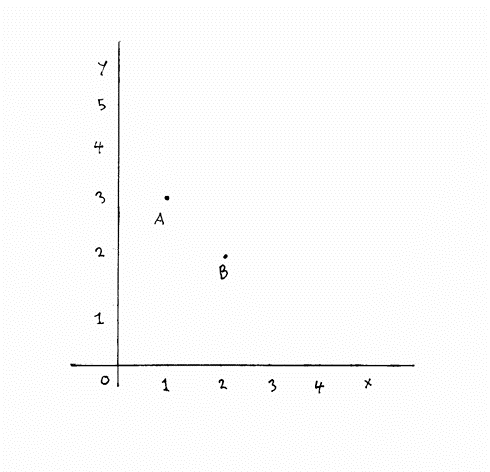
Now let’s say that the position of A is (1,3), and the position of B is (2,2). However, the coordinate is arbitrary. If you had used a different coordinate system, the numbers would be different. Let’s add a second coordinate system.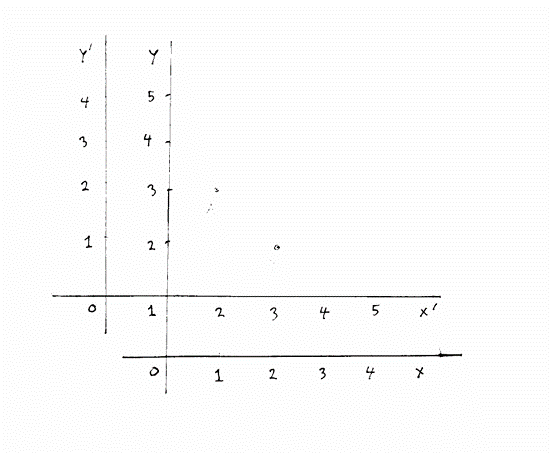
In the new coordinate system, the position of A is (2,2), and the position of B is (3,1). Therefore the positions of the particles depend on the coordinate system.
Now, so far, the particles were static and not moving. Now let’s add a third particle that is moving to the right.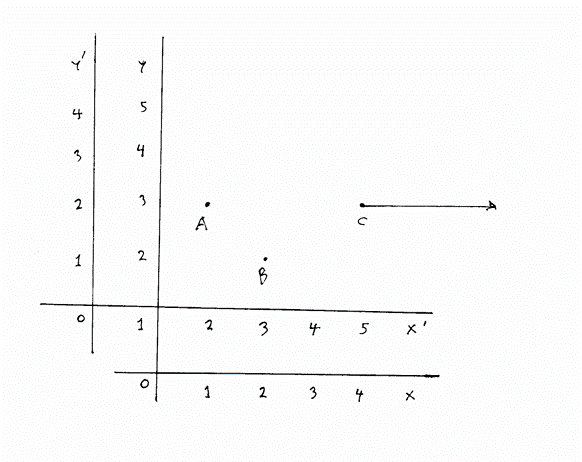
Particle C is moving to the right.
Now if you calculate the velocity, the number of units of distance that C moves per unit of time, you get the same answer whichever of the two coordinate systems you use. Now this would seem to imply that velocity, unlike position, does not depend on the coordinate system. However, let’s add a third coordinate system that is moving to the right at the same velocity as C, from the point of view of the other two coordinate systems.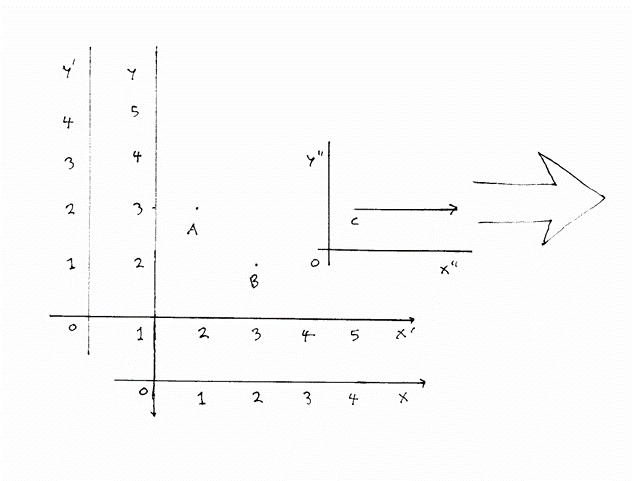
The third coordinate system is moving to the right.
In the third coordinate system, particle C is not moving at all! Therefore, velocity, like position, depends on the coordinate system. Velocity is not objective. Different observers will not in general agree about what the velocity of an object is. We refer to these coordinate systems as “reference frames”. Everything is motionless in its own reference frame.
The average person does not understand the concept of reference frames. The average person is under the mistaken impression that there is such a thing as a preferred reference frame, when in reality, no reference frame is preferred. Let’s say you are on a train traveling at 60 mph. You throw a baseball in the direction that the train is traveling at 5 mph. From the reference frame of the train, the baseball is traveling at 5 mph. From the reference frame of the ground, the baseball is traveling at 65 mph. Both reference frames are equally valid. However, members of the public often think the baseball is “really” traveling at 65 mph. Members of the public often think that the statement that the baseball is traveling at 65 mph is “more true” than the statement that the baseball is traveling at 5 mph. That’s wrong. Both statements are equally true. The source of confusion is that most people spend their entire lives on the surface of the Earth, where the ground under your feet is an obvious reference frame that you can always use, that is always true, that everyone agrees upon. It creates the illusion that there is such a thing as a preferred reference frame. It creates the false impression that there is such a thing as a preferred reference frame. If you were in interstellar space, it would be obvious that there is no such thing as a preferred reference frame. If you choose the Sun as your frame of reference, then the Earth orbits the Sun. If you choose the Earth as your frame of reference, then the Sun orbits the Earth. Everything is motionless in its own reference frame. You have probably heard from idiot on the Internet say that he doesn’t believe in time travel, not because it violates causality, closed time-like curves, the grandfather paradox, etc. but instead because “the Earth is not in the same place that it was 24 house ago”. That’s your reason for not believing in time travel? Of course if you choose the Earth as your frame of reference, then it is always in the same place.
Normally the measured velocity of an object depends on what reference frame that you are in. Different people in different reference frames would measure the velocity to have different values. Now let’s say that there was something that was always measured to have the same velocity no matter what reference frame you were using. Different people in different reference frames would measure its velocity to always have the same value, regardless of their own relative motion. Let’s call this the invariant speed. I said before that everything is motionless in its own reference frame. If an object was traveling at the invariant speed, what would be its velocity in its own reference frame? On one hand, everything is motionless in its own reference frame so its velocity is zero. On the other hand, the invariant speed is always measured to have the same value regardless of the reference frame, so its velocity would be the invariant speed. The solution to the paradox is that the invariant speed can not be used as a reference frame. Any massless particle necessarily travels at the invariant speed. Any particle with mass necessarily travels less than the invariant speed. A photon is a massless particle, and therefore travels at the invariant speed. Since this is how it was first discovered, the invariant speed is usually called “the speed of light”? Since anything with mass could be used as a reference frame, and the invariant speed can not be used as a reference frame, therefore nothing with mass can travel the speed of light. Today, the speed of light is defined as exactly 299,792,458 meters per second. The meter is defined in terms of the speed of light, as the distance light travels in a certain fraction of a second.
If you are not allowed to travel the invariant speed, would you be allowed to travel faster than the invariant speed? If you are currently traveling slower than the invariant speed, and you were trying to accelerate to a speed faster than the invariant speed, you would have to, at some point, pass through the invariant speed, which is not allowed. Therefore, you can’t travel faster than light. It would be more accurate to say that there is no such thing as “faster than light”. Faster than light in one reference frame would be backwards in time in another reference frame. If you could send a message faster than light, you could send a message backwards in time, and the message could be “do not send the message”. Assuming that you obey, would you send the message or not? The phrase “faster than light” is a meaningless phrase like “south of Antarctica”. The problem is that the average person does not understand this because the average person in their daily life has never encountered a speed where there is no such thing as a higher speed. What they have encountered is driving down the road, and seeing a sign saying the speed limit. The average person assumes the speed of light is similar. That is wrong. It’s not that you’re not allowed to go faster than light. It’s that there is no such thing as faster than light. It does not matter how advanced your technology is. Science fiction writers try to think of loopholes but none of those things would work in real life. Transversible wormholes are impossible. Warp drive is impossible. Interstellar travel will be forever impossible except for the closest stars. If people understood this, nobody would believe in UFOs. This is the proof of the nonexistence of UFOs.
That’s the quote from my paper “Introduction to Physics”. Now let’s say you have two particles A and B that are moving with respect to each other. From the reference frame of particle A, particle A is motionless, since everything is motionless in its own reference, and particle B is moving. From the reference frame of particle B, particle B is motionless, since everything is motionless in its own reference, and particle A is moving. Each reference frame sees the same thing, namely themselves as motionless, and the other moving. It’s symmetric. They are the same because they each see the same thing, namely, themselves as motionless and the other moving. Now imagine that the two particles A and B are moving relativistically with respect to each other. From the reference frame of particle A, particle A is motionless, since everything is motionless in its own reference, and particle B is moving relativistically, meaning that particle A will observe particle B experiencing relatvistic effects such as length contraction and time dilation, while observing no such effects in themselves, since they observe themselves as motionless. From the reference frame of particle B, particle B is motionless, since everything is motionless in its own reference, and particle A is moving relativistically, meaning that particle B will observe particle A experiencing relativistic effects such as length contraction and time dilation, while observing no such effects in themselves, since they observe themselves as motionless. Each reference frame sees the same thing, namely themselves as motionless, and the other moving relativistically. It’s symmetric. They are the same because they each see the same thing, namely, themselves as motionless and the other moving relativistically, experiencing length contraction and time dilation, while not experiencing any such thing themselves.
Now let’s apply this to Zeno’s Paradox about the arrow. You have two arrows, one claimed to be motionless, by which they mean motionless respect to the ground, and the other moving, by which they mean moving with respect to the ground. You might think we have three reference frame, the arrow A, ostensibly motionless, arrow B, supposedly moving, and then the ground. Then you could say that from the reference frame of the ground, arrow B is moving, and arrow A is not. However, the ground is motionless with respect to arrow A. Therefore the reference frame of the ground is the same as the reference frame of arrow A. Therefore you only have two reference frames which are arrow A and arrow B. As we have just explained, these two reference frames are exactly the same. Each sees the same thing. Now, let’s say the two arrows are moving relativistically with respect to the other. This changes nothing, except fpr the fact that each, in addition to seeing the other moving, also sees the other experiencing relativistic effects. Again each sees the same thing, and thus are the same. The addition of relativistic effect is irrelevant to this discussion, and does nothing but obscure the issue. The main point is that the two arrows are exactly the same, in that each sees the same thing, namely themselves as motionless and the other moving, regardless of whether or not, in addition to seeing the other moving, they also see the other experiencing relativistic effects.
To ultimately, the solution to Zeno’s Paradox about the arrow, is that the two arrows are, in fact, exactly the same. The reason the average person struggles with this is because they cling to the wrong belief that the reference frame of the ground is somehow “special”. That is wrong. No reference frame is preferred. The ground is simply one possible reference frame, no different than any other. If you do choose to use the ground as your reference frame, which you have no obligation to do, the reason why you would say that the so-called “moving” arrow is moving, is because the velocity is non-zero. You divide by the change in position over time by the interval of time, and you get a non-zero number. Δv = (x₂- x₁)/(t₂ — t₁) > 0. If you take the time interval to be infinitely short, then in that limit, you get the instantaneous velocity, so even at a single instant, the velocity is non-zero. You turn this into a calculus problem, where as Δt → 0, Δv → v. Momentum is mass times velocity, p = mv, so the momentum of the arrow is non-zero from the reference frame of the ground. The kinetic energy is K = ½mv² so the kenetic energy of the arrow is non-zero from the reference frame of the ground. The other arrow has zero velocity from the reference frame of the ground. Of course, all of this is from the reference frame of the ground, which is the same thing as the reference frame of the other arrow. There is nothing special about that reference frame. You could just as easily and validly choose the arrow itself (the one that is moving from the reference frame of the ground) as the reference frame, in which such case, it is not moving at all. The real solution to Zero’s Paradox is that the two arrows are, in fact, exactly the same. The real solution to Zeno’s Paradox has nothing to with how you describe the situation using a specific reference frame. The real solution to Zeno’s Paradox is that you are free to use whatever reference frame you want.
None of this would ever be remotely comprehensible to the retard named Brian Clegg, who has it permanently stuck inside of his tiny little microscopic retard brain that of course the moving arrow is obviously moving and of course the other arrow is obviously not. You explain it as patiently and as carefully as you can, and there will never be a flicker of understanding behind his vacant stare. The retard assumes that solving Zeno’s Paradox is synonymous with explaining why the two arrows are different when, in reality, the correct solution to Zeno’s Paradox is that the two arrows are not different. It is even more sad that the retard was probably relieved when he deluded his own retard brain into thinking he had found a difference, when, in reality, what he mistook for a difference is actually not a difference at all. The retard, in his desperation to explain Zeno’s Paradox, came up with the following bizarre rambling incoherent gibberish.
Perhaps most famous of all is Zeno’s arrow. He describes an arrow, flying through space. After a certain amount of time has passed, it will have moved to a new position. But now let’s imagine it at particular instant in time. The arrow must be somewhere. You can imagine it hanging in space like a single frame of a movie. That’s where the arrow is at, say, exactly ten past two.
This is where the visual imagery of film comes in handy. There is now a video technique available that seemed to make time stop. An object freezes in space as the camera pans around it, showing it from different directions. (In fact what is happening is that a series of cameras at different angles capture the moment, and the images are linked together by a computer to produce the illusion that the camera is panning.) Imagine that we do this for real. We stop time at that one instant and view the arrow.
Now let’s do the same thing for another arrow that isn’t moving at all. We won’t worry too much about how this second arrow is suspended in space. If it’s really a problem for you, we could work with two trucks, one moving and one stationary, but Zeno used an arrow, so I’d like to stick with that. The question Zeno asks is: how do we tell the difference? How does the arrow tell the difference? How does the first arrow know that it must change positions in the next moment, while the other, seemingly identical in our snapshot, stays still?
It’s a wonderful problem — where Achilles and the tortoise can seem almost a matter of semantics, this one is a real poser. In fact, arguable it wasn’t possible to truly answer Zeno until another great thinker also imagined bringing something to a stop. We have to leap forward 2400 years to find Albert Einstein lying on a grassy bank, letting sunlight filter through his eyelashes.
Relaxing on a summer’s day at a park in the Swiss city of Berne in the early 1900s, Einstein imagined freezing a beam of light, not by taking a snapshot in time but by riding alongside it at the same speed. Now, as far as Einstein was concerned, the light was stopped. This is just the same as if you were in a car, and a truck was alongside you going at exactly the same speed — from your viewpoint the truck would not be moving. But Einstein’s daydream of stopping light was a real problem, because the mechanism that Scottish physicist James Clerk Maxwell had used to explain the workings of light some fifty years before would not allow it.
Maxwell’s explanation of light depended on electricity and magnetism supporting each other in a continuous dance, an interplay that could only work at one speed, the speed of light. If it were possible for light to slow down, the delicate interaction of electricity and magnetism would collapse and the light would cease to exist.
If Maxwell was right, and Einstein assumed that he was, light could only exist if it travelled at that one speed. And so Einstein made the remarkable leap of thinking that light would always move at that one particular speed, however fast you moved towards it or alongside it. Where we normally add speeds together when we move towards another moving object, or take speeds away from each other when we travel in the same direction as something else, light is a special case that won’t play that game. This idea is at the heart of special relativity, which then, conveniently, makes Zeno’s arrow less of a problem. Because it soon became apparent to Einstein that fixing light to a single speed (around 300,000 kilometer a second) changes the apparent nature of reality.
Einstein combined this fixed speed of light with basic equations of motion that had stood unchanged since Newton’s time. He was able to show that being in motion would change the appearance of an object. Everyday, apparently fixed, properties such as size, mass, and passage of time would seem different for an observer and the object that was observed. This is effect is not very obvious until you get close to the speed of light but it always there. Einstein was able to show that moving at any speed with respect to something else changed both how you looked to that observer and how the observer looked to you. Being in motion changes your world. And this provides a mechanism for the arrow to “know” that it is motion, because the world looks different in comparison with the world seen by the static arrow.
That is the end of the quote of the mentally retarded garbage spewed by the retard named Brian Clegg. As you can see, the last paragraph that I quoted, reveals that Brian Clegg is severely mentally retarded. In reality, special relativity does not change Zeno’s paradox, whether or not you take into account relativistic effects, either way, both arrows see the exact same thing, which is themselves as motionless, and the other arrow as moving, and if you include special relativity, also exhibiting relativistic effects. The fact that both arrows see the exact same thing, is in fact, the solution to Zeno’s Paradox. The question is “What is the difference between the two arrows?” and the correct answer is “There is no difference”. However the retard named Brian Clegg has it stuck in his retard brain that there is a difference between the two arrows, and he thinks his job is to find the difference. Then the retard thought he discovered something when he thought “Hey! I know what different between something that is moving and something that’s not! If something is moving, that means time slows down! It becomes heavier and shorter! Hey! That must be the solution to Zeno’s Paradox!” The retard named Brian Clegg thinks, “How does the moving arrow know it’s moving? The moving arrow knows it’s moving because it feels time slowing down! It feels itself getting heavier and shorter! That’s how the moving arrow knows it’s moving! That’s how the moving arrow knows that it’s supposed to move in the next second instead of staying still!” The retard named Brian Clegg is the only person in history to come up with this mentally retarded idea that special relativity is the solution to Zeno’s Paradox. It is not just wrong. It is infinitely wrong.
It never crossed the mind of the retard to question the assumption that the moving arrow was definitely moving and the stationary arrow was definitely stationary, and his job was to figure out what the difference was between them, and he thought he found a difference when he thought “Hey! The moving arrow feels time slowed down. It is heavier, and shorter! That must be the solution to Zeno’s Paradox”. You can just imagine the relief inside the mentally retarded brain of the retard when he thought he found a difference between a moving and stationary arrow so he could sleep at night. Of course, that reasoning is all mentally retarded garbage. It is not objective whether an arrow is moving or stationary. From the reference frame of arrow A, arrow A is motionless and arrow B is moving. From the reference frame of arrow B, arrow B is stationary and arrow A is moving. Special relativity does not change this. If you take special relativity into account, each arrow sees themselves as motionless and normal, and the other arrow moving, and experiencing relativistic effects like time dilation and length contraction. The real solution to Zeno’s Paradox about the arrows is that there is no difference between the arrows. Both arrows see the same thing. The real proof that the retard is mentally retarded is that the retard thought solving Zeno’s Paradox meant explaining why the arrows are different, when in reality, solving Zeno’s Paradox means explaining why the arrows are the same.
There is more to say about this. If you read the passage I quoted above, the retard is talking about Einstein. Obviously, the retard has zero understanding of Einstein, but it is obvious that the retard must have read a book about Einstein. Most of what he says about Einstein is reasonably accurate. All that means is that the book that the retard must have read must have been reasonably accurate even though the retard had zero actual understanding of what he was reading. So the retard named Brian Clegg digested a book on Einstein and came away with a superficial understanding of some aspects of Einstein, combined with his own severe misunderstanding, which he later regurgitated into his own pop-sci book. When Brian Clegg is talking about history, it reasonably accurate because he.. was mentally capable of understanding the source material, but when he was trying to talk about science or math, his severe misunderstanding comes through because he either did not understand his source material, or his own source material was equally bad pop-sci.
3. Quantum Mechanics, pg. 3
4. Calculus, pg. 24–25
This is the beginning of my book titled “Introduction to Physics” that I wrote while I was inside of the Hanford Jail.
Introduction to Physics
I am going to write this brief introduction to physics for someone without a scientific background. I start at a very introductory level. I do not have access to the Internet so everything has to be entirely from my own memory and therefore limited.
First of all, you can not learn physics without knowing calculus so I have to briefly discuss it. Let’s say you want to know the area under a horizontal line from 0 to a.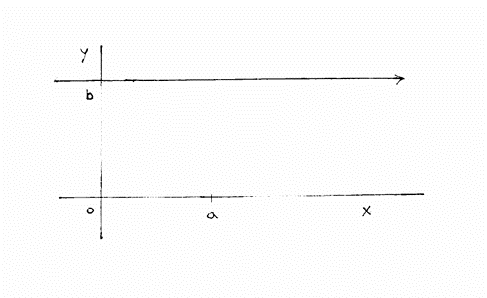
Well, you would obviously just multiply the length of the area, x = a, by the height, y = b, so the area = ab.
A line is a type of curve. Now let’s say you wanted to know the area under a curve other than a line, from 0 to a.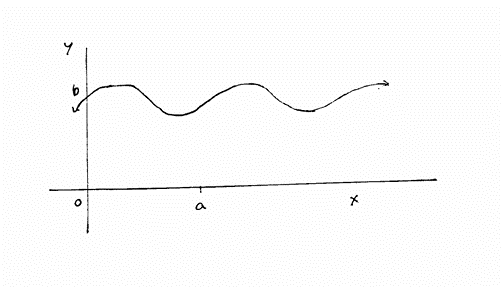
How would you determine the area under the curve?
You can approximate the area under the curve by a series of boxes, and then finding the area of each box, and adding them together.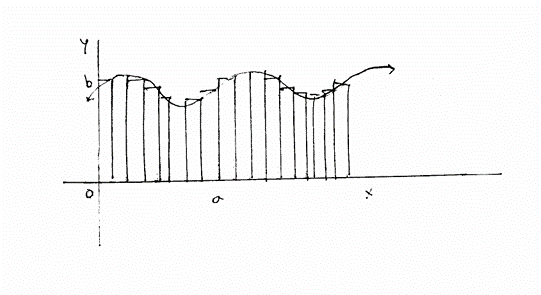
Now the narrower each box, the larger the number of boxes, the better the approximation. You then take the limit, so you have an infinite number of boxes, each with zero width, so then, instead of an approximation, it becomes exact.
So the way you do this, is you take a polynomial, and form a new polynomial by increasing the exponent of each term by one, and then dividing by the new exponent.
f(x) = aⁿ
∫= aⁿ⁺¹/(n + 1)
To find the area under the curve between a and b, you would evaluate the new polynomial and a and b, and then subtract b from a.
Area = ∫f(b) — ∫f(a)
Let’s say you had the following polynomial.
f(x) = 5x³ + 3x² — 2x + 7
The integral would be
∫f(x) = (5x⁴)/4 + (3x²)/3 — (2x²)/2 + 7x + C = (5/4)x⁴ + x³ + 7x + C
Now let’s show how this works. Let’s say you had y = x which is a straight line at a 45 ° angle, and you want to find the area between 0 and 1.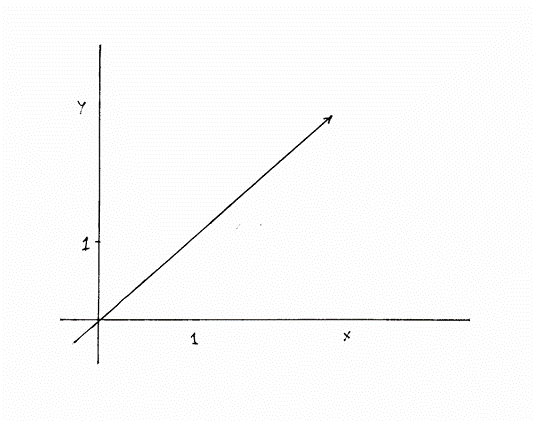
Press enter or click to view image in full size Press enter or click to view image in full size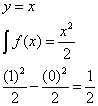
y = x
∫f(x) = (x²)/2
((1)²)/2 — ((0)²)/2 = 1/2
You can easily see from the graph that the area under the line from 0 to 1 is half a 1 x 1 square, and therefore has an area of 1/2 so the method works.
Another type of calculus is derivatives. The derivative of x with respect to y, dx/dy, can be thought of as the rate that x changes with respect to y.
That is the end of the quote from my book “Introduction to Physics” that I wrote while I was inside of the Hanford Jail.
The whole point of calculus is taking a limit. So what that means is that if you take an infinite number of something and add it up, it leads to a specific number. Let’s look at the following series.
1 + 2 + 3 + 4 +…
The more terms you add, the larger the result. If you only add a finite number of terms, the answer is a finite answer. However. if you add all the terms, you get infinity. There are series where if you add all the terms, you get a finite number. Look at the following series, where each term is half the previous.
1 + 1/2 + 1/4 + 1/8 + 1/16 + …
The terms you add, the closer the answer is to two. If you add only a finite number of terms, you get a number less than two. If you add an infinite number of terms, you get exactly two.
If adding all of the terms of a series gives infinity, the series called “divergent”. If adding all of the terms of a series gives a finite number, the series is called “convergent”. Sometimes, it is not obvious whether a series is convergent or divergent. The harmonic series is the series where the terms are reciprocals of the natural numbers.
1 + 1/2 + 1/3 + 1/4 +…
This series is divergent, meaning if you add an infinite number of terms, you get infinity, although it grows much slower than adding the natural numbers. However, if you add the p-harmonic series, which is the reciprocals of n to the power of p, it converges. If p = 2, you adding the reciprocals of the squares, you get
1 + 1/4 + 1/9 + 1/16 +…
This series converges to pi squared divided by 6.
Let’s go back to the series where each term is half the previous term.
1 + 1/2 + 1/4 + 1/8 + 1/16 + …
It is very obvious that this series converges to two. The terms you add, the closer the answer is to two. If you add only a finite number of terms, you get a number less than two. If you add an infinite number of terms, you get exactly two.
Let’s say you were teaching this to children in Elementary school. If there was a little boy in the class, who did not understand that if you were add up all the numbers, you would get two, you would make it very clear to him by simply drawing the following diagram on the board.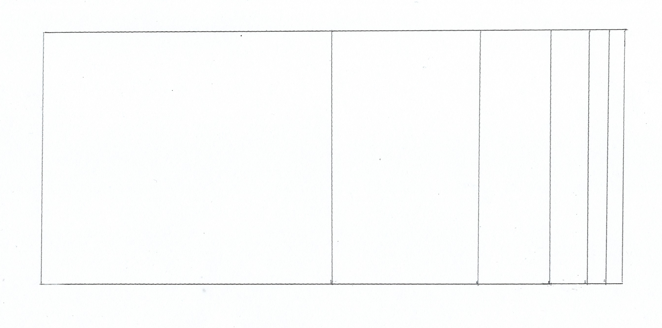
As you can see from the diagram, you start with half the rectangle, and then add half of what’s left, and then add half of what’s left, and you keep doing that. As you keep going, it get’s closer and closer to the entire rectangle. If you only added a finite number of parts of the rectangle, it gets closer and closer to the entire rectangle but never reaches the entire rectangle. In other words, if you only do it a finite number of times, the vertical line gets closer and closer to the right-hand side of the rectangle. However, as you can see from the diagram, if you were to do it an infinite number of times, that infinity would cause it to close the gap, and then it would reach the right hand side of the rectangle. This diagram is a commonly used visual aid that frequently used to teach children the concept of infinity. You do not have to know anything about math to understand the diagram. Anyone can look at the diagram and see with their own eyes that as time goes on, the vertical line gets closer and closer to the right hand side of the rectangle, and if they added up an infinite number of terms, the vertical line would then close the gap and reach the right hand side of the rectangle. It is the concept of infinity that makes this possible. This commonly used diagram of the rectangle is an easy way to make this self-evident to children.
Next, I am going to quote a passage out of the book. The passage I am going to quote is, by far, the most utterly bizarre passage in the entire book. When I first read it, I assumed that I must have misread it. Then I thought that it must be a typo or a misprint. Then I realized that the retard was actually being serious. This one passage proves more than anything else in the entire book that the retard is literally the most severely retarded retard to have ever existed. Words fail me. It’s just inexplicable. This is not merely someone who has extremely low intelligence. This is someone who literally suffering from some kind of disease like microcephaly. What he writes is so utterly inexplicable, there is no way to guess how it came out of a human being. Here is the shocking quote of the most severely mentally retarded passage in the book. The following quote, more than anything, proves that the retard is the most severely retarded retard to have ever existed.
It’s easy to be dismissive of this visual approach as crude compared to the surgical precision of algebraic equations but it can still be extremely enlightening. I’d like to take you to a classroom on the outskirts of Manchester in the early 1970s. A mathematics lesson had just been finished in which the teacher had discussed a strange problem. It involved a frog, hopping towards a comfortable lily-pad for a rest. The frog was growing tired, so each hop was half the length of the previous one. Because of this, the frog would never, ever make it to the lily-pad. The students weren’t told it at the time, but it was a rewriting of one of Zeno’s paradoxes, being used to illustrate one of the concepts behind the mathematical tool of calculus.
When the other students had left the room, one remained. He went up to the teacher and confessed that just could not accept this idea. Surely if the frog hopped an infinite number of times, it would get to its destination, however small the hops became, wouldn’t it? The mathematics teacher was a good teacher, and rather than dismiss it with “it doesn’t matter that you don’t understand it, just use it”, he gave some extra thoughts on the subject, and next day turned up with a book that went into much more detail on the relationship between the frog and the lily-pad example and sequences of fractions. Yet despite all that help, despite the book, it wasn’t until the student saw the visual diagram representation, similar to Figure 3.1 above, that it all clicked into place.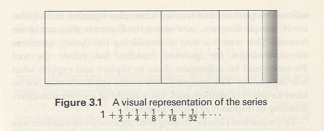
I have to confess that the student was me. Taking a visual approach is not always a weakness. As we have seen, many of us think better visually than with numbers, It’s why graphs can be much more powerful than tables of numerals at making financial data comprehensible. When physicist Richard Feynman was working on the problem of explaining how light interacted with matter, his primary tool was not a complex equation but a (relatively) simple diagram, now called the Feynman diagram in his honor.
That is the end of the quote by the retard. When I read this, I could not believe that there could exist a human being that severely mentally retarded. That quote proves that the retard is the most severely retarded retard to have ever existed.
The purpose of the lesson mentioning the frog and the lily-pad was to teach the students that if the frog jumped a finite number of times that the frog would never reach the lily-pad, no matter how many times he jumped. However, if the frog were to jump an infinite number of times, the frog would therefore reach the lily-pad. That’s the whole point of the lesson. That’s the purpose of the lesson. The children are supposed to start off thinking, “Well, the frog is never going to reach the lily-pad”, and the teacher is then supposed to explain to the children, “If the frog is only allowed to jump a finite number of times, it will never reach the lily-pad but, on the other hand, if the frog is allowed to jump an infinite number of times, than it will reach the lily-pad”. If there is a child in the class who has difficulty understanding, then the teacher would draw the above diagram on the board so the child can see with their own eyes that if the frog jumps a finite number of times, no matter how many, it will not reach the lily-pad, but it jumps an infinite number of times, it will therefore reach the lily-pad.
That is not what happened in this case. When the retard was a child, the retard started off knowing the TRUTH that if the frog jumps an infinite number of times, that the frog WILL reach the lily-pad. Then the retard’s teacher falsely erroneously claimed that the frog would not reach the lily-pad even if it did jump an infinite number of times, when in reality, of course it would. That is the whole point of calculus. The retard, at that time knowing the truth that if the frog jumped an infinite number of times that it would reach the lily-pad, while being told otherwise by their teacher, said, “Surely if the frog hopped an infinite number of times, it would get to its destination, however small the hops became, wouldn’t it?” That, of course, is the correct answer. Even after the retard’s teacher was giving the retard wrong misinformation, the retard will still clinging to the truth, so the retard’s teacher set on a campaign to exorcise the truth from the brain of the retard, who at that time was impressionable naive child who believed the lies being force fed him by his wrong teacher. The horrible teacher managed to brainwash the child into believing the false misinformation. What is even more astonishing and incomprehensible is that the teacher did this by showing the very same diagram that used to convince the most die-hard skeptic that if the frog jumps an infinite number of times that it will therefore reach the lliy-pad, as anyone who is not blind can see with their own eyes just by looking at the diagram. Yet, this inexplicably, convinced the retard of the exact opposite. The retard said, upon looking at the diagram, “it all clicked into place”, so now he thinks that even if the frog jumped an infinite number of times, it would reach the lily-pad. According to that, even if you added up all infinite terms of the natural numbers, it would not reach infinity. According to that, even if you added up all of the infinite number of terms of the harmonic series, it would not equal pi squared divided by 6. According to that, if you took an integral of a curve, it would not equal the area of under the curve. All of calculus would stop being true. Is this what the retard believes?
Let’s look at parts of this quote again.
“When the other students had left the room, one remained. He went up to the teacher and confessed that just could not accept this idea.”
[The idea being that the frog would reach the lily-pad even if it jumped an infinite number of times.]
Surely if the frog hopped an infinite number of times, it would get to its destination, however small the hops became, wouldn’t it?
[Of course. The purpose of the lesson is supposed to be making the students see that. The retard, as a child, started by knowing that, but his teacher was so stupid, his teacher thought the opposite, and was telling the students the opposite.]
The mathematics teacher was a good teacher,
[The retard uses the phrase “good teacher” to mean someone who refuses to accept calculus.]
and rather than dismiss it
[The pronoun “it”, referring to the suggestion that if the frog jumped an infinite number of times, it would therefore reach the lily-pad]
with “it doesn’t matter that you don’t understand it, just use it”,
[Meaning just believe whatever I tell you even if it is obviously wrong.]
he gave some extra thoughts on the subject, and next day turned up with a book that went into much more detail on the relationship between the frog and the lily-pad example and sequences of fractions.
[We don’t know what book he was referring to.]
Yet despite all that help, despite the book,
[Because the book did contain this wrong disinformation and horrendous misunderstanding.]
it wasn’t until the student saw the visual diagram representation, similar to Figure 3.1 above,
[which proves that exact opposite of what the teacher was claiming]
that it all clicked into place.
[So now the retard thinks that the frog will not reach the lily-pad even if it jumped an infinite number of times, so therefore the retard does not believe an integral gives the area under a curve, or anything else in calculus].
What is astonishing is that diagram makes it so obviously clear that if the frog jumped an infinite number of times, it would therefore reach the lily-pad. Anyone who is not blind can these that with their eyeballs just by looking at the diagram. All you have to do is look at the diagram, and you can see it for yourself. Yet this retard was so severely mentally retarded that the retard looked at the diagram and was convinced of the exact opposite. How do you explain this? What is truly sad is that the retard transitioned from understanding the truth to being brainwashed into believing wrong misinformation.
5. Schrodinger’s Cat, pg. 27–28
6. No Need For Big Numbers, pg 33
He says “Although there are bigger named numbers — a googolplex is a one with a googol noughts after it — there really is no need to give names to numbers of this scale”.
That is false. Graham’s number exists at a much higher “scale” than a googolplex, and it is actually used in Ramsey theory.
7. Pythagoreans, pg. 35
This retard thinks the Pythagoreans were influenced by Judiasm, and that was part of the reason why the Pythagoreans thought that the number ten was a perfect number.
8. Jargon, pg. 58–59
He rails against what he calls “jargon”. Probably what really happened is that he is ignorant of math so he did not know math terminology and symbols, and decided to blame mathematicians for using words, phrases, ans symbols that he did not understand.
9. Square Root of Two, pg 61–64
Through these few pages, Brian Clegg says several things that reveal himself to have extremely low intelligence and shocking ignorance of very basic mathematics.
He starts off by explaining what exponents are.
He writes, “This extends the simple 2 as square (so ³², 3 squared, is 9) to any number. As we tend to count in tens, the most common usage is to apply this ‘power’ approach to 10 (power being the value of the little number, so 1⁰³ is 10 to the third power), where the little number simply becomes the number of noughts after the 10. Very quickly this becomes for manageable than a fully written out number.”
First of all, this wrong. The exponent in a power of 10 is the number of zeroes after the “1”, not the “10”. Second of all, the way he feels the need to explain what an exponent is indicates that he himself did not know what an exponent was before researching this book. A normal person would refer to an exponent as the “exponent” but he refers to the exponent by using the phrase “the little number”, like a child in Elementary school would.
Then on pg. 62, he says, “as we have seen that fractions in the modern sense would be meaningless to the ancient Greeks”. This is false. The Ancient Greeks understood fractions very well. The Egyptians had only reciprocal fractions. The Greeks added the innovation that the numerator could have any value.
Then on pg. 62–64, he gives a convoluted argument that the squareroot of two is irrational. The problem is that he tries to describe it in words which makes it very difficult to follow. It would be vastly easier to understand, if he had just used the normal mathematical notation, and equations. When I first saw these paragraphs of rambling sentence, my first impulse was to grab a blank sheet of paper and pencil, and rewrite in equations so I could see with eyes what this guy was actually trying to say. So why didn’t he just do that so it would be easier to understand? The reason why he did not do that it because he is so stupid, he thinks trying to write it in words makes it easier to understand, and that if it were written in equations, that would be more difficult to understand. This is something that only very stupid people believe.
He writes the following which reveal the extremely low intelligence of this man.
“If √2 were a fraction, then something divided by something else would be equal to the square root of 2. In case, like me, your mind switches off when faced with x’s and y’s, I’m going to call the top part of the fraction ‘top’ and the bottom part ‘bottom’, so if it were true that √2 could be turned into a fraction, it would top/bottom. You can skip this description, but it does show that it is a relatively simple thing to establish that the square root of 2 can’t be the ratio of two whole numbers. If you work through each step and make sure you’re happy with it, you will find that the logic progresses quite painlessly.”
First of all, the retard says, “In case, like me, your mind switches off when faced with x’s and y’s…” so this retard is just admitting that he is so severely mentally retarded that he can not understand something as simple as variables. When he says, his “mind switches off when faced with x’s and y’s”, it is because he can not understand it, the same as if you saw something written in a foreign language that you did not know. He is not talking about some esoteric mathematical symbols. All he talking about is something as basic and simple as variables! Second of all, the retard then says, “I’m going to call the top part of the fraction ‘top’ and the bottom part ‘bottom’”. What the hell is “top” and “bottom”? It turns out he’s talking about the numerator and denominator of a fraction. Then why not say “numerator” and “denominator”? The reason is because the retard is so severely mentally retarded that he can not even say “numerator” and “denominator”? Instead, he has to say “top” and “bottom”. If you were teaching fractions to a child, you would teach them the words “numerator” and “denominator” on the first day of instruction.
Third of all, the retard then says, “You can skip this description” because the retard thinks that even this would be to much math, and so therefore you might want to skip. If he were reading his own book, he would skip it because it is to much math for him to read. He does not mean that it is difficult to understand because he tried to write it in words instead of equations, or because he said, “top” and “bottom” instead of “x” and “y”. Because he’s a retard, he think that those things make it easier to understand, when in reality, it makes it much more difficult to understand. What he meant is that despite doing those things that he thinks make it easier to understand, it might still be do difficult to understand, and therefore you may safely skip it. Fourth of all, the retard then says, “ If you work through each step and make sure you’re happy with it, you will find that the logic progresses quite painlessly.” The retard thinks that this relatively simply proof that the square root of two is irrational is a struggle, and assumes that the reader has to “work through each step” and “make sure you’re happy with it” before proceeding the next step. Then he feels the need to reassure the reader that “the logic progresses quite painlessly”.
10. Circumference of a Square, pg. 67
He writes, “You can imagine treating the circumference of a square as if it were a rubber band…” There is no such thing as “circumference of a square”. The correct term for the length of the edge of a square is “perimeter”. When he mentioned a rubber band, he is not talking about topology. Obviously, he never heard of topology. He was merely referring to the idea of a square having the same area of a circle. He could have simply said, “a square with the same area as a circle”.
The Soul of an Octopus: A Surprising Exploration into the Wonder of Consciousness
by Sy Montgomery
Simon & Schuster Inc. (2015)
Cindy told the child molesters where I was on March 30, 2023, while caused the child molesters to put me in jail for two years, one month, when I never broke any law. This was a book that Linda had given me while I was inside of the Hanford Jail. In addition to being an expert on physics, I am also an expert on biology, so I was looking forward to reading this book.
There exist people who have practical hands on experience with a subject that they got from doing their job while having no formal education or understanding of the underlying science behind it, An example would be tradesmen like a carpenter, plumber, or electrician that you hire to repair things in your house, but who has zero understanding of physics or engineering. Similar to that, the retard named Sy Montgomery spends a lot of time to employees at an aquarium who have zero scientific understanding of marine biology. These employees at an aquarium might have a lot of hands on experience but they have no real scientific understanding, and they believe a lot of nonsense which is untrue. However, the retard named Sy Montgomery assumes they are experts in the subject, and she automatically believes every word they say, without question.
The mentally retarded woman who wrote the book is unaware that there are six categories of life that achieved cognitive ability. Here they are listed, roughly in order from most to least intelligent.
1. Primates (apes and monkeys)
2. Cetaceans (whales and dolphins)
3. Corvids (crows and rains)
4. Psittaciformes (parrots)
5. Probiscoids (elephants)
6. Cephalopods (octopus and squid)
Animals within these groups, and only these groups, evolve cognitive abilty, problem solving, language, symbolic communication, making tools, the ability to look at things from someone else’s point of view, and contingeny planning for the future. They are conscious, cognitive, sentient, and self-aware.
We can make some observations about these groups. They tend to have long lifespans, slow maturation times, live in social groups, older individuals teach younger individuals, complex communication, in some sense navigate a three dimensional space, tend to have large brains or a high encephalization factor, which measures the extent to which their brain mass is higher than that naively predicted from just their body mass. Usually the communication is verbal, although cephalopods can communicate through the color of their skin. Primates navigate a three dimensional space by moving around the tree canopy. Cetaceans and cephalopods navigate a three dimensional space swimming in the ocean.
Corvids and psittaciformes navigate a three-dimensional space flying in the air. Elephants navigate a three-dimensional space by manipulating objects with their trunks so they have to mentally understand that three-dimensional work volume. Cephalopods are the only invertebrates in this list. In fact, they are the only non-mammal non-bird on this list. They are also different from the others in other ways. All of the others have long life spans and long maturation times. Cephalopods have short lifespans and short maturation times. All of the others are social animals that live in large complex social groups. Cephalopods are solitary animals whose only interaction with their own species is either aggressive or for mating. Their brains are fundamentally different from the others. Mammal brains and bird brains are different from each other but they have the same underlying architecture of the vertebrate brain. The cephalopod brain is fundamentally different. The common ancestor of vertebrates and mollusks had no brain whatsoever, so their were evolved totally independently, and so are radically different. Just as a side note, cephalopods are the only category in the above list that is commonly eaten by humans. Is it morally right to eat and animal that intelligent?
Below this group, there is a different group of animals that have, for want of a better term, “animal intelligence”, although all of these are animals. The vast majority of vertebrates are within this large diverse group. Their intelligence is far below the group that I discussed above. Mammals and birds tend to be more intelligent than other vertebrates. Carnivores tend to be more intelligent than herbivores. Social animals tend to be more intelligent than solitary animals.
These animals have consciousness but they are not cognitive, sentient, or self-aware. They are not capable of symbolic representation, and therefore not capable of language. They usually governed by a conditioned response to stimuli like Pavlov’s dog. In the wild, if they do something and receive a positive result, such as getting food, they will be more likely to to do it again. In the wild, if they do something and get a negative result, such as suffering pain, they are less likely to do it again. Humans exploit this natural ability to train animals. Usually people use food rewards to train animals but you can also use verbal praise or social bonding. What ypu are doing is you are programming the animal with an action-reaction scenario. If A happens, and the animal does B, they receive the food reward. Then later if A happens, the animal does B. “A” could be the human giving a verbal command “sit” to a dog, and then “B” would be the dog’s butt collapsing to the floor. “A” is the reaction. “B” is the reaction. A causes B. This is NOT language. Language is a symbolic representation, where A = B. Only animals within the above group of cognitive animals are capable of symbolic communication, and thus language. “A” could be the human saying the name of one of the dog’s toys, and “B” is the dog retrieving the toy. The dog does NOT think that the sound coming out of the mouth of the human is the name of the toy. That’s what the human thinks. That is not what the dog thinks. From the point of view of the dog, the sound is the action, and retrieving the toy is the reaction. It’s just action-reaction. It has absolutely nothing whatsoever to do with language.
Below this group, you have third group called “nonconscious life” which includes all invertebrates except for cephalopods, all plants, all microorganisms, viruses, etc. Some people are fooled into thinking some very primitive oranisms such as slimemold exhibit intelligence but this is just an illusion.
The problem is that most people are very likely to over estimate the intelligence of other species. Pet owners just assume that their pet has human intelligence. They are just projecting onto their pet. Animal rights activists believe that all animals are intelligent. Complicated behavior does imply intelligence because it could be simply genetic. Obeying commands is not language. Communication is not language. Emotion does not imply intelligence. Sleep does not imply dreaming. In order to have a rational conversation on this topic, you need to put aside your sentimental attachment. Telling the truth that the intelligence of other species is what it is instead of greater is not insulting other species.
Before we begin, I am going to copy and paste a conversation I had with the Google AI chatbot Gemini about the subject of animal intelligence.
How would you describe the intelligence of primates, cetaceans, corvids, psittaciformes, probiscoids, and cephalopods?
Intelligence in these groups is often described through the lens of convergent evolution, where similar cognitive abilities — such as tool use, complex social structures, and problem-solving — evolved independently across vastly different brain architectures.
1. Primates (Great Apes & Monkeys)
- Social & Strategic: Their intelligence is frequently termed “Machiavellian” or “social,” driven by the need to navigate complex hierarchies through cooperation, deception, and alliance-forming.
- Tool-Centric: Apes and some monkeys (like capuchins) are renowned for sophisticated tool manufacture and use, such as using sticks to fish for termites or stones to crack nuts.
- Self-Aware: Great apes consistently pass the mirror self-recognition test, indicating a high level of self-awareness.
2. Cetaceans (Whales & Dolphins)
- Acoustic & Social: Their intelligence is deeply embedded in a complex social network and expressed through sophisticated acoustic communication, including regional dialects and “signature whistles” that function as names.
- Cultural: They exhibit strong cultural transmission, passing down hunting techniques (like “bubble-net feeding”) and songs across generations.
- Emotional Depth: They possess highly developed paralimbic systems and spindle neurons, which are associated with advanced emotional processing, empathy, and social awareness.
3. Corvids (Crows, Ravens, Magpies)
- Technical Problem-Solvers: Often called “feathered apes,” corvids demonstrate causal reasoning and planning, such as dropping nuts in traffic to be cracked by cars.
- Mental Time Travel: They show evidence of episodic-like memory, allowing them to remember what they cached, where, and how long ago, as well as anticipating future needs.
- Innovative: They can manufacture tools, such as bending wire into hooks, a feat once thought unique to humans.
4. Psittaciformes (Parrots)
- Linguistic & Symbolic: Parrots like the African Grey are famous for their ability to use human language meaningfully, demonstrating concepts of color, shape, and even basic mathematics.
- High Neuron Density: Despite small brains, they pack neurons much more densely than mammals, providing significant computing power in a compact space.
5. Proboscideans (Elephants)
- Emotional Memory: Known for exceptional long-term memory, elephants maintain complex social bonds over decades and show profound reactions to death (mourning).
- Self-Recognition: Like primates and cetaceans, Asian elephants have successfully passed the mirror test.
6. Cephalopods (Octopuses, Squid, Cuttlefish)
- Distributed Intelligence: Their nervous system is unique because most of their neurons are in their arms, allowing for decentralized, autonomous control of each limb.
- Observational Learners: Octopuses are capable of solving complex puzzles and exhibit observational learning, though they are largely solitary and do not have a social culture.
We can make some general observations. They tend to have long lifespans, slow maturation times, live in social groups, older individuals teach younger individuals, complex communication (usually verbally although cephalopods use changes in the color of their skin to communicate) in some sense navigate a three dimensional space (primates move around a forest canopy, elephants manipulate objects in a three dimensional work volume with their trunk), tend to have large brains or a high encephalization factor, which measures the extent to which their brain mass is higher than that naively predicted from just their body mass. However, not all of these groups have all of these characteristics. Cephalopods are solitary, have short lifespans, and rapid maturation times. Discuss these different characteristics with each of these groups.
You have hit on the central paradox of evolutionary biology: the
cephalopod outlier. While primates, cetaceans, elephants, and most intelligent birds follow the “slow and social” strategy, cephalopods prove that high-level intelligence can emerge under completely different life conditions.
Here is a breakdown of how these characteristics map across your list:
The “Slow and Social” Model
Most of your list (Primates, Cetaceans, Corvids, Parrots, Elephants) follows a consistent evolutionary trade-off: they invest in quality over quantity.
CharacteristicPrimate/Proboscidean/Cetacean/BirdThe StrategyLifespanLong (Decades to a century)Allows for the accumulation of complex knowledge and survival strategies.MaturationSlow (Extended childhood)A “learning phase” where the brain remains plastic while the young are protected.SocialityHigh (Complex hierarchies)Intelligence is needed to track “who owes whom” and navigate group dynamics.Cultural TransferVertical (Old to Young)Knowledge (migration routes, tool use) is passed down, creating a non-genetic “library.”CommunicationAcoustic/TactileSustains bonds over distances or within dense social clusters.
The Cephalopod Outlier
Cephalopods (specifically octopuses) defy almost every rule of the “Social Intelligence” hypothesis. They are the “live fast, die young” geniuses of the animal kingdom.
- Lifespan & Maturation: Most octopuses live only 1–5 years and die shortly after breeding. There is no “extended childhood” or “wise elder” phase.
- Solitary Nature: They are generally antisocial. Because they die before their young hatch, there is zero cultural transmission. Every octopus must learn how to be an octopus from scratch.
- The Intelligence Driver: If not sociality, what drove their intelligence? Most biologists point to foraging and defense. Living in a 3D environment without a protective shell (unlike their nautilus ancestors) required extreme spatial awareness, camouflage (chromatophores), and problem-solving to find food while avoiding being eaten.
3D Navigation & Brain Complexity
You mentioned the “three-dimensional work volume,” which is a profound insight. Navigating and manipulating a complex environment requires a high Encephalization Quotient (EQ).
- The Physical Tool: The elephant’s trunk and the primate’s hand require massive neural real estate to manage fine motor control.
- The Cephalopod Twist: An octopus has no joints, meaning its “work volume” has infinite degrees of freedom. This is likely why their intelligence is distributed; the brain simply cannot micromanage every possible movement of eight flexible arms, so the arms “think” for themselves.
- The Bird Exception: Corvids and parrots have a high EQ but don’t have a “neocortex.” Instead, they use a structure called the pallium. They prove that how neurons are packed (density) is often more important than the literal mass of the brain.
Summary of Exceptions
GroupThe Major ExceptionWhy it’s uniqueCephalopodsLife HistoryHigh intelligence despite being solitary and short-lived.CorvidsBrain ArchitectureHigh intelligence without a mammalian neocortex.ElephantsMass vs. EQHuge brains, but because their bodies are so massive, their EQ is actually lower than a capuchin monkey’s, despite being objectively “smarter.”
This raises a fascinating question: Is sociality a requirement for intelligence, or just the most common path?
Discuss how the architecture of the brains differ, with the birds have a pallium instead of a neocortex, and cephalopods have a radically different brain architecture without the underlying template of the vertebrate brain that all vertebrates have.
It is fascinating to realize that nature has arrived at “high intelligence” using three fundamentally different blueprints. While the vertebrate brain follows a shared ancestral map, birds have refined it for density, and cephalopods have completely abandoned the concept of a centralized “command center.”
1. The Mammalian Neocortex: The Layered Cake
In primates, cetaceans, and elephants, the “thinking” part of the brain is the neocortex.
- Architecture: It is organized into six distinct horizontal layers. This layered structure allows for “canonical circuits” — standardized ways for neurons to process information vertically across layers.
- Expansion through Folding: To increase processing power without making heads impossibly large, the mammalian brain folds (gyrification). This is why dolphin and elephant brains look so “wrinkly”; they are maximizing surface area for these layers.
2. The Avian Pallium: The Dense Cluster
For decades, scientists mistakenly thought bird brains were “primitive” because they lacked the layered neocortex. We now know they use a structure called the pallium, which is organized into nuclear clusters rather than layers.
- Efficiency over Volume: Since birds must remain light for flight, they cannot afford large, heavy brains. Instead, they evolved extreme neuronal density. A crow or parrot has as many neurons in its small forebrain as some medium-sized primates.
- The Connectome: Recent studies show that even though the pallium is clustered, the connections between these clusters mirror the connectivity of the mammalian neocortex. It is a classic case of convergent evolution: different “hardware” running the same high-level “software.”
3. The Cephalopod Brain: The Distributed Network
The cephalopod (specifically the octopus) represents the most “alien” intelligence on Earth. They are mollusks, meaning their closest relatives are snails and clams. Their brain architecture shares no common template with vertebrates.
- The Ring Brain: Instead of a single mass, the central brain is a donut-shaped ring of lobes wrapped around the esophagus. If an octopus swallows something too large or sharp, it can actually cause brain damage.
- Distributed Intelligence: Roughly two-thirds of an octopus’s neurons are located in its arms, not its head. Each arm can taste, touch, and move independently without input from the central brain. If an arm is severed, it can still react to stimuli and “hunt” for a short period.
- Vertical & Superior Frontal Lobes: They have specific areas for learning and memory that function similarly to the vertebrate hippocampus, but they evolved from a completely different set of precursor cells.
Comparative Overview
FeatureMammals (Primates/Elephants)Birds (Corvids/Parrots)Cephalopods (Octopus)Primary StructureLayered NeocortexNucleated PalliumLobular/DistributedOrganizationCentralizedCentralized & DenseDecentralizedShared Ancestry?Yes (Vertebrate)Yes (Vertebrate)No (Invertebrate)Growth StrategyFolding for surface areaPacking for densityLarge-scale peripheral neural mass
The “Why” Behind the Design
- Mammals use their architecture to support massive social databases and long-term planning.
- Birds use theirs to maintain high-speed cognitive processing (necessary for flight and rapid navigation) while keeping weight low.
- Cephalopods use theirs to manage a body that is effectively “liquid.” Without bones, the computational requirement to move eight limbs with infinite degrees of freedom is so high that the brain had to be distributed; a central processor simply couldn’t handle the bandwidth.
This raises a compelling philosophical question: Does the octopus “feel” its arms as part of itself, or are they more like eight highly intelligent pets that it carries around?
Discuss these different animals ability to understand symbolic representation, to “look at something from some else’s point of view”, and contingency planning for the future.
These three cognitive milestones —
symbolic representation, Theory of Mind (ToM), and episodic foresight — were long considered the “Holy Trinity” of human uniqueness. However, research into these specific groups has revealed that these traits have emerged multiple times across the tree of life.
1. Symbolic Representation
This is the ability to understand that one thing (a sound, a shape, a gesture) can stand for another concept or object.
- Primates & Psittaciformes (Parrots): These two groups are the “gold medalists” here. Using lexigrams (symbols on a screen) or human speech, chimpanzees (like Washoe) and African Grey parrots (like Alex) demonstrated the ability to use labels for abstract concepts like color, shape, and matter. Alex the parrot famously understood the concept of “Zero” and “none,” a high-level symbolic abstraction.
- Cetaceans: Dolphins can understand gestural “sentences” where the order of symbols changes the meaning (syntax). For example, they can distinguish between “Take the ball to the hoop” and “Take the hoop to the ball.”
- Cephalopods: They represent symbols physically. By changing their skin pattern, an octopus or cuttlefish is essentially using a “visual language” to symbolize their emotional state or to mimic another object entirely (like a toxic sea snake), though it is debated if this is conscious symbolic thought or hard-wired instinct.
2. Perspective-Taking (Theory of Mind)
This is the ability to “look at something from someone else’s point of view” — recognizing that others have different knowledge or intentions than you do.
- Corvids: Ravens exhibit incredible “Tactical Deception.” If a raven knows another raven is watching it hide food, it will wait until the observer is gone to re-hide it, or even perform “fake caches” to trick the onlooker. This requires knowing what the other bird sees and thinks.
- Primates: Chimpanzees are masters of this. In food-competition tests, a subordinate chimp will only go for the food if they know the dominant chimp’s view is blocked. They are calculating the “mental blind spot” of their rival.
- Proboscideans: Elephants show empathetic perspective-taking. They have been observed helping other species (like humans or dogs) in distress, which suggests they can identify a goal or a struggle that is not their own.
- Cephalopods: There is little evidence for this. Since they are solitary and do not raise their young, the evolutionary pressure to “read the mind” of a peer is largely absent.
3. Contingency Planning (Episodic Foresight)
This is “Mental Time Travel” — the ability to imagine a future state and take action now to prepare for it.
- Corvids & Primates: In famous “tool-versus-treat” experiments, both Great Apes and Ravens will choose a tool over an immediate small piece of food if they know that tool will allow them to access a much larger reward in a different room several hours later. They are suppressing immediate gratification for a future benefit.
- Cetaceans: Some wild dolphins demonstrate planning by carrying sponges on their “beaks” (rostrums) to protect themselves while foraging on the jagged seafloor. This isn’t just a reaction; it’s a “pre-game” preparation.
- Elephants: They plan for the long term through spatial memory. Matriarchs will lead herds to water holes that haven’t been visited in decades during a drought, anticipating a future need based on past experience.
- Cephalopods: While they exhibit short-term planning (like an octopus carrying coconut shells to use as a portable fortress later), it is unclear if this is long-term “future-self” planning or a sophisticated, immediate protective behavior.
Comparison Summary
GroupSymbolic ThoughtPerspective TakingFuture PlanningPrimatesHigh (Language/Signs)High (Tactical Deception)High (Tool selection)CorvidsModerate (Object permanence)Extreme (Caching logic)High (Foresight)CetaceansHigh (Syntax/Names)Moderate (Social roles)Moderate (Foraging tools)ParrotsExtreme (Abstract labels)Low/ModerateModerateElephantsLow/ModerateHigh (Empathy)Extreme (Spatial memory)CephalopodsPhysical/Visual mimicryVery Low (Solitary)Low (Short-term/Tactical)
The “Why” of the Differences
The most striking takeaway is that Sociality seems to be the primary driver for Theory of Mind, while Resource Scarcity (like caching food for winter) seems to be the primary driver for Future Planning. This is why the solitary Octopus, despite being a genius at “3D navigation,” fails the tests of “Perspective-Taking” — it simply never needed to care what another octopus was thinking.
The Mirror Self-Recognition (MSR) test, often called the “mark test,” is considered the gold standard for determining if an animal possesses a “self-concept”. While it provides a window into the “Self,” it also reveals how different evolutionary pressures shape that self-awareness.
1. The “Passers”: Social & Large-Brained
Most animals that pass the mirror test share two traits: high sociality and large brains.
- Primates (Great Apes): Chimpanzees, bonobos, and orangutans pass. They use the mirror to inspect marks on their bodies and even explore their own mouths and genitals — areas they cannot see without a reflection.
- Cetaceans (Dolphins & Orcas): Dolphins pass by performing “contingency checks” — making repeated, unusual movements to see if the reflection matches — and then twisting their bodies to view marks.
- Proboscideans (Elephants): At the Bronx Zoo, an Asian elephant named Happy famously passed by repeatedly touching a white “X” on her forehead.
- Corvids (Magpies): Eurasian magpies were the first non-mammals to pass, proving that a layered neocortex isn’t required for self-recognition.
2. The “Failures” or “Busts”
Surprisingly, some of the most intelligent animals regularly fail or provide inconclusive results.
- Psittaciformes (Parrots): Despite their linguistic genius, African Greys like Alex have generally failed the mark test. They may simply lack the “grooming” drive to care about a mark, or their visual processing might not prioritize self-image in that way.
- Cephalopods (Octopuses): Most octopuses treat their reflection as a rival stranger, reacting with aggression (agonistic behavior) or attempting to “fight” the mirror. Because they are solitary, they lack the social “template” to recognize another of their kind — even if that “other” is themselves.
3. Critiques: Is the Test Biased?
Many researchers, including primatologist Frans de Waal, argue that the mirror test is an anthropocentric “visual-only” exam.
- Sensory Bias: Dogs fail the mirror test but pass the “smell mirror” test, recognizing their own scent even when it is slightly modified.
- Lack of Interest: Some animals (like gorillas) may recognize themselves but find direct eye contact — even with a reflection — aggressive or impolite, leading them to avoid the mirror entirely.
- Ecological Irrelevance: For an elephant, having mud or “marks” on their skin is normal; they may not feel the need to remove a paint spot, making the “pass” criteria inherently biased toward grooming-obsessed primates.
Comparison Matrix
Group Mirror ResultPrimary Sense UsedKey Reason for Success/FailurePrimatesPassVisualGrooming instinct + high socialityCetaceansPassVisual/AcousticHigh sociality + contingency checkingElephantsPassVisual/TactileSocial memory + curiosityCorvidsPass (Magpies)VisualHigh technical problem-solvingParrotsFailVisualPotential lack of grooming driveCephalopodsFailVisual/TactileSolitary nature; treat reflection as rival
Discuss animal’s ability to recognize photographs of specific individuals within their social group.
The ability to recognize a specific individual from a 2D representation (a photograph) is a significant cognitive leap. It requires the brain to bridge the gap between a
three-dimensional, moving, multisensory being and a static, flat, odorless image.
This ability is most prevalent in groups that rely on individualized societies, where your survival depends on knowing exactly who is a friend, who is a rival, and who is a relative.
1. Primates: The Facial Recognition Experts
Primates possess specialized brain regions (the fusiform face area) dedicated to processing faces.
- Discrimination: Chimpanzees and rhesus macaques can easily distinguish between photos of familiar group members and strangers.
- Kinship Recognition: Fascinatingly, chimpanzees can match photos of mothers to their sons (whom they have never met) based on facial similarities alone.
- The “Behind the Photo” Logic: Chimps don’t just see a picture; they see the status. If shown a photo of a dominant male, a subordinate will often show signs of submissive posturing, indicating they understand the image represents the actual individual.
2. Cetaceans: The Acoustic-to-Visual Gap
Dolphins are a unique case because their primary world is acoustic (sonar/echolocation).
- Cross-Modal Recognition: Researchers have found that dolphins can recognize their “friends” in photos. This is a massive feat of cross-modal integration: they can take an identity they usually “see” with sound (sonar) and recognize it when presented visually as a flat image.
- Individual Names: Because dolphins use “signature whistles” (names), they seem to store a mental file of an individual that includes their sound, their 3D shape, and their 2D likeness.
3. Corvids: The “Never Forget a Face” Birds
Corvids (especially crows and ravens) are famous for their ability to recognize human faces, but they apply this same scrutiny to their own kind.
- Photography Tests: Crows can be trained to pick out a specific crow’s photo from a lineup of dozens.
- The “Grudge” Factor: In the famous “masked researcher” experiments at the University of Washington, crows recognized the “dangerous” human face not just in person, but also when shown images, and they “told” their offspring and peers about that specific face.
4. Proboscideans: Visual vs. Olfactory
Elephants live in a world governed by scent and sound, yet they possess the visual hardware for photo recognition.
- The Challenge: While elephants can recognize each other in photos, they often rely on “contextual cues” like ear shape and tusk size.
- The Reaction: In some studies, when elephants are shown life-sized photos of deceased relatives, they exhibit “investigative behavior” — touching the photo with their trunks — suggesting they recognize the individual but are confused by the lack of scent and movement.
5. Psittaciformes: Symbolic Socializing
Parrots, particularly highly social species like Macaws and African Greys, treat photos (and increasingly, digital screens) with high social intelligence.
- Video Calls: Recent studies have shown that parrots can be trained to “call” other parrots via tablets. They show a clear preference for calling specific “friends,” indicating they recognize the digital image as the actual individual they know.
6. Cephalopods: The Recognition Gap
As with the mirror test, the octopus remains the outlier.
- Predator/Prey Recognition: An octopus can recognize a specific species of predator in a photo or video and react with camouflage.
- Individual Indifference: Because they are solitary, they do not seem to have the neural machinery to care about “Individual A” vs. “Individual B” of their own species. For an octopus, another octopus is usually just a competitor or a potential mate/predator, not a specific “person” with a history.
Summary Table: Who Sees “Who”?
Group Photo Recognition AbilityPrimary DriverPrimatesExcellentSocial hierarchy and kinship.CorvidsExcellentThreat assessment and social memory.CetaceansHighCross-modal (Sound Vision) integration.ParrotsHighSocial bonding (and digital interaction).ElephantsModerateLarge-scale social network tracking.CephalopodsLow/NicheBasic threat detection; lacks social focus.
The “Why”: The Social Intelligence Hypothesis
The ability to recognize a photograph is essentially the ability to hold a mental representation of an individual in your mind. This is only evolutionarily “worth it” if you live in a society where you need to remember who was nice to you yesterday and who stole your food last week.
1. Believing that animals are intelligent, just have different sensory organs, pg. 29
2. Believing that fish dream, pgs. 37–39
3. Claiming there could be other intelligent animals we don’t know about, pg. 48
4. Believing that her dog has dementia. pg. 58
4. Believing that an octopus can follow where you are pointing. pg. 65
5. Believing a man can smell when fish are stressed. pg. 73
6. Believing octopuses evolved intelligence because they don’t have shells, pg. 81–82.
7. Theory of mind, pg. 83–84
This last thing proves that the woman named Sy Montgomery is mentally retarded. As I explained before, it is only species within the group of cogntivive animals that are capable, of looking at something from someone else’s point of view.
1. Primates (apes and monkeys)
2. Cetaceans (whales and dolphins)
3. Corvids (crows and rains)
4. Psittaciformes (parrots)
5. Probiscoids (elephants)
6. Cephalopods (octopus and squid)
Any animal not in this group is nowhere remotely capable of anything close to such a thing. It requires a huge mental leap to be able to contemplate the mind of someone else or imagine being someone else. Obviously no animal not in the above list could ever be remotely capable of such a thing.
Of all the animals on the above list, the only one that is not capable of a “theory of mind” is the octopus because they are solitary animals, unlike the others that are social animals.
To remind you again, here is what the Google chatbot said on this subject.
2. Perspective-Taking (Theory of Mind)
This is the ability to “look at something from someone else’s point of view” — recognizing that others have different knowledge or intentions than you do.
- Corvids: Ravens exhibit incredible “Tactical Deception.” If a raven knows another raven is watching it hide food, it will wait until the observer is gone to re-hide it, or even perform “fake caches” to trick the onlooker. This requires knowing what the other bird sees and thinks.
- Primates: Chimpanzees are masters of this. In food-competition tests, a subordinate chimp will only go for the food if they know the dominant chimp’s view is blocked. They are calculating the “mental blind spot” of their rival.
- Proboscideans: Elephants show empathetic perspective-taking. They have been observed helping other species (like humans or dogs) in distress, which suggests they can identify a goal or a struggle that is not their own.
- Cephalopods: There is little evidence for this. Since they are solitary and do not raise their young, the evolutionary pressure to “read the mind” of a peer is largely absent.
You are not going to believe what this mentally retarded woman named Sy Montgomery wrote in her book. The following quote is a spew of mentally retarded garbage that came out of the retard named Sy Montgomery. It was painful to read.
The ability to ascribe thoughts to others, thoughts that might differ from our own, is a sophisticated cognitive skill, known as “theory of mind”. Once it was thought to be unique to humans. In typical children, theory of mind is believed to emerge around age three or four. The classic experiment goes like this: A toddler views a video of a girl who leaves a box of candy in box of candy behind in her room. While she’s gone, an adult replaces the candy in box with pencils. Now the child comes back to open her box again. The experimenter asks the tot, what does the little girl expect to find in the box? The toddler will say: pencils. Only an older child will understand that the little girl would expect to find candy, even though that’s not what’s really there.
Theory of mind is considered an important component of consciousness, because it implies self-awareness. (I think this but you think that.) Dr. Brian Hare, director of the Duke Canine Cognition Center, recently demonstrated that dogs understand that others might possess. As an experiment, he presented dogs with two smell-proof containers, one with food, one without. The dogs quickly figured out that the people knew what they did not, and would follow a human’s pointing finger to the hidden treats.
This is precisely what Nancy King’s octopus, Ollie, was doing when she followed her finger to discover the crab she couldn’t find by herself.
Of course, there are many other examples. The birds of prey with whom falconer, or to her dogs, to flush game, African honey badgers follow certain birds (known as honey guides) to find bee’s nests. Both parties seem to realize that when badgers open up the nests to eat the honey, the birds can then feast on the bee larvae.
But of all the creatures on the planet who imagine what is in another creature’s mind, the one who might do so the best is the octopus — because without this ability, the octopus could not prerpetuate its many self-preserving deceptions. An octous must convince many species of predators and prey that it is really something else. Look! I’m a blob of ink. No, I’m a coral. No, I’m a rock! The octopus must assess whether the animals believes its ruse or not, and if not, try something different. In Jennifer’s book, she and her coauthors report that specific displays are directed at particular species under specific conditions. The Passing Cloud display, for instance, is used by an octopus to scare an imobile crab into moving anf giving itself away. But to fool a hungry fish, an octopus is more likely to use a different strategy: to rapidly change color, pattern, and shape. Most fish have excellent visual memories for particular search images, but if an octous changes from dark to pale, jets away, and then turns on stripes or spots, the fish can’t keep track of it.
That’s the end of the quote of the torrent of mentally retarded garbage being spewed out the retard. The fact that bizarre torrent of mentally retarded garbage was spewed out of the retard named Sy Montgomery proves that the retard named Sy Montgomery is the most severely retarded retard to have ever existed. The mentally retarded garbage that I quoted was so infinitely mentally retarded in so many different ways, I don’t know where to begin.
First, the retard named Sy Montgomery gives an accurate description of the “Theory of Mind” using experiments with small children. This accurate description would naively indicate that she knew what the phrase meant, and was not, at least initially, using the phrase to mean something. Her accurate description of experiments involving children would indicate that this rare ability requires stupendously high intelligence that very few animals would be capable of. This obviously rare example of obvious extreme high intelligence rarely observed in the animal world not only requires that you have a cognitive mind, recognize another cognitive minds, that they differ from your own, and then be able imagine yourself being that other person, “what would you think if you had their different information”, “put yourself in someone else’s shoes”. Not suprisingly, that is a very rare ability requing extremely high intelligence.
Then the retard is so severely mentally retarded that the retard thinks that dogs following where people are pointing has something to do with intelligence. I don’t know where the hell the retard got that idea from. Simply following where someone is pointing does not require any intelligence whatsoever. It does imply that anyone is thinking anything. Humans bred dogs to follow where humans were pointing so that dogs would be more effective at assissting humans hunting, where you might need to communicate silently as not to alert prey.
Then the retard repeated the mentally retarded garbage that an octopus could follow where a human was pointing. Obviously no octopus ever followed where a human was pointing. Humans and dogs are the only animals that naturally follow where a human is pointing. Chimps can learn to do it but they have to be taught. In Sy Montgomery’s personal anecdote, her friend Nancy King was tapping on the glass on the aquarium, and the octopus was following the taping sound.
Then the retard Sy Montgomery launched into a utterly bizarre claim that a predator hunting prey, prey animals hiding from predators, or a symbiotic relationship between different species where each benefits from helping the other, has something to do with “theory of mind”. That is beyond infinitely mentally retarded. If a cat hunts a mouse, that does not in any way remotely imply that the cat is imaging the pount of view of the mouse. If a mouse is hides from a cat, that does not in any way remotely imply that the mouse is imaging the pount of view of the cat. If lions learn that they can find a dead animals, that does not in any way remotely imply that the lion is imaging the pount of view of the vulture. If sea kraits (snakes) and yellow goatfish hunt together because they can catch more small fish than when they hunt alone, that does not in any way remotely imply that either is imaging the pount of view of the other. Whether the apparently complicated behavior is genetic, which implies zero intelligence (the third group), or learned, which implies animal intelligence (the second group), it has absolutely nothing whatsoever to do with theory of mind, which requires cognitive intelligence (the third group).
Normally, the species within the cognitive group are capable of the Theory of Mind. The lone exception is cephalopods because they are solitary animals who never interact with their own species except for aggression or mating. Despite that reality, the retard makes the following incomprehensible irrational statement.
“But of all the creatures on the planet who imagine what is in another creature’s mind, the one who might do so the best is the octopus”
Then the retard proceeds to make the utterly bizarre claim that anytime an animal is employing camouflage, that they are supposedly employing the theory of mind. There are thousands of different species of animals that use camouflage. This has absolutely nothing whatsoever to do with knowing the point of view. The mere fact that octopuses have different responses to potential threats from different species of predators has nothing whatsoever to do with knowing the thoughts of another person. It is no different than if you get out an umbrella when it rains, put on a coat when it’s cold, put on a seatbelt in a car, get vaccinated, buy insurance for any number of things. These are simply different responses to different threats. I have absolutely no idea why this retard thought this had anything whatsoever to do with the Theory of Mind.
Why does the retard limit itself to animals? Why not say the same thing about plants? Plants have flowers and produce nectar to attract pollinators. Why not say that the plants have Theory of Mind because they are understanding the point of view of animals that they use as pollinators? Plants produce fruit which is eaten by animals which then distribute the seeds. Why not say that the plants have Theory of Mind because they are understanding the point of view of animals that they use for seed distribution? The retard itself mentioned that tobacco plants produce nicotine to kill insects. Why not say that the plants have Theory of Mind because they are understanding the point of view of insects? There are trees that are connected to other trees by networks of underground fungus. Why not say the trees are understanding the point of view of other trees? Why not say the trees are understanding the point of view of the underground fungus?
None of these things have anything ro do with the theory of mind, which is looking at something from someone else’s point of view, which is effectively imagining that you are somebody else, with the knowledge of that other person. The fact that humans bred dogs to look where a human is pointing so they would be more effective at assisting human hunters has absolutely nothing whatsoever to do with looking at the world from someone else’s point of view or imagining that you are someone else. If an animal uses camouflage, that has absolutely nothing whatsoever to do with looking at the world from someone else’s point of view or imagining that you are someone else. If an animal uses different defense strategies to evade different types of predators, either because it is genetic or because it is learned behavior, that has absolutely nothing whatsoever to do with looking at the world from someone else’s point of view or imagining that you are someone else. What makes all of this really bad misunderstanding more baffling and inexplicable is that the retard started off by giving an accurate description of theory of mind based on experiments with small children, which would seem to indicate that she knew what the phrase meant. The only explanation is that she is mentally retarded.
8. Unified Field Theory, pg. 90
The retard named Sy Montgomery writes the following.
While stroking an octopus, it is easy to fall into a reverie. To share such a moment of deep tranquility with another being, especially one as different from us as an octopus, is a humbling privledge. It’s shared sweetness, a gentle miracle, an uplink to a universal consciousness — the notion, first advanced by pre-Socratic Greek philosopher Anaxagoras in 480 BC, of sharing an intelligence that animates and organizes all life. The idea of universal consciousness suffuses both Western and Eastern thought and philosophy, from the “collective unconsciousness” of psychologist Carl Jung, to unified theory, to the investigations of the Institute of Noetic Sciences founded by Apollo 11 astronaut Edar Mitchell in 1973.
That is the end of the quote by the retard. The so-called “Institute of Noetic Sciences” by nothing but flakey New Age mumbo jumbo and people pretending to have magic powers. What jumps out at you is that buried within the torrent of mentally retarded garbage of that paragraph is the phrase “Unified Field Theory”, which primarily refers to Einstein’s failed attempt to construct a theory in which electromagnetism and gravity emerged as different aspects of a single theory. Although it was unsuccessful, it was serious physics so it is profoundly insulting to Einstein and other physicists to worked on it to include it in the above list of anti-science nonsense. Obviously the retard named Sy Montgomery has zero clue what the phrase “Unified Field Theory” means.
Colorful History of Popular Delusion
by Robert E. Botholomew and Petr Haskell
Prometheus Books (2015)
This is a book that I got because I once saw it in the UBC Bookstore.
1. Believing that ghosts might be real, as opposed to aliens, pg. 73
Falling Upwards: How We Took to the Air
by Richard Holmes
1. Believing that ancient civilizations, such as the Nazca and Chinese had hot air balloons, pg. 10–12


Leave a comment