I wrote this in response to a retard using the name “swissgirl199” who posted the following post on Physics Forums.
The retard has since been banned on Physics Forums.
In quantum mechanics, a particle like an electron does not exist at a single, precise point in space before measurement; instead, it exists in a delocalized state of probabilities described by a mathematical wave function. This fundamental concept means the particle is literally spread out across multiple possible locations simultaneously until the act of observation forces it to choose a specific coordinate.
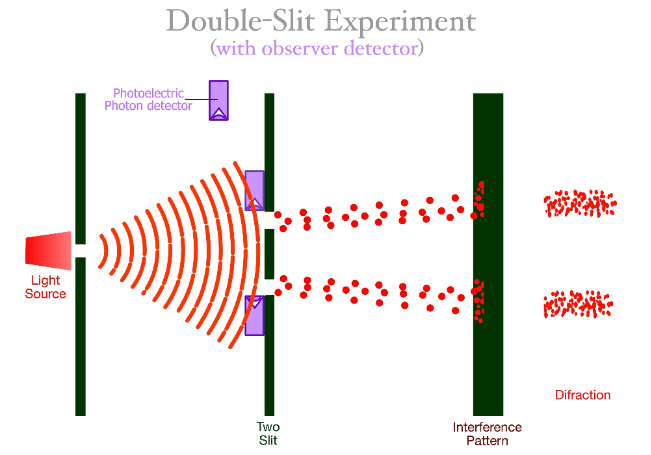
The Wave Function and Probability
- Wave Function: A mathematical equation (\(\Psi \)) that contains all the physical information about a quantum system.
- Superposition: The physical state where an electron exists in all possible locations at the exact same time.
- Born Rule: A principle stating that squaring the wave function’s amplitude gives the actual probability of finding the particle at a specific spot.
The Collapse of the Wave Function
When a measurement or observation occurs, the physical state shifts instantly:
- Interaction: A detector, photon, or measuring device interacts with the unlocalized electron wave.
- Collapse: The spread-out wave function abruptly sharpens into a single, highly localized spike.
- Localization: The electron materializes at one specific point, registering as a definitive particle.
The Double-Slit Evidence
The most famous proof of this behavior is the double-slit experiment:
- Unobserved: Fired electrons travel through both slits simultaneously as spread-out waves, creating an interference pattern on a background screen.
- Observed: Placing a detector at the slits forces each electron to localize, destroying the wave behavior and making them pass through only one slit like tiny bullets.
This disproves the retard’s wrong misunderstanding that the electron is located at a precise single location, even without being observed, and then instantly “jumps” to another precise location. What really happens is the probability of the electron being at various points in space, if you were to choose to observe it, changes over time, but since it is never at a specific point in space when it is not observed, the visualization of the electron being at point A and then “jumping” to point B is false. The electron never “makes jumps”.
Next I will begin by quoting a section from my own article “Introduction to Physics” which I wrote while I was inside of the Hanford Jail.
Let’s say you had the following points.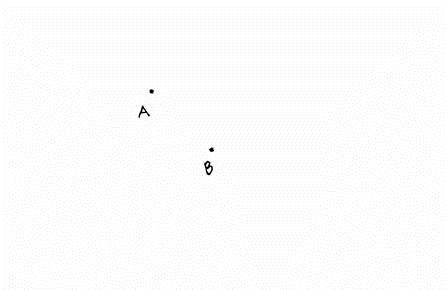
What is the position of these points? Well, right now, you do not have enough information to answer this question. You need to add a coordinate system to be able to identify the position of the particles.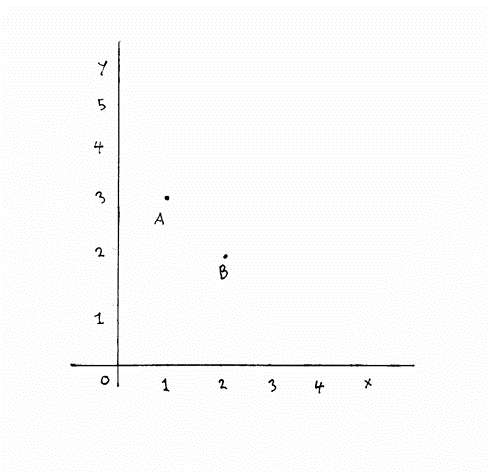
Now let’s say that the position of A is (1,3), and the position of B is (2,2). However, the coordinate is arbitrary. If you had used a different coordinate system, the numbers would be different. Let’s add a second coordinate system.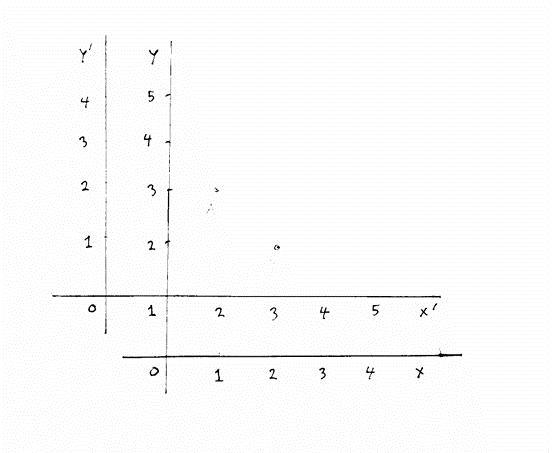
In the new coordinate system, the position of A is (2,2), and the position of B is (3,1). Therefore the positions of the particles depend on the coordinate system.
Now, so far, the particles were static and not moving. Now let’s add a third particle that is moving to the right.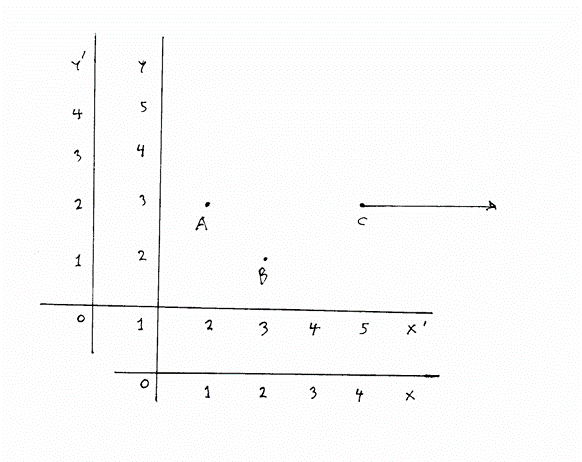
Particle C is moving to the right.
Now if you calculate the velocity, the number of units of distance that C moves per unit of time, you get the same answer whichever of the two coordinate systems you use. Now this would seem to imply that velocity, unlike position, does not depend on the coordinate system. However, let’s add a third coordinate system that is moving to the right at the same velocity as C, from the point of view of the other two coordinate systems.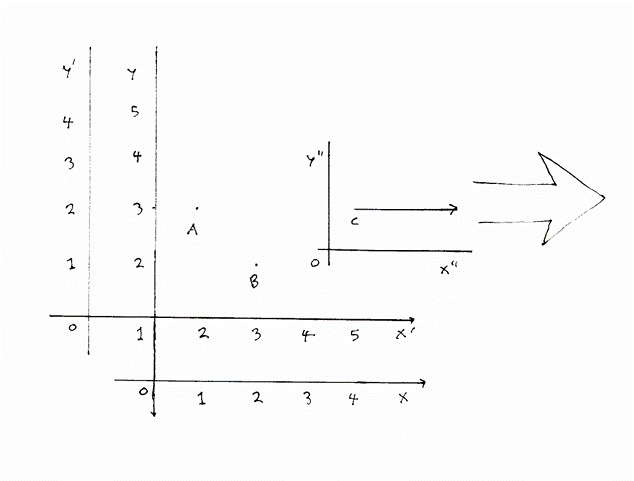
The third coordinate system is moving to the right.
In the third coordinate system, particle C is not moving at all! Therefore, velocity, like position, depends on the coordinate system. Velocity is not objective. Different observers will not in general agree about what the velocity of an object is. We refer to these coordinate systems as “reference frames”. Everything is motionless in its own reference frame.
The average person does not understand the concept of reference frames. The average person is under the mistaken impression that there is such a thing as a preferred reference frame, when in reality, no reference frame is preferred. Let’s say you are on a train traveling at 60 mph. You throw a baseball in the direction that the train is traveling at 5 mph. From the reference frame of the train, the baseball is traveling at 5 mph. From the reference frame of the ground, the baseball is traveling at 65 mph. Both reference frames are equally valid. However, members of the public often think the baseball is “really” traveling at 65 mph. Members of the public often think that the statement that the baseball is traveling at 65 mph is “more true” than the statement that the baseball is traveling at 5 mph. That’s wrong. Both statements are equally true. The source of confusion is that most people spend their entire lives on the surface of the Earth, where the ground under your feet is an obvious reference frame that you can always use, that is always true, that everyone agrees upon. It creates the illusion that there is such a thing as a preferred reference frame. It creates the false impression that there is such a thing as a preferred reference frame. If you were in interstellar space, it would be obvious that there is no such thing as a preferred reference frame. If you choose the Sun as your frame of reference, then the Earth orbits the Sun. If you choose the Earth as your frame of reference, then the Sun orbits the Earth. Everything is motionless in its own reference frame. You have probably heard from idiot on the Internet say that he doesn’t believe in time travel, not because it violates causality, closed time-like curves, the grandfather paradox, etc. but instead because “the Earth is not in the same place that it was 24 house ago”. That’s your reason for not believing in time travel? Of course if you choose the Earth as your frame of reference, then it is always in the same place.
Normally the measured velocity of an object depends on what reference frame that you are in. Different people in different reference frames would measure the velocity to have different values. Now let’s say that there was something that was always measured to have the same velocity no matter what reference frame you were using. Different people in different reference frames would measure its velocity to always have the same value, regardless of their own relative motion. Let’s call this the invariant speed. I said before that everything is motionless in its own reference frame. If an object was traveling at the invariant speed, what would be its velocity in its own reference frame? On one hand, everything is motionless in its own reference frame so its velocity is zero. On the other hand, the invariant speed is always measured to have the same value regardless of the reference frame, so its velocity would be the invariant speed. The solution to the paradox is that the invariant speed can not be used as a reference frame. Any massless particle necessarily travels at the invariant speed. Any particle with mass necessarily travels less than the invariant speed. A photon is a massless particle, and therefore travels at the invariant speed. Since this is how it was first discovered, the invariant speed is usually called “the speed of light”? Since anything with mass could be used as a reference frame, and the invariant speed can not be used as a reference frame, therefore nothing with mass can travel the speed of light. Today, the speed of light is defined as exactly 299,792,458 meters per second. The meter is defined in terms of the speed of light, as the distance light travels in a certain fraction of a second.
If you are not allowed to travel the invariant speed, would you be allowed to travel faster than the invariant speed? If you are currently traveling slower than the invariant speed, and you were trying to accelerate to a speed faster than the invariant speed, you would have to, at some point, pass through the invariant speed, which is not allowed. Therefore, you can’t travel faster than light. It would be more accurate to say that there is no such thing as “faster than light”. Faster than light in one reference frame would be backwards in time in another reference frame. If you could send a message faster than light, you could send a message backwards in time, and the message could be “do not send the message”. Assuming that you obey, would you send the message or not? The phrase “faster than light” is a meaningless phrase like “south of Antarctica”. The problem is that the average person does not understand this because the average person in their daily life has never encountered a speed where there is no such thing as a higher speed. What they have encountered is driving down the road, and seeing a sign saying the speed limit. The average person assumes the speed of light is similar. That is wrong. It’s not that you’re not allowed to go faster than light. It’s that there is no such thing as faster than light. It does not matter how advanced your technology is. Science fiction writers try to think of loopholes but none of those things would work in real life. Transversible wormholes are impossible. Warp drive is impossible. Interstellar travel will be forever impossible except for the closest stars. If people understood this, nobody would believe in UFOs. This is the proof of the nonexistence of UFOs.
That is the end of the quote from my paper “Introduction to Physics”.
Since a photon can not be used as a reference frame, you can not speak of the point of view of a photon. However, the retard thinks that you can speak of the point of view of a photon, and then claims that from the point of view of a photon, all events or points in time are simultanous. This is false because a photon can not be used as a reference frame which means that you can not speak of the point of view of a photon. A massless particle, such as a photon, by definition travels at the invariant speed regardless of the reference frame from which you are measuring its speed. If you could use the photon itself as a reference frame, what would it speed be measured to be from that reference frame? On one hand, it would be motionless since everything is motionless within its own reference frame. On the other hand, its speed would be the invariant speed, since its speed is measured to be the invariant speed in all reference frames, by definition. The only ay out of this paradox is to say that a massless particle can not be used as a reference frame. Because a photon can not be used as a reference frame which means that you can not speak of the point of view of a photon. So we have so far established false statements or examples of very bad misunderstanding made by the retard.
1. Electrons make jumps. This is false because an electron does not have a localized position when it is not observed.
2. From the point of view of a photon, all events are simultaneous. This is false because a photon can not be used as a reference frame, and therefore you can not speak of the “point of view” of a photon.
The retard then apparently believes that there is no difference between an electron and a photon, and then made the following false statements.
1. Photons make jumps. This is false because a photon does not have a localized position when it is not observed.
2. From the point of view of a photon, all events are simultaneous. This is false because a photon can not be used as a reference frame, and therefore you can not speak of the “point of view” of a photon.
However, now we have a new phenonoma which is that these two statements, in addition to being false, also contradict each other.
If a photon made jumps, that would mean that it is at point A and instantly jumps to point B. That would mean that it was at point A first and point B second. This would contradict the claim that from the point of view of a photon, all events or points in time were simultaneous.
If from the point of view of a photon, all events were simultaneous, then from from the point of view of a photon, point A and point B would be simultaneous, or A could not come before B. This would contradict the claim that a photon made jumps, that would mean that it is at point A and instantly jumps to point B. That would mean that it was at point A first and point B second.
If a photon made jumps (which is doesn’t), that would mean that all events were not simultaneous to the photon (which they are not).
all events were not simultaneous to the photon (which they are not), that would mean a photon does not make jumps (which is doesn’t).
Therefore, not only are these two false statements false, but in addition to being false, they also contradict each other.
Here are the two false statements.
1. Photons make jumps. This is false because a photon does not have a localized position when it is not observed.
2. From the point of view of a photon, all events are simultaneous. This is false because a photon can not be used as a reference frame, and therefore you can not speak of the “point of view” of a photon.
The following are true about both false statements. They are both
A) False
B) Contradict the other
C) Believed by the retard
The retard not only believes two false statements but also believes two false statements that contradict the other! If you just believed one of the false statements, you would merely be stupid. However if you simultaneously believe two false statements which, in addition to being false, also contradict each other, then you are mentally retarded. This retard never seemed to notice that these false statements contradicted each other, and so the retard believed them both simultaneously, despite the fact that they contradicted each other.
None of this has anything whatsoever to do with whether space or spacetime is quantized or discretized.
Then the retard made another glaring error which revealed shocking ignorance. The retard read an article about the 2022 Nobel Prize in Physics, and saw the phrase “non-locality”. The retard had no idea what the word “non-locality” meant, and guessed incorrectly that it had something to do with the retard’s false claims that an electron makes jumps, or a photon has a point of view, or whatever the hell the retard is droning on about. Of course the phrase “non-locaity” n the context of quantum mechanics has absolutely nothing to do with the retard’s misunderstanding of the word or any of the false claims in the retard’s rambling incoherant post. Obviously photons do not “make jumps”. That is nonsense. Obviously, there is absolutely nothing whatsoever about the 2022 Nobel Prize in Physics that in any way implies thhat photons “make jumps”. That is nonsense. Yet the retard is under the mistaken impression that the 2022 Nobel Prize has something to do with photons “making jumps” when nobody ever said any such thing. The retard keeps tossing around the word “non-locality” without having the slightest clue what that words mean. The retard was proudly citing the 2022 Nobel Prize in Physics as if it constituted some sort of vindication for the retard while having zero understanding of what the 2022 Nobel Prize in Physics was actually awarded for.
The 2022 Nobel Prize in Physics was awarded to Alain Aspect, John F. Clauser, and Anton Zeilinger for groundbreaking experiments with entangled photons, which definitively proved that the universe is governed by quantum non-locality. Their pioneering work demonstrated that two entangled particles can remain instantaneously connected regardless of the physical distance separating them, fundamentally shifting our understanding of physical reality.
1. Defining Quantum Non-Locality
Classical physics relies on the principle of local realism, which asserts two core concepts:
- Realism: Objects have definite, measurable properties before they are observed.
- Locality: Physical processes cannot transmit information or influence faster than the speed of light.
Quantum non-locality violates these rules. When two particles are entangled, their quantum states are fused into a single system. Measuring the property of one particle (such as its polarization or spin) instantaneously dictates the state of its entangled partner. This correlation persists even if the particles are separated by light-years, completely defying classical locality.
2. The Einstein-Podolsky-Rosen (EPR) Paradox
The debate over non-locality began in 1935 when Albert Einstein, Boris Podolsky, and Nathan Rosen published the EPR paradox.
- The Claim: Einstein rejected the idea of instantaneous influence, famously calling it “spooky action at a distance.” He argued that quantum mechanics was incomplete.
- Hidden Variables: The EPR paper proposed that the particles must carry predetermined instructions, known as “local hidden variables,” which dictate the measurement outcomes long before they are observed.
3. Bell’s Theorem: The Theoretical Turning Point
In 1964, Northern Irish physicist John Stewart Bell transformed this philosophical debate into an experimental question. He mathematically proved that if local hidden variables were real, there would be a strict upper limit to how correlated the measurement outcomes of two separated particles could be. This boundary is known as Bell’s inequality. If experiments could show correlations that exceeded this mathematical limit, local realism would be proven false, confirming quantum non-locality.
4. The Nobel-Winning Experiments
The 2022 Nobel Laureates progressively closed experimental loopholes to confirm that Bell’s inequality is violated in nature.
| Laureate | Experimental Contribution | Impact on Non-Locality |
|---|---|---|
| John F. Clauser | Built the first practical experiment to test Bell’s inequality using entangled photons. | Proved a clear violation of Bell’s inequality, favoring quantum non-locality over local realism. |
| Alain Aspect | Introduced a mechanism to switch polarization analyzer orientations while photons were in flight. | Closed the “locality loophole” by ensuring the settings could not communicate via sub-light signals. |
| Anton Zeilinger | Utilized multi-particle entanglement and demonstrated quantum teleportation. | Extended non-locality to complex networks, paving the way for practical quantum information technologies. |
5. Implications for Modern Physics
The validation of non-locality does not mean we can use entanglement to send messages faster than light; the random nature of quantum measurements prevents faster-than-light communication, preserving Einstein’s theory of relativity. Instead, it proves that the universe cannot be explained by local hidden variables.
Today, quantum non-locality is no longer just a philosophical curiosity. It serves as the foundational resource driving the development of quantum computing, secure quantum cryptography (such as Quantum Key Distribution), and the architecture of a future quantum internet.
None of this had anything to do with whatever the retard was babbling about. The retard also thought that their incoherent rabbling diatribe and very bad misunderstanding was an argument for space being discretized. Absolutely nothing that we have been talking about has anything whatsoever to do with wether space is discretized. Nobody knows why the retard thinks that it might.
Particles never “make jumps”. You might see a diagram showing electrons filling electron shells but that is just done for illustrative purposes. Physicists know that is not a literal picture. Even if particles “made jumps”, that would in no way imply that spacetime was discretized. If spacetime was discretized, that would in no way imply that particles “made jumps”. The 2022 Nobel Prize in Physics does not in any way imply that particles “make jumps”. The 2022 Nobel Prize in Physics in no way implies that spacetime is discretized. None of these things have anything to do with each other.
Currently, in advanced theoretical physics, it is an open question whether space is discretized.
The theory of discretized space suggests that space is not a smooth, continuous fabric, but is instead made of tiny, indivisible units or “pixels,” usually thought to be at the scale of the Planck length (1.6 x 10^-35 meters).
Here are the primary arguments for and against this theory.
Arguments For Discretized Space
- Resolves Infinities: Continuous space leads to mathematically impossible infinities in quantum field theory. Discrete space provides a natural cutoff point that eliminates these infinities.
- Quantization Consistency: Most other fundamental aspects of physics—like light, energy, and matter—are quantized. It is logically consistent that spacetime would be quantized too.
- Black Hole Thermodynamics: Jacob Bekenstein and Stephen Hawking showed that black hole entropy is proportional to the surface area of its event horizon. This suggests information is stored in discrete, finite Planck-sized bits.
- Loop Quantum Gravity (LQG): This leading candidate for a “Theory of Everything” successfully describes space mathematically as a network of intersecting quantum loops, implying a minimum possible volume.
Arguments Against Discretized Space
- Violates Lorentz Invariance: Einstein’s theory of Special Relativity relies on Lorentz invariance, meaning the laws of physics are the same for all observers. A discrete grid could break this symmetry, as the grid would look different to an observer moving near the speed of light.
- Lack of Experimental Evidence: The Planck scale is far too small for current technology to probe directly. Particle accelerator experiments and observations of cosmic rays have found no evidence of a spatial grid down to incredibly tiny scales.
- The Cosmic Ray Paradox: If space were discrete, high-energy cosmic rays traveling across the universe should interact with the spatial grid, lose energy, and slow down. Observations show these rays arrive with their high energies intact, indicating space is smooth even at extreme scales.
- Alternative Explanations: Other major framework theories, like String Theory, can resolve quantum infinities without requiring space itself to be chopped up into discrete blocks.
Obviously the retard would not understand any of this, and nothing the retard said has anything to do with it.


Leave a comment