Ernest Rutherford is most famous for discovering the atomic nucleus in his gold foil experiment in 1909. Ironically, he did not get the Nobel Prize for it because he had gotten the Nobel Prize in Chemistry the year before in 1908, for radioactive decay, and they were hesitant to give him a second one, especially for related work, although he was nominated 27 times. Rutherford also quipped that all of science is either physics or stamp collecting. It was not true at the time he said it but historically it was true. Before Darwin, biologists just classified life without explaining why. Before plate tectonics, geologists just classified rocks without explaining why. Before nuclear physics, chemists just classified elements without explaining why. Later they discovered the underlying reasons for the classifications they invented earlier. It is human nature that when confronted with a large number of things that are similar in some ways but different in other ways, that you will try to classify them based on their characteristics.
🧬 Biology (Pre- vs. Post-Darwin)
- The Stamp Collecting Era: Carl Linnaeus created his massive taxonomic system in the 1700s. It was brilliant cataloging, but it offered no underlying mechanism for why a cat and a leopard shared traits beyond “divine design.”
- The Predictive Pivot: In 1859, Charles Darwin introduced natural selection. Instantly, the “stamps” (species) became a connected tree of life, turning classification into a dynamic map of evolutionary history.
🪨 Geology (Pre- vs. Post-Plate Tectonics)
- The Stamp Collecting Era: Early geologists mapped strata and categorized minerals based on hardness, color, and location. They could tell you where a mountain was, but not the unified force that put it there.
- The Predictive Pivot: The acceptance of plate tectonics in the 1960s completely unified the science. Volcanoes, earthquakes, and mountain ranges were no longer isolated anomalies; they were predictable outcomes of moving crustal plates.
🧪 Chemistry (Pre- vs. Post-Quantum Mechanics)
- The Stamp Collecting Era: Dmitry Mendeleev built the Periodic Table in 1869 by grouping elements by their weights and behaviors. It was the ultimate stamp album — highly organized, yet no one knew why the intervals repeated.
- The Predictive Pivot: The discovery of the electron and the development of quantum mechanics in the early 1900s revealed that electron shells dictate chemical behavior. Chemistry was effectively explained by the underlying physics of electromagnetism.
🌌 The Pattern of Scientific Maturity
Every discipline seems to follow this exact three-step evolutionary trajectory:
- Observation: Gather data and spot patterns (Stamp Collecting).
- Unification: Discover the core mechanism driving the patterns (The Theory).
- Prediction: Use the theory to forecast undiscovered phenomena (True Science).
The evolution of stellar astronomy perfectly mirrors the “Stamp Collecting to Predictive Science” pattern. For centuries, stargazers could only catalogue what stars looked like from the outside. It took the birth of quantum mechanics and nuclear physics to finally unlock what stars actually are.
🏷️ Phase 1: The Stamp Collecting Era (Taxonomy)
In the late 19th and early 20th centuries, Harvard University astronomers — most notably Annie Jump Cannon and Antonia Maury — began cataloguing the light signatures (spectra) of hundreds of thousands of stars.
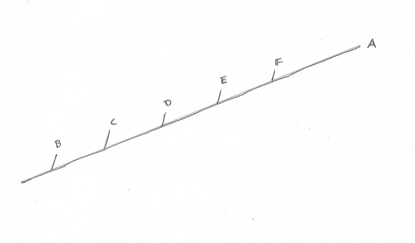
- The Classification: They sorted stars into alphabetical categories based on the strength of their hydrogen lines: A, B, C, D… all the way to Q.
- The Mystery: This was pure stamp collecting. Astronomers had created a massive, beautifully organized card catalogue of stars, but they had absolutely no idea what the letters meant. They did not know a star’s composition, its temperature, or why the lines varied.
📐 Phase 2: The Transitional Pattern (The HR Diagram)
Between 1911 and 1913, Ejnar Hertzsprung and Henry Norris Russell plotted these “stamps” on a graph, charting stellar luminosity (brightness) against their spectral color.
- The Discovery: They noticed a distinct pattern: most stars fell along a single, continuous diagonal band (the Main Sequence).
- The Missing Link: This was a massive leap forward because it proved the categories weren’t random. However, it still lacked an underlying physical mechanism. Russell initially guessed — incorrectly — that stars started out big and red, then shrank and cooled as they aged.
⚛️ Phase 3: The Predictive Pivot (Astrophysics)
The ultimate shift from description to explanation happened in 1925 with a groundbreaking doctoral thesis by British-American astronomer Cecilia Payne-Gaposchkin.
- The Physics Applied: Payne applied the newly minted laws of quantum mechanics (specifically atomic ionization theory) to the stellar spectra collected at Harvard.
- The Revelation: She discovered that the alphabetical “stamps” (rearranged to O, B, A, F, G, K, M) were actually a direct measurement of a star’s surface temperature, not its age.
- The Overwrite: More shockingly, her physics proved that stars are composed almost entirely of hydrogen and helium. At the time, the scientific establishment (including Henry Norris Russell himself) believed stars had the same chemical composition as Earth. Payne’s application of physics completely overthrew that premise.
🔋 Phase 4: The Core Mechanism (Nuclear Fusion)
While Payne explained what stars were made of and how hot they were, science still didn’t know how they shined.
In 1938, Hans Bethe used nuclear physics to calculate the proton-proton chain and the CNO cycle. He proved exactly how stars fuse hydrogen into helium, unlocking the ultimate mechanism behind the entire Hertzsprung-Russell diagram.
With Bethe’s equations, astronomy officially matured into astrophysics. Stars were no longer just pretty lights to categorize — they were predictable, quantifiable nuclear reactors.
I am going address how people appeached this monumental task in the field of biology, and how their philosophy changed throughout history.
I lived in Vancouver, and like everyone living in this city, I wish I had a penny every time I heard the phrase, “We acknowledge the unceded territory…” One time when I was at the Vine Arts Festival, an Indian woman said that her six year old son enjoying throwing a stick, pretending that it’s spear, saying that he was going to use it to “make war on Canada”. Also, at the Vine Arts Festival, I saw a teenage Native American boy wearing a T-shirt that read “I am not ready for reconciliation”. When I was at Canada Day at Canada Place during the Canada 150 celebration, I saw a Native American man wearing a t-shirt that read, “You: 150, Me:10,000+”. One time when I was at the Vancouver Folk Music Festival, a woman on stage compared sending Native American children to the white man’s school with the Holocaust. When I was at the ironically named “March for Science”, which was an anti-science event held at Science World, the keynote speaker with an Indian woman who was a shaman who led drum circles and vision quests. Physicists at UBC complained about her selection as the keynote speaker. When she was on stage, she derisively ridiculed modern Western science, claiming erroneously that they were only rediscovering what her ancestors knew thousands of years ago. Pretending that she was talking to a scientist, she put on a mocking patronizing insulting tone of voice, and said, “I am glad that you are finally catching up to us! That’s good!” At the Talking Stick Festival at Yaletown Roundhouse, the Native Americans, with a big smile on their face, derisively refer to non-Indians in Vancouver as “guests”, implying that they are generously allowing you to live in your house on your land which you paid money for. They also refer to the white New Age hippies and witches in Vancouver as “thieves” because they go into the forest to gather supposedly medicinal herbs and magic mushrooms, as if the Native Americans owned all naturally occurring organisms or that there was a shortage of any of these things.
In Vancouver, there is Native American performance group called “Tsatsu Stalqayu”, which translates as “Coastal Wolf Pack”. They are a multigenerational Coast Salish traditional song-and-dance group based in Vancouver, representing communities like Musqueam, Squamish, Tsartlip, and Nanaimo. To their great credit, they lack the overt anti-white racism that you come to expect from the Indians in Vancouver. I have seen these people many times, such as the Vancouver Folk Music Festival, the Talking Stick Festival, and Canada Day at Canada Place. They put on a performance that includes a 12 foot tall humanoid puppet dressed in full Salish regalia. The puppet is supposed to represent “Xe:Is” which is a creator god in their mythology. The puppet was made by the Mortal Coil Performance Society. In their performance, they act out the creation myth of the Coast Salish.
The Core Myth: The Birth of the Three Realms
Instead of a single human-centric narrative, the performance retells how the universe was carefully structured into interdependent domains. It honors the shared birth and sacred beauty of the land, the sea, and the sky.
- The Transformer/Creator (Xe:ls): Played by the 12-foot giant puppet Me’k (Elder), this central figure uses large-scale movements to shape the physical landscape of the Pacific Northwest and call forth its living components.
- The Emergence of Animals: The performance highlights how the animal kingdoms were established before humans. Through traditional Coast Salish choreography, dancers embodying specific creatures move counter-clockwise — the sacred direction of Coast Salish ceremonial dance.
Interactivity and the “Unfinished” Story
Rather than leaving the myth in the past, the performance links the ancient creation story directly to the modern climate crisis and environmental stewardship.
- The Living Inheritance: The storytelling details how the Coast Salish people inherited a pristine world with the cultural obligation to act as stewards of the water and land.
- The Open Ending: The performance deliberately leaves the final chapter unwritten. It concludes by presenting the audience with a stark visualization of the earth’s current environmental struggles and asking a single, punchy question: “You tell me how the story ends.”
In their story, they talk about the three realms of water, sky, and land. They divide all animals into four categories, which are the swimmers, the flyers, four legs, and two legs, which are humans. It is not surprising that they divided animals into four groups because they believe that the number four is sacred, such as the four seasons and the four compass directions. Let’s look at this from the point of view of taxonomy in biology. The swimmers are every marine and freshwater animal. It includes all fish, marine invertebrates, freshwater invertebrates, amphibians, marine mammals, and freshwater mammals. The flyers are all flying animals, so it would include all birds, flying insects, and bats. The four legs are all land vertebrate tetrapods, so it would include the vast majority of reptiles and mammals. The two legs is reserved for humans alone.
So we can make a couple of observations about this as a taxonomic system.
First of all, there are many animals who do not all into any of these four groups. All terrestrial invertebrates are excluded from any of these groups. All crawling insects are excluded. All snakes are excluded. There is no group for land animals without four legs. They do not fall into any of these four categories.
Second of all, for some animals, it is ambiguous which group they should fall into. Do river otters spend enough time in the water do count as “swimmers”, or should they be considered “four legs”?
Third of all, unrelated animals with very little similarity are lumped together into the same group. Fish, squid, whales, sea otters, and frogs are very different from each other but are placed in the same group simply because they live in the water. Birds, flying insects, and bats are very different from each other, and yet are placed in the same group simply because they are fly.
Fourth of all, it is exceedingly simple. There are only four groups, and no subgroups, which does not seem like an effective way to capture the enormous diversity of animal life.
Fifth of all, humans are considered special, and somehow preferred, because they are the only species assigned to their own group. There are only four groups, and yet one of the four groups has only one species in it. On one hand, humans are included with the other animals because they are included in this taxonomic system. On the other hand, they are also set apart because they are the only animal given their own group, acknowledging their unique status. This tension between thinking of humans as similar to other animals, and thinking of them as extremely different, has existed in biological taxonomy throughout history, and we still have it today.
So what did they use to define membership in a group in the Coast Salish taxonomic system? They based on the environment they lived in, and their method of locomotion. So what they are doing is that they are using characteristics to determine what category an animal is placed in. Different variations on this theme was how all biological taxonomic classification was done up until Charles Darwin.
1. Coast Salish: Relational & Cosmological Taxonomy
The Coast Salish organize the natural world not by what an animal looks like structurally, but by its realm of existence, behavioral spirit, and kinship to humans.
[ COSMIC CIRCLE / ALL LIFE ]
                              │
       ┌──────────────┬───────┴──────┬──────────────┐
       ▼              ▼              ▼              ▼
   [ FLYERS ]    [ SWIMMERS ]   [ FOUR-LEGS ]  [ TWO-LEGS ]
    (Sky)          (Water)         (Land)        (Humans)
- Core Logic: Life is divided into four sacred pillars based on habitat and locomotion: Flyers, Swimmers, Four-Leggs, and Two-Leggs (Humans).
- Defining Feature: Boundaries are fluid. Physical forms are “cloaks,” allowing for spiritual transformation across realms (e.g., a Land Wolf becoming a Sea Killer Whale).
- Human Position: Humans are placed on a horizontal plane of equality (or as the vulnerable “youngest siblings”) to animals, tied by literal ancestral lineage and stewardship.
2. Aristotle: The Scala Naturae & Functional Logic
In ancient Greece, Aristotle developed the first formalized Western taxonomy, categorizing organisms by their teleology (purpose) and vital soul.
[ THE LADDER OF BEING ]
                           ▲
                           │  [ Humans ] (Rational Soul)
                           │  [ Animals ] (Sensitive Soul / Movement)
                           │  [ Plants ] (Vegetative Soul / Growth)
                           │  [ Non-Living Matter ] (Inanimate)
- Core Logic: A strict, linear hierarchy called the Scala Naturae (Great Chain of Being), ranking life from “lowest” to “highest.”
- Defining Feature: He divided animals into two primary groups: Enaima (with red blood, roughly vertebrates) and Anaima (without red blood, roughly invertebrates), further sorting them by their method of reproduction and locomotion.
- Human Position: Humans sit at the absolute apex of the natural world, uniquely possessing a “rational soul” that rules over animals and plants.
3. Medieval Bestiaries: Allegorical & Moral Taxonomy
Medieval European bestiaries abandoned physical and biological accuracy entirely, organizing animals based on their Christian allegorical meaning and moral lessons.
[ MORAL DIALECTIC OF LIFE ]
                           │
             ┌─────────────┴─────────────┐
             ▼                           ▼
      [ SAINTLY VIRTUES ]         [ DEVILISH VICES ]
    (Pelican = Christ's sacrifice)  (Serpent = Deceit & Satan)
- Core Logic: Animals were grouped by their symbolic attributes and theological lessons rather than physical traits or habitats.
- Defining Feature: Real animals (lions, eagles) were categorized identically alongside purely mythical ones (unicorns, dragons) because both served the same purpose: illustrating biblical truths or vices.
- Human Position: The animal kingdom was viewed strictly as a living textbook created by God for human moral instruction.
4. Carl Linnaeus: Morphological & Binomial System
In the 18th century, Linnaeus revolutionized science by creating a standardized, nested hierarchy based purely on shared physical and anatomical structures.
[ KINGDOM ] ➔ [ CLASS ] ➔ [ ORDER ] ➔ [ GENUS ] ➔ [ SPECIES ]
- Core Logic: Organisms are sorted into fixed, unchanging boxes based on sexual organs (in plants) and anatomical traits (in animals). It introduced binomial nomenclature (e.g., Homo sapiens).
- Defining Feature: It is a static “snapshot” system. Linnaeus believed species were created by God as fixed entities that never changed or morphed into other species.
- Human Position: While religious, Linnaeus made the groundbreaking move of classifying humans anatomically as animals, placing Homo sapiens inside the order of Primates alongside monkeys.
5. Charles Darwin: Phylogenetic & Evolutionary Tree
Darwin completely shattered the static, hierarchical models by proving that classification should reflect common descent and historical timeline. [1]
[ TREE OF LIFE ]
                              ▲
                 ┌────────────┴────────────┐
                 ▼                         ▼
            [ Species A ]             [ Species B ]
                 └────────────┬────────────┘
                              ▼
                     [ COMMON ANCESTOR ]
- Core Logic: A dynamic, branching “Tree of Life.” Animals are classified based on evolutionary relationships (phylogeny) and how recently they shared a common ancestor.
- Defining Feature: Physical traits are no longer just evaluated at face value; they are analyzed to see if they are homologous (inherited from a shared ancestor) or analogous (evolved independently, like the wings of a bird and a bat).
- Human Position: Humans are completely integrated into the evolutionary tree, stripped of any cosmic apex status, and viewed as a single twig on a massive, continuously branching bush. [1, 2, 3, 4, 5]
Summary Comparison
System Primary Axis Boundaries View of Animals Coast Salish Relational / Ecological Realms Fluid (Transformation) Ancestors, Teachers, & Equals Aristotle Intellectual / Functional Soul Fixed Ladder Lesser souls serving human intellect Medieval Theological / Moral Symbolism Alegorical Boxes Living metaphors for human morality Linnaeus Anatomical / Sexual Structures Fixed Nested Hierarchy Static biological specimens Darwin Historical / Genetic Descent Dynamic Branching Tree Evolutionary cousins sharing ancestry
The Expanded Taxonomic Hierarchy of the Linnaean system of Classification
- Domain: The highest modern level above kingdoms.
- Superkingdom
- Kingdom: The primary Linnaean base group.
- Subkingdom
- Infrakingdom
- Superphylum
- Phylum: Known as Division in botany.
- Subphylum
- Infraphylum
- Superclass
- Class: A core Linnaean rank.
- Subclass
- Infraclass
- Superorder
- Order: A core Linnaean rank.
- Suborder
- Infraorder
- Superfamily
- Family: A core Linnaean rank.
- Subfamily
- Tribe: An extra intermediate level between family and genus.
- Subtribe
- Genus: A core Linnaean rank.
- Subgenus
- Species: The base Linnaean rank.
- Subspecies: Variations within a single species.
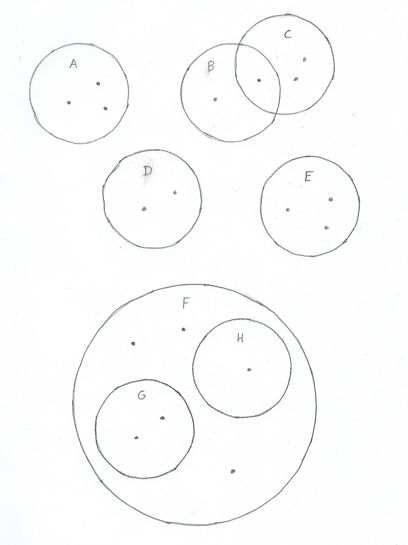
Despite their differences, up until Darwin, species, both plants and animals, were put into categories based only on their characteristics. If you were to draw this as a diagram, the categories would be sets that can be drawn as circles. The sets could have subsets and could overlap.
This taxonomic system says nothing about the evolutionary relationships between the groups. If we were the draw the lineages, you would see that membership of two species in one group has nothing to do with how long ago they had the common ancestor. You would see that lineages could both enter a group at any time after the beginning of the group, and also leave the group at any time. Membership in a group is defined only by possession of characteristics. If a lineage evolves a characteristic that defines membership in a pre-exiting group, it would enter a pre-existing group. If a lineages evolves to lose a characteristic that is a defining characteristic of a group that it is currently in, that lineage will leave the group.
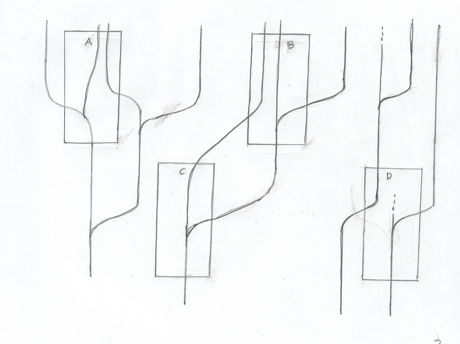
I call this type of taxonomic classification system “Type 0”. All taxonomic classification systems prior to Darwin were Type 0. What information does a Type 0 classification system communicate? In a Type 0 classification system, membership in a group is defined by one thing.
- Possession of specific characteristics
Therefore, if you are told that a species is a member of a group, that tells you one thing.
- The species possesses all of the characteristics that define membership in the group.
If you are told that a species is not a member of a group, from that, you can only conclude the following.
- The species does not possess at least one (possibly more than one) of all of the characteristics that define membership in the group.
At this point, you know literally nothing whatsoever about its ancestry. At this point, you can not say that the lineages currently in the group are descended from a specific common ancestor. Even if you assume that all life had a common ancestor, that common ancestor could have long predated the beginning of the specific group that you are talking about. You know that the lineage is currently in the group but you do not know if it evolved from the first species that was a member of the group or if the lineage entered the group at a different time. If you are talking about an extinct species that existed in the remote past, you do not know if the lineage later left the group. You know that the members in the group share characteristics but you do not know if they share those characteristics because they inherited those characteristics because their common ancestor had those characteristics, or if they both evolved those characteristics independently after their lineages diverged from their common ancestor. Both birds and bats are flying animals with wings but not because their common ancestor was a flying animal with wings.
After Charles Darwin, biologists started thinking about taxonomy in biology differently. They started thinking that membership in a group should communicate what the history of the lineage was. They started thinking that two species had similar characteristics because they inherited those characteristics from a common ancestor, which is not always true. Two species could share a characteristic, not because they both inherited from a common ancestor, but instead because they evolved it independently, long after their lineages diverged from a common ancestor without that characteristic. At the same time, people still believe that membership in a group requires possessing a list of specific characteristics that members of the group are required to have in order to be members of the group. If you look up the name of a specific group, say “mammals”, in the dictionary, it lists characteristics that members of the group have. If I say a name of a famous group, such as “feline”, “butterfly”, “primate” or “oak tree”, a picture pops into your mind. Well, what is the picture? The picture is a picture of an organism with a list of specific characteristics. If membership in a group had nothing to do with characteristics, no picture would appear in your mind since membership in a group would say nothing about what characteristics the species possesses. So then we are led to a type of classification system that I call Type I. In a Type I classification system, in order for a species to be member of a taxonomic group, in addition to possessing a list of specific characteristics, the species must also be descended from a specific species that all members of the group must be descended from in order to be members of the group.
In a Type I classification system, membership in a group is defined by two things.
- Descended from a specific common ancestor that is the basal point for the taxonomic group
- Possession of specific characteristics
Therefore, if you are told that a species is a member of a group, you know that both of the following statements must be true.
- The species is descended from a specific common ancestor that is the basal point for the taxonomic group.
- The species possesses all of the characteristics that define membership in the group.
If you are told that a species is not a member of a group, that means either one, or both, of the following two things are true.
- The species is not descended from a specific common ancestor that is the basal point for the taxonomic group
- The species does not possess at least one (possibly more than one) of all of the characteristics that define membership in the group.
If you are using a Type I classification system, and you are told a species is a member of a taxonomic group, you have more information than you would have if you were using a Type 0 classification system and told that a species were a member of a taxonomic group. In both cases, you know that the species is guaranteed to possess a list of characteristics but if you are using a Type I classification system, in addition to that, you also know that the species is descended from a specific common ancestor that is the basal point for the taxonomic group.
If you are using a Type I classification system, and you are told a species is not a member of a taxonomic group, you have less information than you would have if you were using a Type 0 classification system and told that a species were not a member of a taxonomic group. If you were using a Type 0 classification system, and were not that a species were not a member of a group, you would know that it does not possess all of the characteristics that define membership in the group. You would at least know that about the species. However, if you were using Type I, and were told that a species were not a member of the group, you would not even know that, because you would not know WHY the species was not a member of the group. It might be because the species one or more of the characteristics necessary to be a member of the group. It might be because it is not descended from a specific species that all members of the group must be descended from in order to be members of the group. It could be fr either of those reasons, or for both of those reasons. Both of those reasons might be true.
A taxon is what I have been calling a group or category. Within classification system Type 0, a lineage can either enter or leave a taxon. Within classification system Type I, a lineage can leave a taxon but can never enter a taxon. According to classification system Type I, a criterion for membership in a group is being descended from the first species that was a member of the group, that defined the beginning of a group. In order to be a member of a group, a species must be descended from the first member of the group, which means all lineages within a group have been within that group since the beginning of the group. Therefore, unlike Type 0, within Type I, a lineage can not enter a group after the beginning of the group. However, according to classification system Type I, in addition to being descended from the first member of the group, an additional criterion for membership in a group, is possessing a list of specific characteristics that all members of the group are required to possess in order to be members of the group. If a descendent of the first member of the group evolves to lose one of those characteristics, the lineage will leave the group.
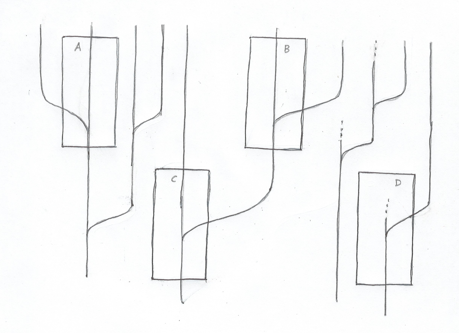
Let’s look at these two concepts that can be used to define membership in a group.
A. The species is descended from a specific common ancestor that is the basal point for the taxonomic group.
B. The species possesses all of the characteristics that define membership in the group.
In classification system Type 0, membership is defined by B, and not A. In classification system Type I, membership is defined by both A and B. This obviously leads you to consider the remaining possibility which is to define membership in a group by A and not B. I call this classification system Type II.
What information does a Type II classification system communicate? In a Type II classification system, membership in a group is defined by one thing.
- Descended from a specific common ancestor that is the basal point for the taxonomic group
Therefore, if you are told that a species is a member of a group, that tells you one thing.
- The species is descended from a specific common ancestor that is the basal point for the taxonomic group.
If you are told that a species is not a member of a group, from that, you can only conclude the following.
- The species is not descended from a specific common ancestor that is the basal point for the taxonomic group
At this point, you know literally nothing about its characteristics. At this point, the only thing you can say is that the lineage is descended from a specific common ancestor. You can NOT say that because it is a member of the group that it possesses such-and-such characteristics, no matter how obvious, fundamental, or universal those characteristics might naively seem. We know that species can evolve to be radically different from their ancestors and lose characteristics that might seem fundamental.
According to classification system Type II, any species that evolved from the first member of a group, the basal common ancestor of all members of the group, is necessarily, by definition, currently a member of the group, regardless of how different it is from the common ancestor, or most of the other current members of the group. What that means is that no lineage can ever leave a group. It also means that a group can not end until the last descendent of the first member of the group dies, or the last species descended from the original basal point goes extinct.
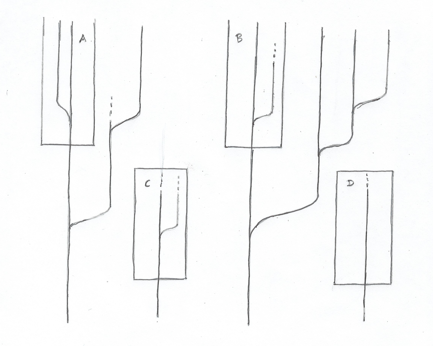
In classification system Type 0, lineages can both enter and leave a group.
In classification system Type I, lineages can leave a group but can not enter a group.
In classification system, Type 0, lineages can never enter nor leave a group.
This might initially seem quite reasonable at first but few biologists stop to consider the true ramifications of what this actually means. If no lineage can leave a group, that means that if A evolved from B, then A is a subset of B. It means A literally is B. Any member of A is, by definition, also a member of B. Any member of A is just as much a member of B as any other member of B. If B evolved from C, then B is a subset of C, which A is also a subset of C. Any member of B is a member of B is a member of C. Since every member of A is a member of B, that means that every member of A is also a member of C. You then keep going. If C evolved from D, that means C is a subset of D, and you going back to the first life on this planet.

A is a subset of B is a subset of C is a subset of D is a subset of E…
If mammals evolved from reptiles that means that mammals literally are reptiles. If reptiles evolved from amphibians that means reptiles literally are amphibians, which means mammals are also amphibians. If amphibians evolved from fish, that means that amphibians literally are fish, which means that mammals and reptiles literally are fish. Humans are just as much fish as tuna, halibut, cod, mackerel, sardines, red snapper, trout, herring, and goldfish. When I say “just as much”, I mean literally 100% just as much, not slightly less, but literally 100% just as much. According to Type II, humans are literally a type of fish, no different than the other types of fish that I listed. If somebody gave you the following list.
tuna, halibut, cod, mackerel, sardines, red snapper, humans, trout, herring, and goldfish
and then asked, “Which of these is not like the others?”, you would scratch your head, shrug your shoulders, and say
“Beats me! I don’t see any difference between any of those types of fish that you included on your list!”
In order to refer to fish without accidentally including humans, you would have to contrive a tortured phrase like “non-human fish”. All life on this planet evolved from Archaea. According to classification system Type II, if A evolved from B, that means A is B. Therefore, according to classification system Type II, all cellular life on this planet is Archaea. Humans would be Archaea.
Earlier I conducted a thought experiment where I tossed out phrases like “feline”, “butterfly”, “primate” or “oak tree”. No doubt pictures popped into your head when reading those words, which proves that you use classification system Type I because if you were using classification system Type II, no pictures would pop into your mind at all, because, according to classification system Type II, there is no such thing as what a member of a group “looks like”, because classification system Type II says literally nothing whatsoever about what characteristics an organism possesses. Type II only refers to ancestry. It says nothing about characteristics. If you are using Type II, it is meaningless to ask what a member of a specific group “looks like”. They could literally look like anything since Type II has nothing to do with characteristics. If you showed a picture of a cat to someone using classification system Type II, and asked them, “Is that a feline or an oak tree?”, they would have to answer, “There is no way to tell from the picture.”
If someone showed you a picture of a cat, and asked you, “Is this a feline or an oak tree?”, you would probably say “feline”. However, when you do that, what are you actually doing? You are seeing characteristics of the organism in the picture, and using those characteristics to identify what group it is a member of, which means that you are therefore using Type I, since Type II has nothing to do with characteristics. If you are using Type II, then by definition, you can NOT use the characteristics of organism to identify what group it is a member of. If you are using Type II, and somebody showed you a picture of a cat, and said, “Is this a cat or an oak tree?”, you are required to say. “There is no way to know from looking at the picture”. You might say that something that looks like a cat can’t evolve from something that looks like an oak tree but stranger things have happened in the history of this planet. All vertebrates, including humans, evolved from animals similar to tunicates which only had a primitive notochord in their larval phase, and none in their adult phase. If someone showed you a picture of an adult tunicate, you might think that it was hard to believe that humans evolved from something that looked like that but, indeed that is what happened. Furthermore, if you are using Type I, you are not required to say that humans are tunicates, but if you are using Type II, you are required to say that humans are tunicates. According to Type II, if A evolved from B, that means A is B, no matter how different it looks.
I said before that in response to Charles Darwin, biologists switched from Type 0 to Type I. Type I held sway for about 150 years. Then around the Millennium, the biology community shifted from Type I to Type II. There was never any discernable impetus for this cultural shift. It was apparently arbitrary but it took hold. Now this would all be fine and dandy if they just enthusiastically embraced Type II but that it not what they did. As I have explained, Type II is extremely counterintuitive to most people, so when biologists starting switching to Type II, instead of switching entirely to Type II, they would publicly pay lip service to Type I, while simultaneously clinging to Type I, in some cases, subconsciously clinging to Type I without realizing it, because Type II is so counterintuitive for most people.
Both Type I and Type II are internal consistent but they are inconsistent with each other. You have to choose one. You can’t do both at the same time. You can’t go back and forth. Trying to do both at the same time, has real world negative consequences. If you are using Type II, you would say that if A evolved from B, that means A is B. It would not bother you to say it. On the other hand, if you are paying lip service to Type II while subconsciously clinging to Type I, than it would bother you say that A is B. If you are clinging to Type I, you would think it “sounded ridiculous” to say that humans were a type of fish. If you really believed in your heart that Type II was the way to go then you would not think it “sounded ridiculous” to say that humans were a type of fish. You would firmly say with sincere conviction, “Of course humans are fish!”
Let’s say that the evolutionary relationship between A, B, and C is in dispute. Let’s say there is a debate as to which of the two following diagrams is correct. In the diagram on the left, A evolved from B which evolved from C. In the diagram on the right, A and B both evolved from C, where B evolved from C earlier than A evolved from C.
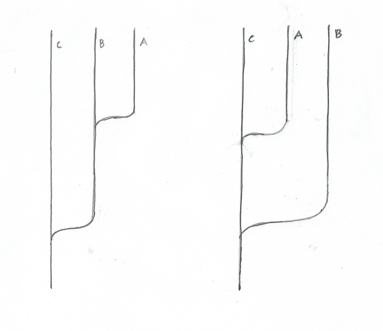
Often there is an incomplete fossil record, and there is more than interpretation consistent with the data. Which interpretation you endorse could be influenced by subconscious bias. You might select one interpretation because you prefer it. Why might someone prefer one of the two above diagrams over the other? Let’s say that person is using classification system Type II. According to the diagram on the left, A evolved from B, which means that, according to Type II, A is a subset of B. According to the diagram on the right, A did not evolve from B, which means that A is not a subset of B. If you really believed in heart that Type II was the way to go, it would not bother you to say A was a type of B. However, if you were paying lip service to Type II while subconsciously clinging to Type I, it would bother you to say that A was a type of B. That would give you a reason to prefer the diagram on the right to the diagram on the left. Therefore if a biologist is advocating the diagram on the right, you don’t know if that’s what the evidence is pointing to, or if the biologist is bias because that is what they would prefer because they don’t want to say that A is B, because they think that would supposedly “sound ridiculous”, although if they really believed in their heart that Type II was the way to go, then they would not believe that saying that A was a subset of B “sounded ridiculous”. On the other hand, if you don’t want to say that A is a type of B, you could simply achieve that goal by simply using Type I. According to Type I, A is not B in either of th two diagrams. There is nothing wrong with Type I. If you want to use Type I, then use Type I. There is nothing wrong with Type II. If you want to use Type II, then use Type II. The problem is people paying lip service to Type II while subconsciously clinging to Type I.
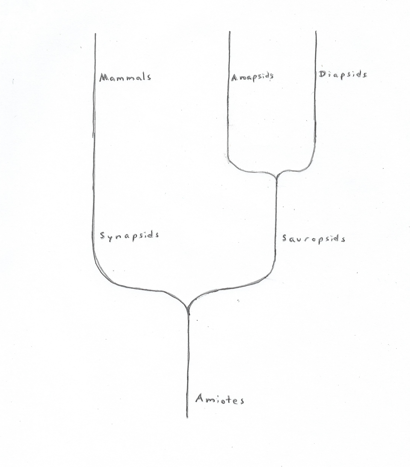
Next I am going to illustrate this with a few concrete examples. Below is the family tree describing the origin of reptiles.
[ Lobe-finned Fish ]
                                 │ (~365 Mya)
                                 ▼
                        [ Early Amphibians ]
                                 │ (~320 Mya)
                                 ▼
                         [ Early Amniotes ]
                                 │
         ┌───────────────────────┴───────────────────────┐
         ▼                                               ▼
   [ Synapsids ]                                   [ Sauropsids ]
(Single skull opening)                         (Ancestors to all reptiles)
         │                                               │
         ▼                               ┌───────────────┴───────────────┐
     Mammals                             ▼                               ▼
                                   [ Anapsids ]                    [ Diapsids ]
                              (Solid skull structure)         (Two skull openings)
                                         │                               │
                                         ▼                       ┌───────┴───────┐
                                  Early Turtles                  ▼               ▼
                                 (Testudines)            [ Lepidosaurs ]  [ Archosaurs ]
                                                          (Scaly lizards) (Ancient lizards)
                                                                 │               │
                                              ┌──────────────────┤       ┌───────┴───────┐
                                              ▼                  ▼       ▼               ▼
                                           Squamata        Sphenodontia Crocodilia   Dinosaurs
                                       (Snakes/Lizards)    (Tuataras)  (Crocodiles)      │
                                                                                         ▼
                                                                                       Birds
So you can see that Amniotes (which had zero skull openings) evolved into synapsids (which had one skull opening) and sauropsids (which had zero skull openings), and then sauropsids evolved into anapsids (which had zero skull openings) and diapsids (which had two skull openings). Ok, so where do you want to put the beginning of reptiles? Well, you can put it anywhere you want because these categories are all human inventions. The lineages and their evolutionary relationships are objectively true, independent of humans, put the idea of drawing a box around it, and giving it a name, is a human invention called a taxonomic system.
Let say you choose amniotes to be the first reptiles. In that case, if you are using Type I, you would say that mammals, including humans, are not reptiles because we evolved to lose characteristics that all reptiles must have in order to be reptiles. Mammals are warm blooded, have hair, milk, four chambered heart, etc. If you are using Type II, you would say that all mammals, including humans, are reptiles, by definition, regardless of how different we become from other reptiles, because no lineage can ever leave a category no matter how different it gets. You have no choice but to say that humans are reptiles because according to Type II, membership in a category has nothing to do with characteristics, and no lineage can ever leave a category.
Let’s say you choose sauropsids to be the first reptiles. In that case, if you use Type I, you would say that mammals are not reptiles for two different reasons. First of all, mammals are not descended from the basal species that all reptiles are descended from, and therefore not reptiles. Second of all, mammals lack characteristics that reptiles must have, by definition, and therefore not reptiles. Either of those two reasons alone would be enough to exclude mammals from the group called “reptiles”. If you are using Type II, you would say that mammals, including humans, are not reptiles, not because of their physical appearance or any other characteristics, which is irrelevant, but because the first official reptile occurred on a different lineage after the branch point between that lineage and the lineage that led to mammals. Someone using Type II would say that the reason humans are not reptiles has nothing to do with the fact that we have hair instead of scales, give birth to live young instead of laying eggs, are warm blooded instead of cold blooded, have a four chambered heart instead of a three chambered heart, none of those things, all of which are irrelevant, but instead, only because we are not descended from the randomly selected basal species of the group which we call “reptiles”, even though the decision as to where to designate the basal point, was always an arbitrary decision in the first place. Someone using Type II would say that humans are not reptiles, not because we are warm blooded, have hair, milk, or anything else, but instead only because we are not descended from sauropsids, which were randomly selected as the official basal point of the group called “reptiles”, although you could, just as easily with equal justification, have selected amniotes to be the official basal point of the group called “reptiles, which would have then forced anyone using Type II to say that humans were reptiles.
So let’s look at the following four combinations, whether you choose to officially designate amniotes or sauropsids as the basal point for the group called “reptiles” and whether you choose to use Type I or Type II.
1. Choose amniotes as first reptiles, use Type I — Humans are not reptiles.
2. Choose amniotes as first reptiles, use Type II — Humans are reptiles.
3. Choose sauropsids as first reptiles, use Type I — Humans are not reptiles.
4. Choose sauropsids as first reptiles, use Type II — Humans are not reptiles.
Of the four combinations, three of the four say that humans are not reptiles, and one of the four requires that you say humans are reptiles. As far as the underlying science is concerned, all four of these are equally valid since these are just arbitrary conventions. The two choices leading to the four combinations are all allowed and equivalent.
There are many similar examples in physics where different formalisms or conventions are mathematically equivalent. In quantum mechanics, you either work in the Schrodinger picture or the Heisenberg picture. The Schrödinger picture keeps operators static and evolves the state vectors, while the Heisenberg picture keeps state vectors static and evolves the operators. In superstring theory, you could either use the RNS formalism or the GS formalism. The RNS formalism manifests worldsheet supersymmetry. Spacetime supersymmetry is not obvious and must be explicitly constructed using the Gliozzi-Scherk-Olive (GSO) projection. The GS formalism manifests spacetime supersymmetry from the very beginning. Worldsheet supersymmetry is absent. In each of these cases, in some cases, it is easier to use one, and in other cases, it is easier to use the other so which you use depends on the circumstances. You can describe electron spin with either the Pauli spin matrices or quaternions, but we almost always choose the Pauli spin matrices. We use the Pauli spin matrices instead of quaternions to describe electron spin primarily because the Pauli matrices directly map to the x, y, and z spatial coordinates of experimental physics, and they seamlessly integrate into the complex-valued Hilbert spaces used throughout quantum mechanics. Similarly, even though the four options listed above are equally valid, the majority of biologists choose the fourth option. Why is that? It is not because one is easier to use, like the examples I gave from physics. The real reason is less justified than the reasons for choices of formalism or convention in physics.
The reason is this. Just to repeat, these are the four equivalent options.
1. Choose amniotes as first reptiles, use Type I — Humans are not reptiles.
2. Choose amniotes as first reptiles, use Type II — Humans are reptiles.
3. Choose sauropsids as first reptiles, use Type I — Humans are not reptiles.
4. Choose sauropsids as first reptiles, use Type II — Humans are not reptiles.
It has become fashionable for biologists to publicly pay lip service to Type II while secretly clinging to Type I. You don’t want to be caught out of lock step with current fashion. That would be like wearing a straw hat after September 15 which led to the Straw Hat Riot of 1922. If you are using Type II, you are then left with the following two options.
1. Choose amniotes as first reptiles, use Type II — Humans are reptiles.
2. Choose sauropsids as first reptiles, use Type II — Humans are not reptiles.
If someone actually believed in their heart that Type II was the way to go, they would enthusiastically embrace the first of those two options. They would say, “Of course humans are reptiles!” However, they don’t want to say that because they think it “sounds ridiculous”. Well, why would they think it “sounds ridiculous”? Someone that used Type II would not think that sounded ridiculous. Someone who used Type II would think it was great! The reason why they think it “sounds ridiculous” to say that humans are reptiles is because they are clinging subconsciously to Type I, while publicly paying lip service to Type II. Therefore if somebody wants to publicly pay lip service to Type II, because that’s the current fashion, but they don’t want to say that humans are reptiles because they think that “sounds ridiculous”, which they would not believe unless they were clinging subconsciously to Type I, they would then choose sauropsids as the basal point for the group called “reptiles”.
Now is that the secret real reason why most biologists have decided to choose sauropsids as the basal point for the group called “reptiles”? You have to at least be suspicious that that might be the secret real reason. The biologists could be subconsciously influenced by their own bias without being consciously aware of it. It is also very important to remember that if you make any reference to the number of holes in the skull then that means that you are therefore using Type I anyway, since only Type I makes any reference to characteristics of any kind.
Let’s take a graph of the evolution of reptiles, and put a dotted horizontal line across it. On a specific lineage, above the line, you call it “reptiles”, and below the line, you call it “proto-reptiles”.
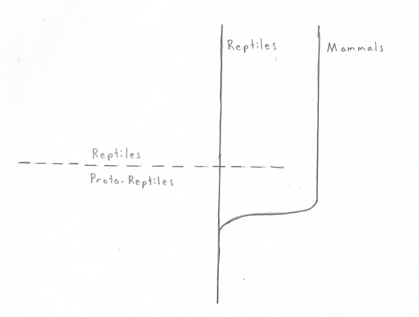
The location of the horizontal line is arbitrary so you can move it up and down however you want. If you want avoid the veiled snickers and condescending eye rolling you would receive from your colleagues if you did not pay the obligatory lip service to Type II, and also avoid the incredulous blank stares while apologetically mumbling, with a straight face, that humans are type of reptile, you might choose to put the arbitrary horizontal line above where the lineage leading the mammals branched off. However, wherever you choose to put the horizontal line, a so-called proto-reptile is going to be very similar to a reptile in any case. Therefore we are only arguing about which of two very similar things something is. That is not a hugely important debate. Any biological taxon X is going to evolve from a very similar thing you could call “proto-X”. Where you choose to put the line between X and proto-X is arbitrary, and X and proto-X are necessarily very similar. The first feline evolved from a “proto-feline” which was very similar to a feline. The first oak tree evolved from a “proto-oak tree” which was very similar to an oak tree. The first primate evolved from a “proto-primate” which was very similar to a primate. So what difference does it really make whether you call something X or “proto-X”?
The debate as to what to call it is not important. You are only arguing about what words to call something, like debating whether to call Pluto a planet. According to the International Astronomical Union (IAU), Pluto is a type of planet called a “dwarf planet”, but somebody else disagrees with the IAU and refuses to say that Pluto is a planet, that’s fine, because they are not claiming that Pluto is not spherical, does not have an atmosphere, is not geologically active, etc. They are not disagreeing about something physical, such as the diameter of Pluto, but instead what word to call it.
Reptiles evolved from reptiliomorphia, which are often called “reptile-like amphibians”. These were one of two branches of early amphibians, the other of which were the batrachomorpha, which eventually evolved into modern amphibians, which are called lissamphibia, and includes frogs and salamanders. Batrachomorpha and reptiliomorphia evolved from stegocephalia, often considered the first amphibians, and which are also called “stem tetrapods”, “amphibian-grade tetrapods” or “basal tetrapods”. Whether or not you decide that mammals evolved from reptiles, either way, the mammal lineage also evolved from reptiliomorphia. We then have the following four options similar to what we had before.
1. Choose stegocephalia as first amphibians, use Type I — Humans are not amphibians.
2. Choose stegocephalia as first amphibians, use Type II — Humans are amphibians.
3. Choose batrachomorpha as first amphibians, use Type I — Humans are not amphibians.
4. Choose batrachomorpha as first amphibians, use Type II — Humans are not amphibians.
However, when you go farther back to when amphibians evolved, there is no possible debate about the fact that amphibians definitely evolved from fish, and the lineage that led to humans undeniably definitely evolved from fish. In this case, no amount of denial or wishful thinking will enable to dance around it. The direct forerunners of amphibians were lobe-finned fish, which flourished in the Devonian period (the “Age of Fishes”). Unlike ray-finned fish, which have cartilaginous fins, lobe-finned fish possessed robust bones inside their fleshy fins. This bone structure — featuring one long bone leading to two smaller ones — is the exact blueprint found in the arms and legs of all terrestrial vertebrates today. Early examples include Panderichthys, which had a flattened skull and an elongated snout well-suited for hunting in shallow, muddy waters. As fish ventured into shallow, weed-choked waters to avoid larger predators or find new food sources, selective pressures favored those with modified anatomy. A famous transitional fossil from this era is the tiktaalik, which is 375 million years old, often referred to as a “fishapod.” It represents the bridge between fish and amphibians, possessing gills and scales alongside a mobile neck, sturdy ribcage, and fin-bones strong enough to prop itself up in shallow water.
So we are left with the following unavoidable choice.
1. All land tetrapods evolved from lobe-finned fish — use Type I — Humans are not fish.
2. All land tetrapods evolved from lobe-finned fish — use Type II — Humans are fish.
So there you are. You either use Type I or you say humans are fish. There is absolutely no way around it. If someone sincerely believed in their heart that Type II was better than Type I, they would proudly enthusiastically trumpet, “Of course humans are fish!” Yet you never hear all of these biologists, who claim they use Type II, say that. Well, why not? Why don’t they say it? Because none of these biologists who feel obligated to pay lip service to Type II, because that’s the current fashion, actually in their heart, support Type II. They all secretly cling to Type I. You can’t definitely can’t say that in public. Fashion faux pas? Instead they sweep it under the rug. “Don’t look over there!” “Don’t pay any attention to the man behind the curtain!” Every pompous ass who struts around, and with intentionally insulting condescension in their voice, declaring, as if they are educating an ignorant person, “If A evolves from B, that means A is B”, if you put them on the spot, and retort, “Oh! So you are saying humans are fish then?”, all of a sudden, they clam up, and red in the face. That’s one way to make them fall silent. (A rare gift when you can manage it). Either that or they hem and a haw, “Well…er….well, I, uh…well, see…uh…”
Here is a diagram showing how birds evolved from dinosaurs.
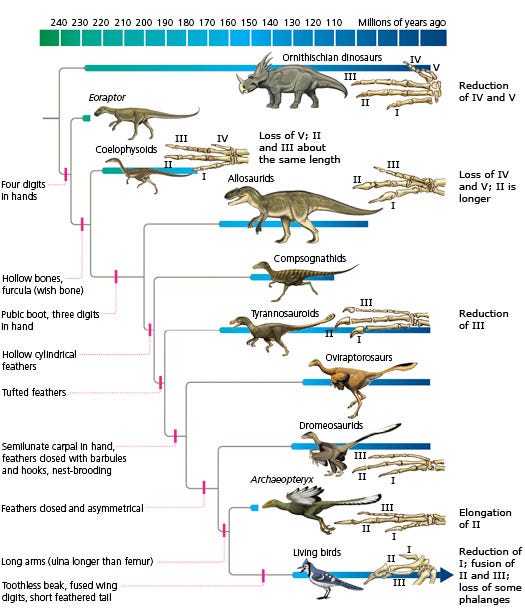
Now, the point where the first mammals evolved was close to the point where the first reptiles evolved, so you could easily move the official beginning of reptiles up or down on the diagram, to be either before or after the lineage leading to mammals branched off. Therefore you could move the horizontal line that represents the boundary between reptiles and proto-reptiles above where the mammal lineage branched off so that you could then say that you were using Type II while still not saying that mammals were reptiles. Unfortunately, you can not pull the same trick with dinosaurs and birds because the first birds evolved a very long time after the first dinosaurs evolved. On the diagram, the bird lineage starts near the top of the diagram, while the beginning of dinosaurs is at the bottom of the diagram. If hypothetically, you were to move the horizontal line representing the boundary between dinosaurs and proto-dinoaurs to be above where the bird lineage branched off, you would then have to say that the vast majority of dinosaurs were no longer dinosaurs.
So we are left with the following unavoidable choice.
1. Birds evolved from coelurosaurs — use Type I — Birds are not dinosaurs.
2. Birds evolved from coelurosaurs — use Type II — Birds are dinosaurs.
So we are in a similar situation that we had before about whether humans are fish. There is no way to dance around it. However, the biology community reacted differently. Biologists did want to say that humans are fish, even though Type II requires that you say that humans are fish. Biologists did not want to say that humans were fish because they think that “sounds ridiculous” even you though you would not believe that it “sound ridiculous” if you actually believed in your heart that Type II was better than Type I. Biologists did not want to admit they were using Type I, even though they were using Type I. So instead biologists just swept it under the rug, and refused to talk about it at all.
However, they did not do that with birds and dinosaurs. Instead they decided to actually say what Type II requires that you say, which is that if A evolves from B, that means A is B. Therefore the biologists went ahead and publicly said that Type II requires that you say, which is that birds are dinosaurs. Apparently, they did not think it “sounds ridiculous”. Although, you could argue that it “sounds ridiculous” in the same way that it “sounds ridiculous” to say mammals are reptiles, amphibians, and fish, and in fact, all life on this planet is a type of Archea. There is a long list of profound differences between dinosaurs and birds, even if you compare the specific dinosaurs that birds evolved from, which are the most bird-like dinosaurs, and the earliest birds, which were the most dinosaur-like birds.
If I show you pictures of fish, amphibians, reptiles, mammals, dinosaurs, and birds, and asked you to identify them. you would have no problem identifying them, which proves that you are using Type II, because Type II has nothing to do with characteristics, which means that you can never identify what group an organism belongs to by looking at a picture of the organism. If you showed a picture of a cat to someone using Type II, and asked them, “Is that a feline or an oak tree?”, they would say, “There is no way to know from looking at the picture.” It is the same as if you showed a picture of a beautiful woman with an hourglass figure wearing a string bikini to a Democrat, and asked, “Is that a man or a woman”, they would say, “There is no way to know from looking at the picture”. It is the same as if you showed a picture of a muscle man wearing a speedo to a Democrat, and asked, “Is that a man or a woman”, they would say, “There is no way to know from looking at the picture”.
One time I went to the Beaty Biodiversity Museum, and there was a woman there who was an invited speaker, and who referred to dinosaurs by using the phrase “non-avian dinosaurs”. Find out if this woman goes to a conference, and volunteer to work behind the scenes at the conference. Usually at conferences, they have a dinner. Get a job working at a morgue. While in the morgue, cut off little pieces of flesh from a human corpse, and sneak it home by hiding it in your clothes. Then when you are volunteering to work at the conference, cook up the strips of human meat, and put it on the plate of food that will be given to the woman. Tribes in Papua New Guinea that practiced cannibalism into the 20th Century say that it tastes like pork. In fact, in their language, it literally translates as “long pig”. There is a good chance that the woman would believe that it was pork, and would eat it without suspecting anything unusual. Then after the dinner, tell the woman the truth about what you did. If she believes that birds are dinosaurs, then she believes that if A evolved from B , that means A is B, which means she believes that humans are fish. From her point of view, eating human meat is just eating fish. From her point of view, after the learning the truth about what you did, it was no different than if she went to Lohn John Silvers and ordered fish and chips. She would have absolutely no objection whatsoever. If she does object, then she is admitting that birds are not dinosaurs. Then say, “Oh!…Oh!…Oh!…So you admit that if A evolved from B, that does not mean that A is B!…So you admit that birds are not dinosaurs!…So you will never again say ‘non-avian dinosaurs”!…Well that’s a relief!”
Let’s compare the amount of information that the different classification systems give you.
In a Type 0 classification system, membership in a group is defined by one thing.
- Possession of specific characteristics
Therefore, if you are told that a species is a member of a group, that tells you one thing.
- The species possesses all of the characteristics that define membership in the group.
If you are told that a species is not a member of a group, from that, you can only conclude the following.
- The species does not possess at least one (possibly more than one) of all of the characteristics that define membership in the group.
In a Type I classification system, membership in a group is defined by two things.
- Descended from a specific common ancestor that is the basal point for the taxonomic group
- Possession of specific characteristics
Therefore, if you are told that a species is a member of a group, you know that both of the following statements must be true.
- The species is descended from a specific common ancestor that is the basal point for the taxonomic group.
- The species possesses all of the characteristics that define membership in the group.
If you are told that a species is not a member of a group, that means either one, or both, of the following two things are true.
- The species is not descended from a specific common ancestor that is the basal point for the taxonomic group
- The species does not possess at least one (possibly more than one) of all of the characteristics that define membership in the group.
In a Type II classification system, membership in a group is defined by one thing.
- Descended from a specific common ancestor that is the basal point for the taxonomic group
Therefore, if you are told that a species is a member of a group, that tells you one thing.
- The species is descended from a specific common ancestor that is the basal point for the taxonomic group.
If you are told that a species is not a member of a group, from that, you can only conclude the following.
- The species is not descended from a specific common ancestor that is the basal point for the taxonomic group
Therefore, if you are using either Type 0 or Type II, and you are told that an organism or species is a member of a group, you have less information than you would have if you were using Type I, and were told that an orgamism species is a member of the group.
If you are using either Type 0 or Type II, and you are told that an organism or species is not a member of a group, you have more information than you would have if you were using Type I, and were told that an organism species is a member of the group.
All three give equivalent amounts of information but they give differing amounts of information under different circumstances. Type 0 and Type I give you more information if you are told that an organism or species is not a member of a group, and Type II gives you more information if you are told that an organism or species is a member of a group. Type 0 and Type II give equivalent amounts of information under the same circumstances, but the information itself is different information. Type 0 gives you information about its characteristics, and Type II gives you information about its ancestry.
Type 0 gives you information about its characteristics whether you are told it is a member of the group or not a member of the group. Type II gives you information about its ancestry whether you are told it is a member of the group or not a member of the group. Type I gives you information about both its characteristics and ancestry if you are told that it is a member of the group, but gives you absolutely no information whatsoever if you are told that it is not a member of the group.
There are advantages and disadvantages to all three of these taxonomic systems. So which should you use? After Charles Darwin, unless you walk around wearing a T-shirt that says, “I’m not ready for reconciliation”, you are probably not going to use Type 0. I should not be quite so glib. Modern mainstream biologists effectively use Type 0 when they use phrases like “alpha male”, “apex predator”, extremophile”, “keystone species”, etc. Here are some examples.
1. Holotype and Type Specimen
2. Type Species
3. Monotypic Taxon
4. Lazarus Taxon
5. Singleton Species
6. Species Endling
7. Living Fossils
8. Transitional Forms
9. Keystone Species
10. Apex Predators
11. Extremophiles
12. Troglobites
13. Invasive Species
14. Alphas in Dominance Hierarchy
15. Animal Hybrids
16. Urban Wildlife
17. Flagship Species
18. Translocated Species
However, that is not a taxonomic system intended to encompass all life on Earth.
So that leaves Type I and Type II. Type I gives you more information when you are told that an organism or species is a member of a group. Type II gives you more information when you are told that an organism is not a member of a group. In practice, you are usually more interested in knowing as much as you can about organisms or species when told that they are a member of a group as opposed to being told that they are not a member of a group. Therefore that would lead to Type I.
It is important for people to recognize how incomplete the fossil record is. Usually when an animal dies, it is completely devoured by predators and scavengers, and if there anything left, it is widely scattered. This is literally what happens to 99.9% of animals that die.
The immediate destruction and dispersal of remains happen through a highly efficient biological recycling system:
- Predator Consumption: Predators frequently consume entire smaller prey animals whole or break down major bones of larger prey to access the nutrient-rich marrow.
- Scavenger Efficiency: Vertebrate scavengers like vultures, hyenas, and coyotes can strip a large mammal carcass down to the bone in a matter of hours or days.
- Bone Dispersal: Scavengers regularly carry off individual limbs or crush and scatter smaller skeletal fragments across vast distances, subjecting them to weathering.
- Invertebrate and Microbe Cleanup: Once larger pieces are gone, billions of insects (like blowflies and beetles) and bacteria consume the microscopic organic residues.
Depending on what environment you are in, it also usually rapidly decomposes to the point where there is nothing visible left. This is even more true in a hot humid climate.
The rapid breakdown of organic matter in tropical or humid climates is driven by three main factors.
- Microbial Proliferation: Bacteria and fungi multiply exponentially in warm, wet conditions, breaking down soft tissues via putrefaction at a hyper-accelerated pace.
- Hyperactive Insect Activity: Flies, beetles, and flesh-eating larvae (maggots) thrive in the heat. The humidity keeps the carcass soft and moist, allowing insects to feed and lay eggs continuously.
- Speed of Chemical Reactions: Ambient heat naturally accelerates autolysis (the chemical self-destruction of cells by their own internal enzymes).
Even if there are remains left, those remains are not going to be buried unless they are in geographical location where erosion results in an addition process where sediment is deposited on top of it as opposed to a subtraction process where the soil that is already there is removed. Let’s say the remains are buried. Fossilization is not going to occur unless there are the right conditions for a specific mineralization process.
Fossilization through mineralization follows a specific sequence of geological and chemical events.
Rapid Burial: An organism dies and is quickly covered by sediments (like mud, sand, or volcanic ash). This limits oxygen exposure, protecting the remains from scavengers and rapid decay.
Infiltration: As layers of sediment build up, groundwater laden with dissolved minerals (such as silica, calcite, and iron) seeps through the porous organic remains.
Precipitation: The water fills empty cavities, cellular walls, and internal bone structures (the lumen). The minerals precipitate out of the water and form microscopic crystals within these spaces.
Replacement: Over thousands or millions of years, as groundwater continues to flow, the original organic tissue itself may dissolve and be molecularly replaced by inorganic minerals.
Key Minerals Involved
The type of mineral deposited dictates the color, hardness, and detail of the resulting fossil.
Silica (Silicification): The most common mineral; creates very hard, detailed fossils like petrified wood.
Calcite (Carbonate Mineralization): Often fills the porous spaces of shells, bones, and teeth.
Pyrite (Pyritization): Iron and sulfur replace the remains, occasionally creating metallic, gold-like fossils.
These conditions are rare conditions so the vast majority of animal remains have no chance of fossilization. Soft bodied animals are particularly difficult to fossilize so fossils of such animals are exceedingly rare.
Let’s say the remains do successfully fossilize. The vast majority of existing fossils remain locked in the Earth forever because erosion does not bring them to the surface. In order for the fossil to be brought to the surface, there must be specific appropriate erosion taking place at that specific geographic location. Of those few fossils that are brought to the surface and exposed by appropriate erosion, the vast majority of those are then destroyed by the same erosion shortly thereafter. In order for the fossil to be discovered, a human has to walk by and see it. Of the fossils that are brought to the surface and not immediately destroyed shortly thereafter, the vast majority just lie on the ground, unseen by human eyes. Of those fossils that are exposed, that are chanced upon by a human, the vast majority of those are seen by a human who does not have the slightest clue what they are looking at, dismisses it as a rock, and just keeps walking by. Of the tiny percentage of fossils discovered by a human with enough knowledge in their head to recognize what they are looking at, the majority of those are discovered by an amateur fossil hunter who will just take it home, proudly show it off to his friends, and then put it in a shoebox under his bed, or a professional criminal to plans to make money by selling it on the black market. Today, sometimes paleontologists discover fossils not by knowing where to dig but by knowing who to talk to. If you know a guy who knows a guy, he might be able to get you in contact with an even more shadowy guy.
Taking all of this into account, the fossil record is frustratingly incomplete. From this point of view, if you are trying to piece together the evolution of group X, it would stupendous good luck to find a fossil of a direct ancestor of group X. More often, the best you can hope for is to find a fossil that is a close cousin to the lineage leading to X. If you look at a diagram, these close cousin are not literally on the same line leading to X, but they are a short distance off the line. They are like twigs on the branch. If these offshoots are only a short distance off the main line, then they are presumably similar to the common ancestor between their line and the line that you are interested in that leads to X.
We believe that tiktaalik was not a direct ancestor of land vertebrates but a close cousin that was presumably similar to the direct ancestor. We believe that archaeopteryx was not a direct ancestor to modern birds but a close cousin that was presumably similar to the direct ancestor. With ancient hominids, there is often a debate as to whether a species is considered a direct ancestor or a cousin. Australopithecus afarensis, Homo habilis, Homo erectus are considered direct ancestors. Ardipithecus ramidus, Homo naledi, Homo neanderthalensis, and Denisovans are considered cousins. There is ongoing debate as to whether Sahelanthropus tchadensis was a direct ancestor or a close cousin. If it was a close cousin, it was presumably similar to the direct ancestor.
Another thing is that the origin of any group, let’s say a species, is far more complicated than is generally recognised. Let’s say A evolved from B. It might be depicted in a diagram as looking like what you see on the left. However, if you zoom in on the branch point, it actually looks more like what you see on the right.
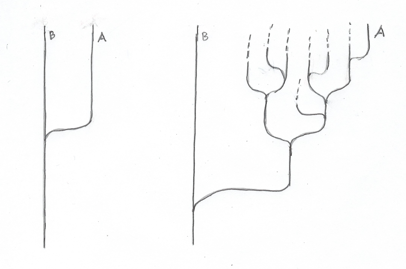
Now, if you combine this with what I said before about fossils, that you are going to only have a few sporadic fossils from any of the complicated tangled branches in the diagram, then how can you possibly reconstruct it? This diagram also illustrates that the number of individual branch points is much larger than is generally recognized. Most of them lead to dead ends. Both Type I and Type II define groups either entirely or partially based on being descended from a specific common ancestor. Does that mean that every single branch point necessarily starts and defines a new group? If so, the total number of groups, the total number of taxa, would be staggeringly large, many orders of magnitude larger than is officially recognized. Obviously we do not have names for the vast majority of these groups. The vast majority are unknown and will never be known. Even if they are known, we do not have names for them. Should we say that a group does not exist unless it is officially recognized and given a name by scientists? How should we handle this?
You might think that even if the other categories are human inventions that species must objectively exist but that is not true. Even something as apparently basic and fundamental as a species is a human invention. In middle school, they teach the kids that two organisms that create fertile offspring are defined as the same species, and then they always cite mules to illustrate the point. Although the vast majority of mules are stable, there are 60 documented cases of female mules having offspring. A horse has 64 chromosomes (32 pairs), and a donkey has 62 chromosomes (31 pairs). This mismatch usually causes the offspring to be infertile. The rare fertile female donkeys result when the egg retains only the 32 intact horse chromosomes from her mother. If she mates with a horse, the offspring are horses. If she mates with a donkey, the offspring are normal infertile mules. However, there are many species that are considered different species, but nonetheless, create fertile offspring. Both lions and tigers have 38 chromosomes (19 pairs). There is no mismatch in the number of chromosomes. The males are sterile but the females are fertile. The offspring of a male lion and female tiger is called a liger. The offspring of a male tiger and female lion is called a tigon. The offspring of a male lion and female liger is called a liliger. The offspring of a male lion and female tigon is called a litigon. The offspring of a male tiger and female liger is called a tiliger. The offspring of a male tiger and female tigonis called a titigon. They say that two species are considered different species, even if they can produce fertile offspring, if they are different enough, but it is a matter of opinion whether they are different enough.
There is debate about how many species of elephants there are. Some people say there are two species, which are African and Asian elephants. Some people separate African elephants into two species, which are African bush elephants and African forest elephants, which means there would be three species of elephants all together. Of course African bush elephants and African forest elephants have fertile offspring, and have always done so naturally in the wild. The number of giraffes is far more debated. Up until recently, all giraffes were considered one species. In August 21, 2025, the IUCN SSC Giraffe and Okapi Specialist Group recognized four species of giraffes, which are the northern giraffe, the reticulated giraffe, the masai giraffe, and the southern giraffe. Of course they can all create fertile offspring with each other. These four species are further divided into several subspecies. There is no clear criteria for designating a population a species versus a subspecies. Also, there is no particular reason why this specific conservation group should get to decide how many species of giraffes there are. Most vague of all, and also most familiar to us, are the canines of North America. The most famous wolf is the gray wolf. There is a smaller wolf on the east coast called the eastern wolf. In the south there is the almost extinct red wolf, which inspired the hillbilly cryptozoology creature called the “howler”. There were also coyotes through North America. All of these animals interbreed with each other. There were never sharp boundaries between them. As you traveled from west to east, the gray wolf gradually morphed into the eastern wolf, and as you traveled south, the eastern wolf gradually morphed into the red wolf. All of these mated with coyotes to create coywolves. Then humans introduced dogs, and they all interbred with dogs. How many species would you say that is?
Let’s say A is similar enough to B that it is considered the same species as B. Let’s say B is similar enough to C that it is considered the same species as C. Let’s say C is similar enough to D that it is considered the same species as D. However, let’s say that A is so different from D, that A is not a member of the same species as D. If you decided that A, B, C and D were two species, where would you draw the line between them? The very concept of a species breaks down. This example illustrates that the concept of a species is a human invention.
For a century, the conservation movement was misguided because they were fixated on preserving specific species, and preserving small patches of geography like national parks. If you decide to call a population a subspecies, does that mean that you should care less about preserving it if you call it a species? If the only goal is to preserve species, you could put them in zoos, aquariums, and gardens. They are believed that you could just preserve patches of real estate, as if you could put a wall around it, and not care what happens immediately outside of it. Today, it is recognized that this is misguided. The goal is not to preserve individual organisms or species, and it’s arbitrary whether to call a population a “species”, but to preserve the complex interactions between them in a functioning ecosystem. You can not preserve an ecosystem by trying to build a wall around a postage stamp sized piece of real estate. The ecosystems extend far beyond their boundaries. None of the land set aside for conservation exists in isolation. You also can not eliminate human impact on the natural world, even within protected areas. Instead you should try to manage the necessary impact in a controlled planned way. For example, you can set up natural corridors to allow migratory animals to safety travel through developed areas.
Before I gave examples of biologists using Type II who don’t want to say that humans are fish, or that all cellular life is Archaea, because they think it “sounds ridiculous”. Biologists who use Type I, are guilty of a similar thing. According to Type I, in order to be a member of a group, in addition to being descended from a specific common ancestor, it must also have specific characteristics that all members of the group must have. For example, a defining characteristic of plants is that they must, at least at some point in their lives, photosynthesize. However, there exists several parasitic plants that never produce chlorophyll, never photosynthesize, and survive entirely by siphoning energy off their host.
Common Examples of Chlorophyll-Free Parasitic Plants
- Dodder (Cuscuta): A thin, stringy vine (sometimes called witch’s hair or devil’s gut) that wraps around green host plants and uses peg-like structures called haustoria to suck out water and food. Part of the morning glory family (Convolvulaceae). Its closest cousins are everyday green garden plants like sweet potatoes and morning glories.
- Ghost Pipe (Monotropa uniflora): Also called the corpse plant, this waxy, white woodland flower gets its energy indirectly from photosynthetic trees by siphoning off underground fungal networks (mycoheterotrophy). Belongs to the heather family (Ericaceae). It is closely related to green, photosynthetic shrubs like blueberries, cranberries, and azaleas.
- Rafflesia (Rafflesia arnoldii): Famous for producing the world’s largest individual flower, it lives completely hidden inside tropical Tetrastigma vines, emerging only to bloom. Belongs to the spurge family (Euphorbiaceae). Its closest relatives include the green Poinsettia and the rubber tree plant. [1]
- Broomrape (Orobanche) and Squawroot (Conopholis): Root-parasitic wildflowers that attach directly to the underground roots of host plants without ever producing green leaves or making their own food. Belongs to the broomrape family (Orobanchaceae). This family actually contains a mix of fully green plants, partly parasitic green plants (like Indian paintbrush), and completely non-green parasites.
How Independent Loss of Chlorophyll Happens
When a plant begins stealing nutrients from a host, the evolutionary pressure to maintain its own food-making machinery drops.
- The Parasitic Shift: An ancestral plant forms a parasitic connection to a host root or fungus.
- Genetic Mutation: Random mutations damage the genes responsible for creating chlorophyll or chloroplasts.
- Relaxed Selection: Because the plant is stealing food, these normally fatal mutations do not kill it.
- Gene Deletion: Over millions of years, the useless “photosynthesis genes” completely decay and disappear from the plant’s DNA.
Scientists have found that this transition from self-feeding to total parasitism has occurred independently at least 12 distinct times across different flowering plant lineages.
If someone was using Type II, they would just say that these are all plants because they evolved from plants, and must therefore be plants regardless of anything else. If someone was using Type I, they would have to say that none of these things are plants because, according to Type I, an organism must be capable of photosynthesis at some point in its life in order to be a plant. Well, in that case, if someone was using Type I, what would they say these things are? You can’t say they are animals, because, according to Type I, no lineage can enter a category. If the lineage leaves the plant kingdom, does that mean that it forms it’s own kingdom? If this happened 12 different, then each of these 12 lineages would be 12 different kingdoms. This is what Type I requires that you say. Yet you never hear biologists who use Type I say that, because they think it “sounds ridiculous”. You can avoid this by using Type II, but then you have to say that all cellular life is a type of Archea. Biologists who use Type II, temporarily slip into Type I whenever they find Type II inconvenient. Biologists who use Type I, temporarily slip into Type II whenever they find Type I inconvenient. The problem is that no single taxonomic classification system is going to do all the things you want it to, and not, at some point or other, strike you as counterintuitive.
The phrases Type 0, Type I, and Type II are broad catch-all categories that contain many specific taxonomic systems, each of which has advantages and disadvantages. However, we are currently at a turning point in human history. For the first time in human history, we do not need any taxonomic systems at all. We can do DNA tests that measure how genetically different two different species are, and how long ago their lineages diverged.
1. High-Throughput DNA Sequencing
Scientists extract and sequence the genomes of different species using modern Next-Generation Sequencing (NGS) technologies. This provides the exact order of chemical bases (A, T, C, G) across the genome.
2. Sequence Alignment
Powerful bioinformatics computers line up corresponding chromosomes and genes from each species to identify where they match and where they differ.
- Single Nucleotide Polymorphisms (SNPs): Single-letter mutations where one species has a different base than another.
- Insertions and Deletions (Indels): Sections of DNA that were added or lost over time.
3. Calculating Genetic Distance
The overall difference is calculated as a percentage or mathematical score representing evolutionary distance.
- Percent Identity: Humans and chimpanzees share roughly (98.8%) of their DNA, meaning their genetic distance is small.
- Conserved vs. Variable Regions: Essential genes (like ribosomal DNA) change slowly, while non-coding regions mutate quickly.
4. Applying the Molecular Clock
To find out when species diverged, scientists convert genetic distance into a timeline using the Molecular Clock hypothesis.
T = D/2r

- T = Divergence time
- D = Genetic distance (mutations per site)
- r = Mutation rate (mutations per site per year)
5. Fossil Calibration
Because mutation rates can speed up or slow down, scientists calibrate the molecular clock using the fossil record.
- Fossil Dating: If the oldest fossil ancestor of two groups is radiometrically dated to 10 million years ago, that sets a baseline.
- Rate Adjustment: Scientists divide the genetic distance by the fossil age to calculate the exact mutation rate for that lineage.
This is objective quantifiable numerical data from a reproducible repeatable experiment. Anyone can go to the lab, do the same experiment, and get the same results within a margin of error. Then you can graphically represent the results. What we usually do at that point is superimpose categories from a taxonomic system onto it, but this is not strictly necessary. You could simply publish the raw data without any reference to any taxonomic system. You could say that we have transcended the very concept of a taxonomic system. You would then not have to worry about any of the negative aspects of any of the taxonomic systems that we currently have. That is probably where we are headed. Biology has become much more quantitative, and that is good for biology.
Recently there has been a shift in biology, where biology is becoming more mathematical, more quantitative, and requiring more math and more physics. We have sub disciplines of biology such as biophysics, biochemistry, biomathematics, bioinformatics, biostatistics, systems biology, computational biology, cellular biology, molecular biology, genomics, and genetic engineering. These subjects require far more technical knowledge of mathematics, physics, chemistry, and computer science than was necessary to do biology in the past. Even the old fashioned field biologist that observes wildlife, today takes DNA samples, and puts radio collars, satellite collars, or GPS tags on the animals, and collects a huge amount of big data which is analyzed using computer algorithms.
All of this is good for biology but unfortunately the undergraduate curriculum has not been updated to reflect this new reality. Today it is still customary for biology majors to only have to take one luke warm watered down “physics for life science” class towards the end of their last year, and this in no way prepares them for what they will probably have to do later. This is why we have seen an increase in physicists doing biology, which they call “biophysics”, not because physicists are more interested in biology than they used to be, but because the biologists are unable to do it themselves so they need physicists to do it for them. There has been an increasing movement to update the requirements to a more “calculus based” undergraduate biology program.
Press enter or click to view image in full size
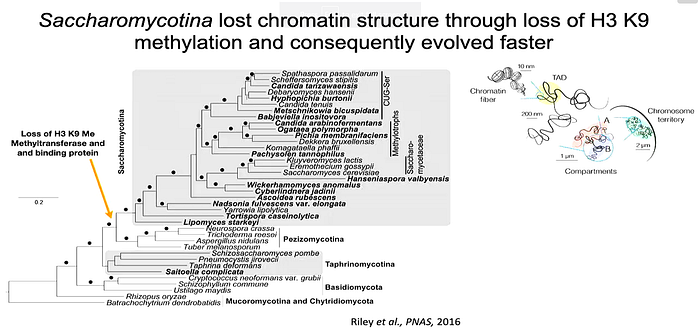
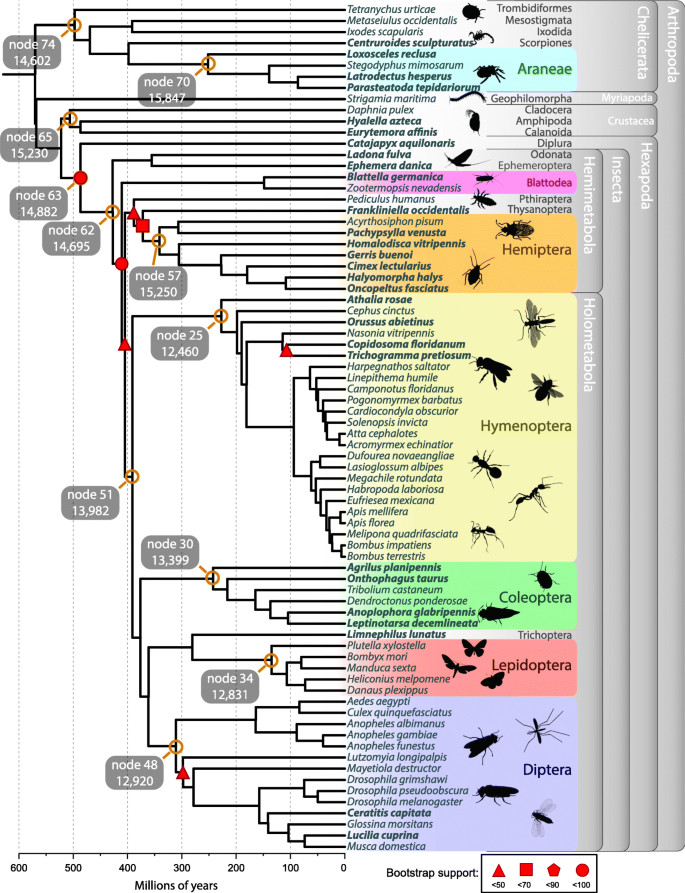
Press enter or click to view image in full size
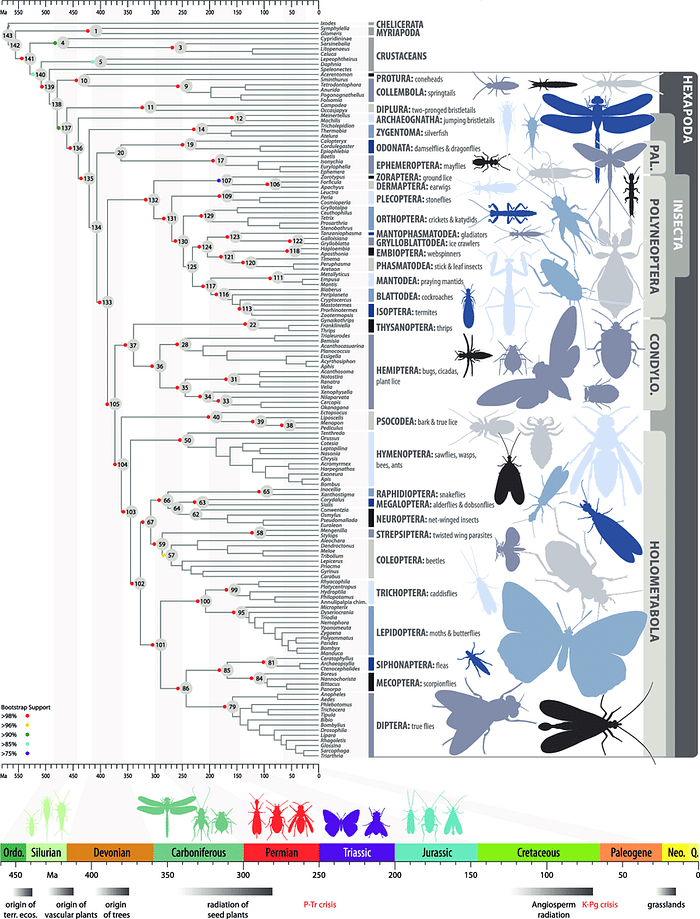
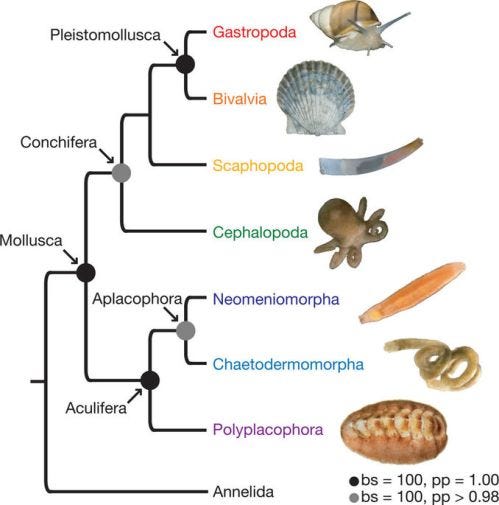
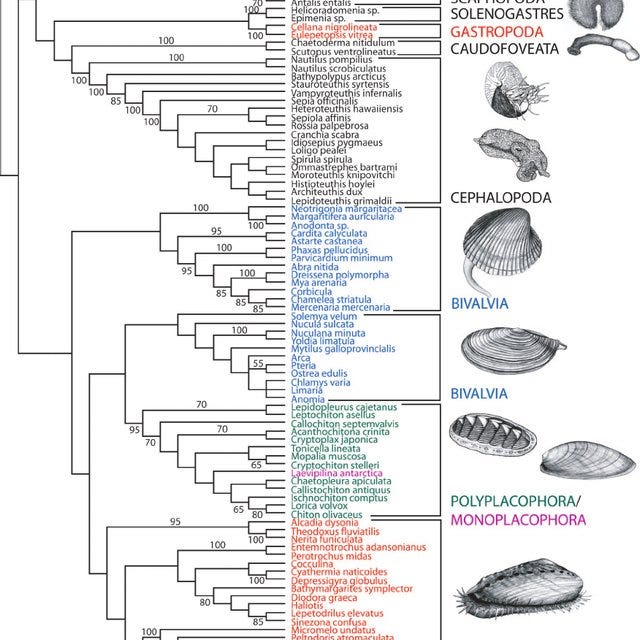
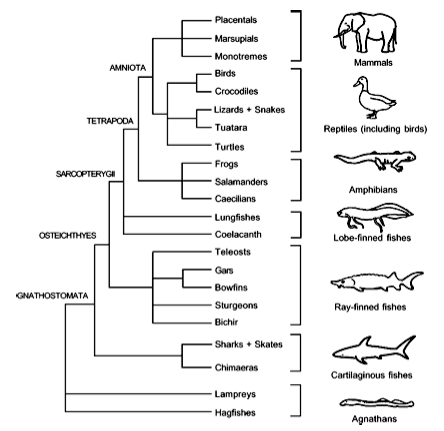
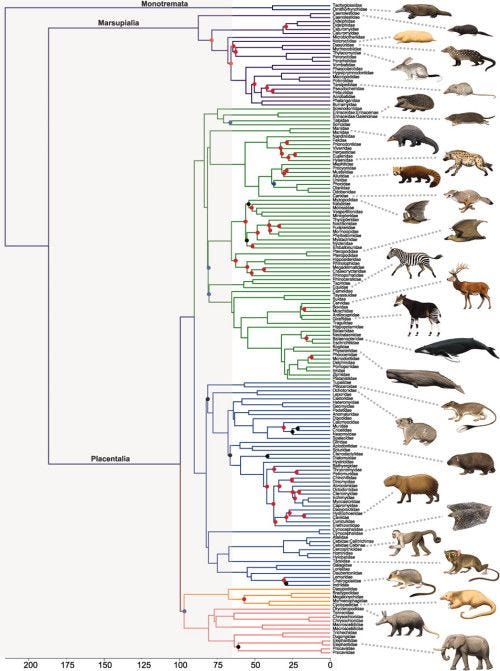
Press enter or click to view image in full size
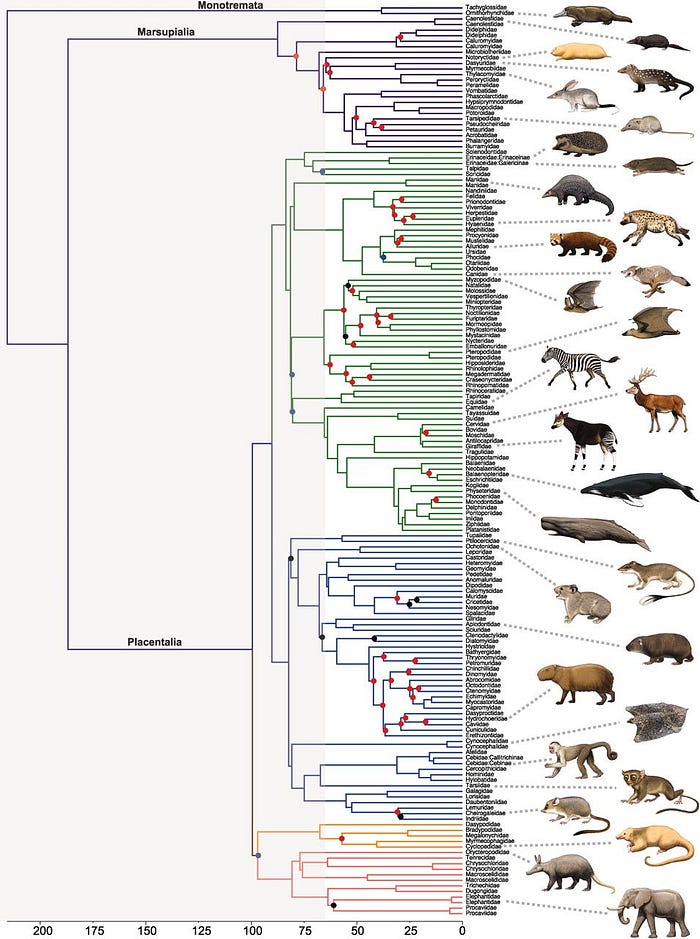
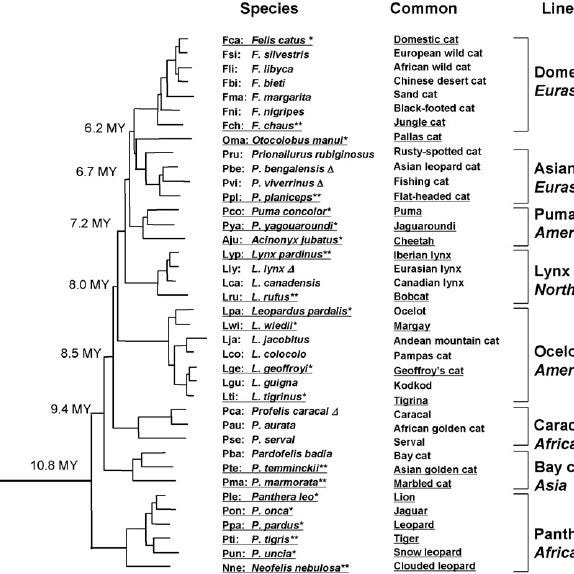
Press enter or click to view image in full size
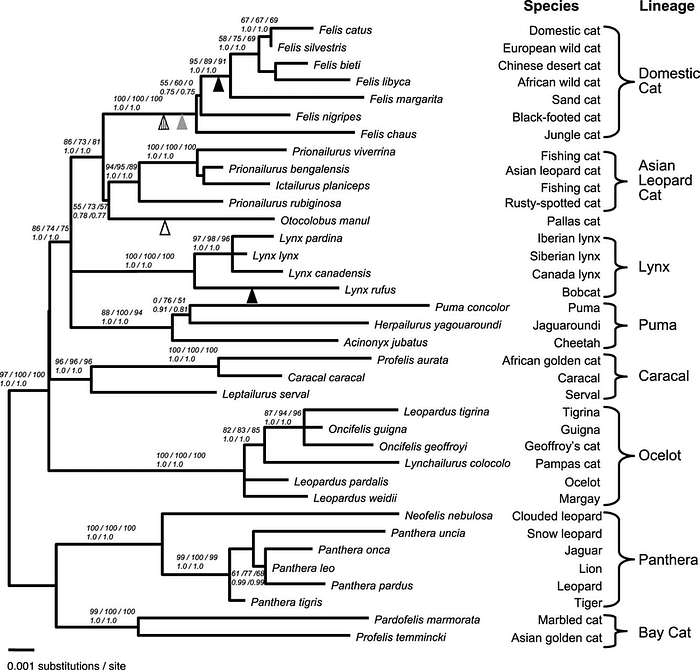
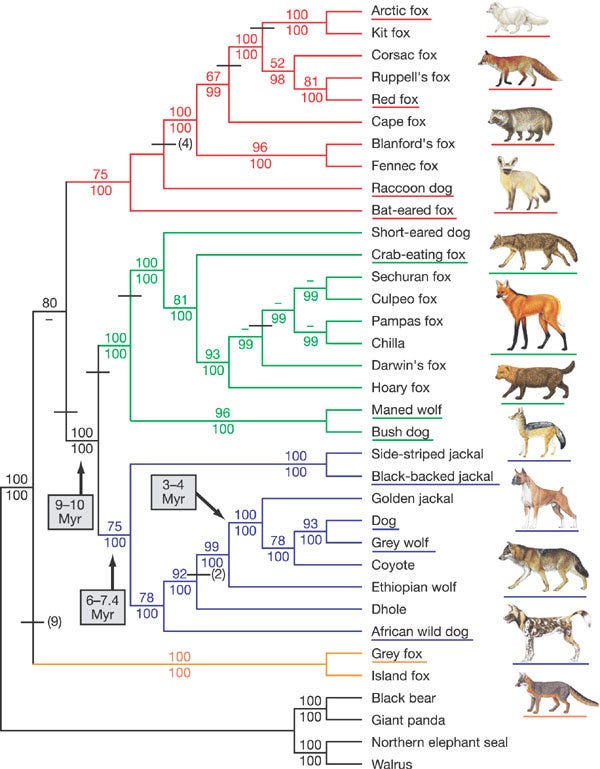
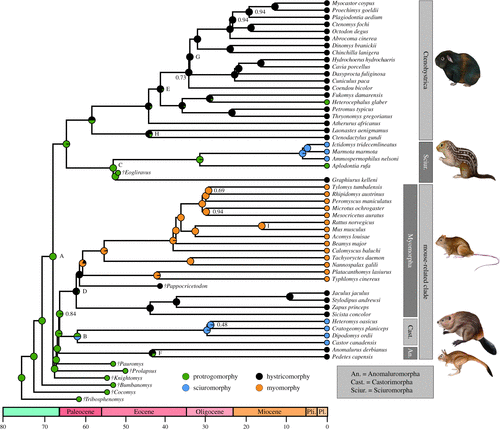
Press enter or click to view image in full size
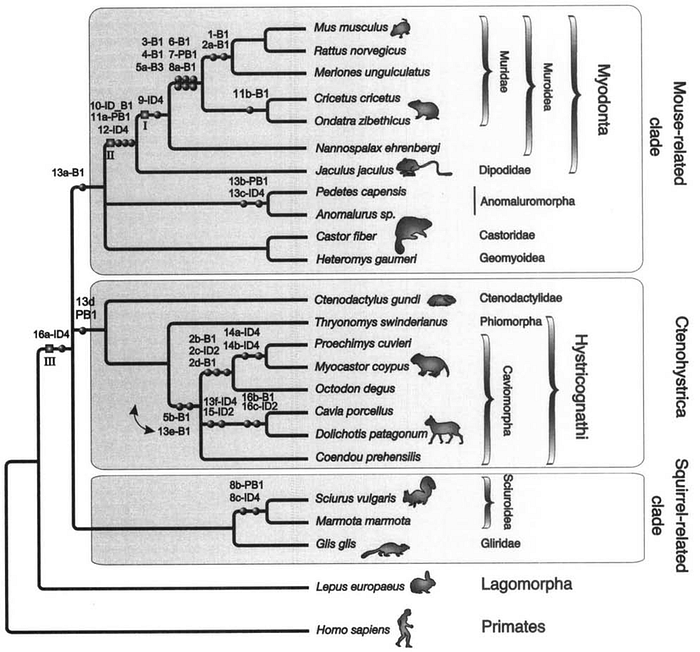
Press enter or click to view image in full size
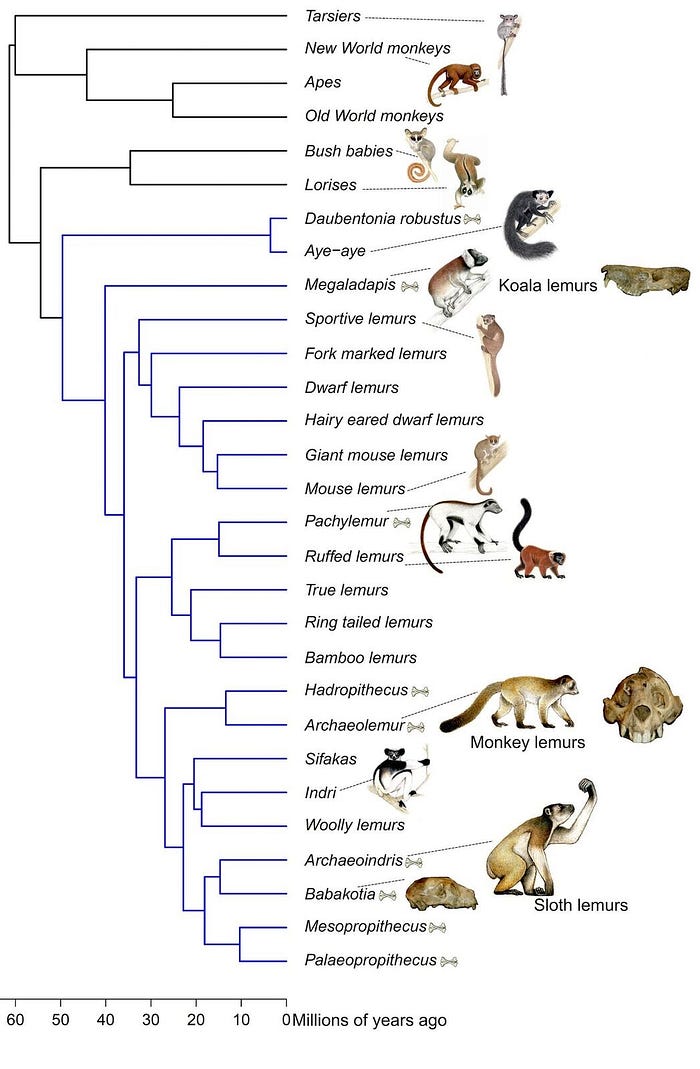
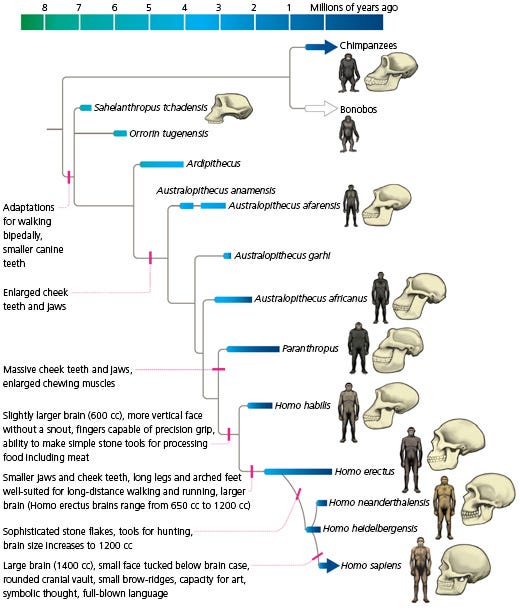


Leave a comment